A warning before boarding. Uttar Pradesh has more people than Brazil and more history than most continents. It contains the last flat edge of the Himalayan foothills, the Ganga’s longest stretch, the Bundelkhand plateau, a slice of Delhi’s suburbs and some of the poorest villages in Asia. Every generalisation below has a district, a caste or a mohalla that contradicts it. I have tried to stick to what I could check, and where I could not, I say so. But this one is also personal, and on the personal parts I am, by definition, an unreliable witness. Read it the way you would listen to an uncle on a charpai after dinner: with affection, with patience, and with the pinch of salt he would never admit you need.
When someone in Geneva asks where in India I am from, I say “Lucknow, about eight hours by train from Delhi.” It is a tidy answer, and it is true, but it is not the whole answer. It leaves out the other half of me, which belongs further east, in Purvanchal. Most Europeans have heard of neither, and simply nod. Indians have heard of both, and there is a small pause after I say it. It is the pause of a person placing me — capital or countryside, Nawabs or strongmen — and deciding whether to be polite about it.
I have learned to enjoy that pause. It contains most of what this essay is about. In it are the Ganga and the Gomti, the ghats of Varanasi and the imambaras of Lucknow, Kabir and Tulsidas, Premchand and Mir, Nehru’s Allahabad and eight men shot at a tehsil office in Ghazipur in 1942. In it too are the headlines: the riots, the encounters, the gangsters who became legislators and the legislators who behaved like gangsters, the young men from Ballia and Gorakhpur sleeping on railway platforms in Mumbai. The pause is a whole state trying to fit into a second.
My own version of the state comes in three parts. My family belongs to Jahurabad, a village in Ghazipur district, on the eastern edge of UP where it shades into Bihar and the Ganga bends towards Bengal. I grew up in Lucknow, the capital, three hundred-odd kilometres to the west, in a city that says pehle aap, after you, and, the cynics will tell you, means it about half the time. They have not met the good people of Lucknow, for whom it means it all the time, and who will go to extraordinary lengths to make it so. And between the two sat Varanasi, close enough to the village to be the big city of every childhood trip, and the place where, whether you believe any of it or not, you learn that people in UP take death more seriously than almost anyone on earth. Threaded through all three is Rasra, in Ballia district, my mother’s hometown: the nanihaal, the mother’s home, where the rules were softer and the food more generous. Mau, Ballia and Azamgarh were the relatives’ towns, the wedding towns, the towns where someone always knew someone.
The overnight train east out of Lucknow’s Charbagh station was where the two halves of my life met. The Lucknow half boarded in pressed clothes and said aap to strangers. Somewhere after midnight the dialect in the compartment changed, aap became tum and then tohar, the tea got sweeter, and by the time the train was deep in Purvanchal the man in the next berth was telling you, without being asked, which of the local strongmen he knew personally. That journey, I have come to think, is Uttar Pradesh in miniature: a courtesy at one end, a swagger at the other, and in between a very long night full of people with opinions.
This essay is an attempt to explain the state that sits in that pause: where it came from, what it has given India, what it has done to itself, and what it did to me.
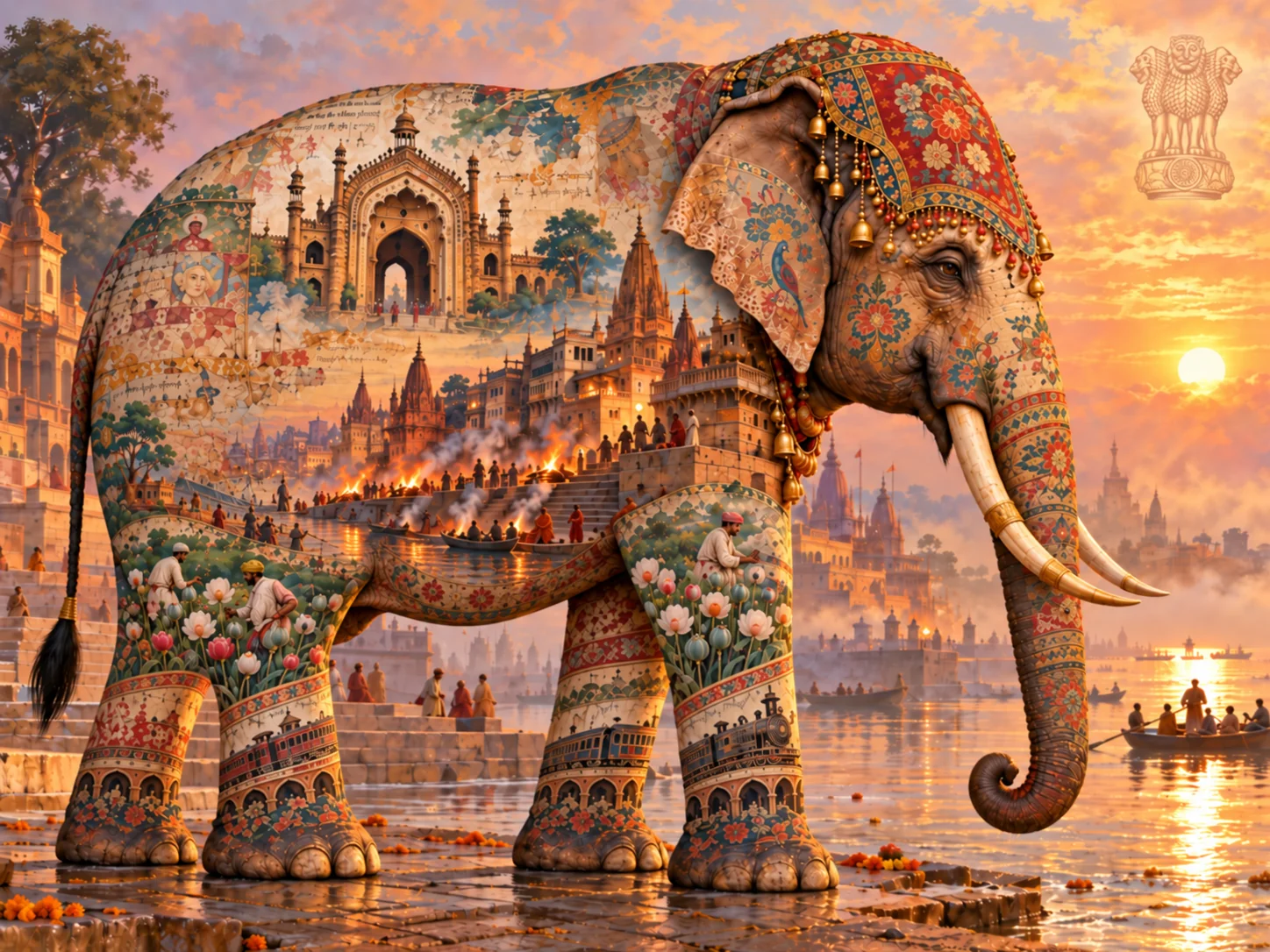
A country pretending to be a state
Start with the number, because in UP everything starts with the number.
The last census, in 2011, counted 199,812,341 people in Uttar Pradesh. There has been no count since; the next census, delayed by the pandemic and then by politics, now has its reference date in March 2027. The government’s own projection puts the state at about 244 million this October. That is roughly the population of Nigeria, the sixth most populous country on earth, and more than any country in Europe, South America or Africa. If UP were independent, it would sit between Pakistan and Brazil in the world’s table, with a seat at the UN and, presumably, a very loud delegation.
It is also India’s fourth-largest state by area, and it touches nine other states and Delhi, more neighbours than any other state has. Eighty of the 543 members of the Lok Sabha are elected from it; the next largest, Maharashtra, sends forty-eight. The state assembly has 403 seats. On polling day, UP holds more voters than most countries hold people.
The state is younger than its size suggests. The British built it by accretion: the territories they took from the Mughals and the Marathas became the North-Western Provinces in 1836; the kingdom of Awadh, which they annexed in 1856, was bolted on in 1877; the whole was renamed the United Provinces of Agra and Oudh in 1902. On 24 January 1950, two days before India became a republic, it became Uttar Pradesh, the “northern province”, keeping its initials, which is the sort of economy UP appreciates. In November 2000 its hill districts left to form Uttaranchal, now Uttarakhand, and the plains, which had always held most of the people, carried on.
Why so many people?
There are three answers, and they operate on very different clocks.
The oldest is the soil. UP is mostly the middle Ganga plain, a trough filled over millions of years with Himalayan silt, flat, fertile and fed by rivers that do not dry up in summer because they are fed by snow. It is some of the best farmland on the planet, and people have been farming it intensively for about three thousand years. Dense farmland supports dense villages, and the plain has been one of the most crowded places on earth for as long as anyone has been counting. At the first all-India census in 1901, the territory that is now UP already held about 47 million people, close to a fifth of everyone in what is now India.
The second is a slow demographic transition. Across India, falling death rates were followed, a generation or two later, by falling birth rates. In the south, where women were more educated and married later, the second fall came early. In UP it came late. In the National Family Health Survey of 1992–93 the average woman in UP could expect to have about 4.8 children. By 2019–21 it was 2.4, still above the national 2.0 and the replacement level of 2.1, but falling fast. The gap is closing; it has not closed. A population that was already the largest kept growing faster for longer, and the momentum of all those young people having children of their own will carry it upward for another decade or two.
The third is a political choice. When India redrew its internal map along linguistic lines in the 1950s, UP was the obvious candidate for division and was not divided. In 1955 the historian K. M. Panikkar, a member of the States Reorganisation Commission, wrote a dissenting note arguing that a single state this large would unbalance the federation, and proposed carving a new state out of its western districts. He was overruled. In 2011 the UP assembly, under Mayawati, passed a resolution to split the state into four: Purvanchal in the east, Bundelkhand in the south, Awadh Pradesh in the middle and Paschim Pradesh in the west. The resolution went to Delhi and has stayed there. Everyone who governs UP discovers, sooner or later, that there is a great deal of power in being the elephant.
That power is about to be tested. Parliamentary seats have been frozen since 1976 on the basis of the 1971 census, precisely so that states that controlled their populations would not be punished for it. The freeze lifts after the first census taken after 2026. If seats are redistributed by population, UP’s share of the Lok Sabha rises and the south’s falls, and the argument over whether that is democracy or a penalty for success is one of the defining fights of the coming decade. Somewhere in that argument is the whole paradox of UP: the same numbers that make it poor per head make it powerful in total.
The same numbers that make UP poor per head make it powerful in total.
The oldest valley
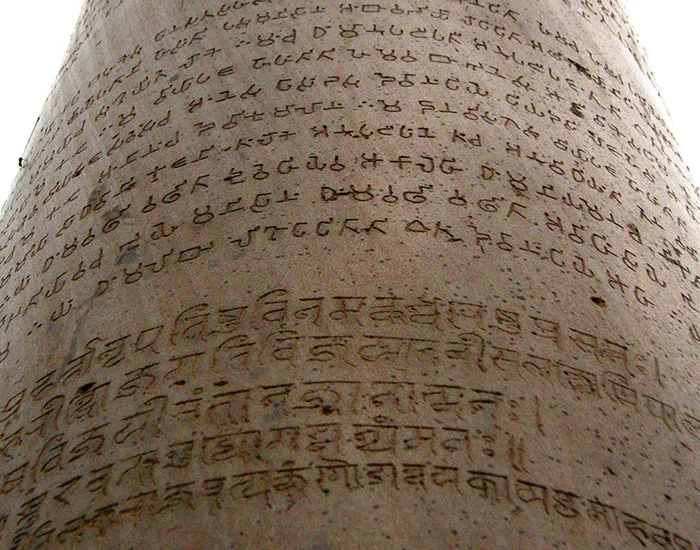
There is a stone pillar inside the fort at Prayagraj, the city that most of my family still calls Allahabad, and it is the best single object I know for explaining Uttar Pradesh.
It was raised in the third century BCE, probably by Ashoka, and carries his edicts. Six hundred years later a court poet named Harisena carved, on the same polished sandstone, a long praise-poem for the Gupta emperor Samudragupta, listing the kings he had conquered. Around 1605 the Mughal emperor Jahangir added his own genealogy, in Persian. In between, over the centuries, pilgrims and travellers scratched their names on it. Buddhist dharma, Sanskrit imperial boasting, Persian dynastic pride and graffiti: four civilisations, one stone, none of them bothering to erase the others. That is the state’s history in a sentence. It is not a story of one culture replacing another. It is a palimpsest, written over again and again, with everything still faintly legible underneath.
Epics and republics
The earliest layer is a mixture of memory and myth. The Ramayana’s Ayodhya, capital of the kingdom of Kosala, is on the Saryu in central UP; Krishna’s Mathura and Vrindavan are on the Yamuna in the west; the Mahabharata’s Hastinapur is near Meerut. How much of the epics happened is a question for archaeologists and believers, who rarely agree. What is certain is that by the sixth century BCE the plain was divided among the mahajanapadas, the great kingdoms and republics of early India, and that several of the most important of them — Kashi, Kosala, Vatsa, Panchala, Surasena and the Malla republic — lay inside what is now Uttar Pradesh.
Into that world came a prince from the Shakya clan, on the Nepal border, who left home, found what he was looking for under a tree in Bihar and walked back west to explain it. Around 528 BCE, in a deer park at Sarnath, a few kilometres outside Varanasi, the Buddha gave his first sermon to five former companions. He spent more rainy seasons at Shravasti, in the grove of Jetavana, than anywhere else, and he died at Kushinagar, near Gorakhpur. Three of the four holiest places of Buddhism are in UP. Two and a half centuries later Ashoka raised a pillar at Sarnath topped by four lions facing the four directions; since 1950 that lion capital has been the emblem of the Republic of India, stamped on every rupee note and every passport. India, officially, looks at the world through a Buddhist monument in Varanasi district.
The Jains claim the same ground: Parshvanath, the twenty-third tirthankara, is said to have been born in Varanasi, and the tradition places the births of several earlier ones in Ayodhya.
Sarnath
Sarnath deserves more than a sentence, because it is the most layered small place I know.
The Buddha’s first sermon there, to five ascetics who had abandoned him as a backslider, is remembered as Dhammacakkappavattana, the setting in motion of the wheel of the teaching: the four noble truths and the middle way between indulgence and self-torture. On that spot a whole monastic city grew. Ashoka raised his pillar in the third century BCE; the Guptas built the great Dhamek stupa, whose solid brick-and-stone drum, around the fifth or sixth century CE, still stands more than forty metres high; and when Xuanzang came in the seventh century he counted, by his own account, some fifteen hundred monks. Then, at the end of the twelfth century, in the wars that brought the Ganga plain under the Delhi Sultanate, the monasteries were sacked and abandoned, and Buddhism, which had been born on this plain, all but disappeared from it for seven hundred years.
What happened next is the palimpsest again. In 1588, under Akbar, a Mughal noble built an octagonal brick tower on top of an old Buddhist mound nearby, the Chaukhandi stupa, to mark the spot where Akbar’s father Humayun had once rested; a Mughal monument on a Buddhist ruin, commemorating an emperor’s nap. In 1835 the British archaeologist Alexander Cunningham began digging the site, and in 1904–05 the engineer F. O. Oertel uncovered, broken but magnificent, the lion capital that had crowned Ashoka’s pillar. When the Constituent Assembly chose the symbols of the new republic in 1947 and 1950, it took two things from that single object found in the dirt outside Varanasi: the four lions became the state emblem, and the wheel carved on the capital’s base, the wheel of the dharma first set turning at Sarnath, became the chakra at the centre of the national flag. Every time India flies its flag, it is quoting a sermon given in a deer park in Varanasi district.
The revival came from abroad. The Sri Lankan Buddhist reformer Anagarika Dharmapala campaigned for decades to restore the Buddhist holy places, and in 1931 his Maha Bodhi Society opened a new temple at Sarnath, the Mulagandha Kuti Vihara, its walls painted by a Japanese artist, Kosetsu Nosu. Thailand, Japan, China, Myanmar, Tibet and Sri Lanka have since built temples there, so that a walk through the village is a small tour of Buddhist Asia. And the Tibetans came, in a way that ties Sarnath to the twentieth century’s great exile.
When the fourteenth Dalai Lama fled Tibet in March 1959, his first home in India was not Dharamsala but Mussoorie, a hill station that was then part of Uttar Pradesh; he lived there, at Birla House, for a year, until April 1960, before moving to Dharamsala in Himachal. It was in Mussoorie, in UP, that the Tibetan government-in-exile first took shape. In 1967, with the support of Jawaharlal Nehru’s government, a Central Institute of Higher Tibetan Studies was founded at Sarnath to preserve the scholarship of the monasteries that had been lost; it is now the Central University of Tibetan Studies, and one of its long-serving directors, Samdhong Rinpoche, went on to become the elected prime minister of the Tibetans in exile. The Dalai Lama has returned to Sarnath many times to teach. There is something right about it: the tradition that left this plain eight hundred years ago came back, in exile, to the deer park where it began.
I first went to Sarnath as a child, with my parents, and remember mostly the heat and the ice cream. I did not understand then that I was standing at the source of the wheel on my own flag. I went back in 2025, as an adult, and it was only then that the place landed: that a sermon given to five ascetics in a deer park is what India chose to put on its flag and its passport, and that the four lions I had seen on every rupee note of my life had been dug out of the ground a short walk away.
Empires on the Ganga
The Kushans made Mathura, around the first and second centuries CE, one of the two great workshops of early Indian sculpture; some of the earliest images of the Buddha as a human figure were carved there, in the local red sandstone. The Guptas, whose age is remembered as classical India’s golden one, left their boast on the Allahabad pillar. In the seventh century Harsha ruled northern India from Kannauj, and the Chinese pilgrim Xuanzang, who visited, described a rich city of monasteries and temples. Kannauj was so prized that for the next two centuries three dynasties — the Pratiharas, the Palas of Bengal and the Rashtrakutas of the Deccan — fought over it in what historians call the tripartite struggle. Today Kannauj is famous mainly for perfume. Empires come and go; attar lasts.
Then the plain became the prize of a new set of conquerors. Mahmud of Ghazni sacked Mathura and Kannauj in 1018. In 1194 Muhammad of Ghor defeated Jaichand of Kannauj at Chandawar, near Etawah, and the Ganga plain passed, over the following decades, into the Delhi Sultanate. For the next five and a half centuries, most of UP was ruled from Delhi or Agra, or by governors who took orders from there when it suited them.
Those centuries built half of what the world now thinks of as India. The Sharqi sultans of Jaunpur, independent from 1394 to 1479, made their city such a centre of learning that it was called the Shiraz of India, and built mosques, like the Atala, whose great gateways look like temples translated into Arabic; the Atala itself stands where a temple once stood. The Mughals made Agra their capital; Akbar built Fatehpur Sikri, a red sandstone city beside the tomb of a Sufi saint, and held debates there between Muslim, Hindu, Jain, Zoroastrian and Christian scholars. Between 1632 and 1653 his grandson Shah Jahan built the Taj Mahal for his wife Mumtaz Mahal, and gave UP the one building everyone on earth recognises.
The same dynasty broke things too, and it would be dishonest to leave that out. In 1669 Aurangzeb ordered the demolition of the Kashi Vishwanath temple in Varanasi, and a mosque, the Gyanvapi, was built on part of its site; the next year he did the same to the great Keshavdeva temple at Mathura. The present Vishwanath temple was built beside the mosque in 1780 by Ahilyabai Holkar, the Maratha queen of Indore. Both buildings are still standing, wall to wall, and both are still in court. The palimpsest, in UP, is not only on pillars.
Awadh
The part of this history I grew up inside began in 1722, when a Persian nobleman named Saadat Khan was made the Mughal governor of Awadh, the old land of Kosala. As the empire weakened, his descendants, the Nawabs, became kings in all but name. They ruled from Faizabad, near Ayodhya, until 1775, when the Nawab Asaf-ud-Daula moved the court to Lucknow, a modest town on the Gomti, and set about turning it into the most extravagant city in India.
It was in Awadh that the East India Company learned how to own a country without appearing to. In 1764, at Buxar, just across the Ganga from Ghazipur district, the Company defeated the combined armies of the Nawab of Awadh, the Nawab of Bengal and the Mughal emperor. The Treaty of Allahabad that followed gave it the right to collect the revenues of Bengal, Bihar and Orissa, and reduced Awadh to a buffer state that paid for the Company’s troops. For ninety years the Nawabs were allowed to spend lavishly on poetry, music, architecture and food, while the Company took more and more of their land and their revenue. In February 1856, citing misgovernment, it annexed what was left and sent the last king, Wajid Ali Shah, poet, dancer and composer, into exile in Calcutta.
The British called it misgovernment. The people of Awadh called it something else, and fifteen months later they said so.
Rebels, from Ballia to Allahabad
The British called what happened in 1857 a mutiny. For a long time Indians called it the First War of Independence. Historians now tend to call it the rebellion or the uprising, which is less stirring and more accurate: it was many revolts at once, by soldiers, landlords, peasants, dispossessed princes and religious leaders, with different grievances and no single plan. What is not in dispute is where its heart was. It was Uttar Pradesh.
The Company’s Bengal Army was recruited overwhelmingly from Awadh and the eastern districts: tall, high-caste peasant boys from villages like the ones my family comes from, known across India as purbiyas, easterners. When the army turned, it was their villages that turned with it. The first shots, in the story every Indian schoolchild learns, were fired on 29 March 1857 at Barrackpore near Calcutta by a sepoy named Mangal Pandey, who was hanged a week later. He was born in Nagwa, in Ballia district. The eastern districts have been claiming the rebellion ever since, with some justification and a good deal of volume.
The uprising proper began at Meerut, in western UP, on 10 May, when sepoys freed comrades who had been jailed for refusing the new greased cartridges, shot their officers and marched on Delhi. Within weeks it had spread across the plain. At Lucknow the British garrison held out in the Residency for months against a siege led, in the name of her young son, by Begum Hazrat Mahal, one of Wajid Ali Shah’s wives, who refused every British offer of a pension and died in exile in Kathmandu. At Kanpur, Nana Sahib, the adopted heir of the last Peshwa, besieged the British entrenchment; the surrendering garrison was massacred at the river at Satichaura Ghat, and the women and children who survived were later killed at a house called the Bibighar. At Jhansi, the widowed Rani Lakshmibai rode out against the British and died fighting in 1858. And across the eastern districts the old Rajput landlord Kunwar Singh of Jagdishpur fought a guerrilla campaign into his eighties; the story in Ballia is that, wounded by a British bullet while crossing the Ganga, he cut off his own arm and offered it to the river.Kunwar Singh was about eighty in 1858. The story of the arm is told throughout the Bhojpur region, usually placing the crossing near Shivpur ghat, opposite Ballia; he reached Jagdishpur and died there within days. The details belong to tradition rather than the record.
The British reprisals were at least as terrible as the massacres, and on a far larger scale. Along the Grand Trunk Road and in the villages of Awadh, suspected rebels were hanged from trees in their hundreds, sometimes without anything resembling a trial; villages were burned; Delhi and Lucknow were sacked. Awadh passed to the Crown. The purbiya peasant-soldier, the backbone of the army that had conquered India for the Company, was recategorised as unreliable, and recruitment shifted to Punjab and the hills. The east of UP, which had given the empire its army, was left to farm, to migrate and to remember.
The long road to 1947
When the national movement came, it came through UP again, in forms as various as the rebellion.
In 1916 the Congress and the Muslim League, meeting in Lucknow, agreed the Lucknow Pact, the high point of Hindu–Muslim political cooperation before Partition. At Anand Bhawan in Allahabad, Motilal Nehru and his son Jawaharlal turned a lawyer’s mansion into the movement’s northern headquarters. On 4 February 1922, at Chauri Chaura near Gorakhpur, a crowd of protesters set fire to a police station, killing more than twenty policemen inside; Gandhi, horrified, called off the entire Non-cooperation Movement, a decision many of his younger followers never forgave.
Some of those young followers took up guns. On 9 August 1925, members of the Hindustan Republican Association stopped a train at Kakori, just outside Lucknow, and took the government cash it was carrying. Four of them were hanged in December 1927. Two of the four were friends from Shahjahanpur: Ram Prasad Bismil, an Arya Samaji Hindu who wrote poetry in Urdu, and Ashfaqulla Khan, a Pathan Muslim who wrote it in Urdu too. Their friendship is still invoked in UP whenever someone needs proof that Hindus and Muslims once died for each other rather than because of each other. In 1921 a fifteen-year-old Sanskrit student in Varanasi, arrested during the non-cooperation protests, gave his name to the magistrate as “Azad”, free; Chandrashekhar Azad kept the name until 1931, when, surrounded by police in a park in Allahabad, he used his last bullet on himself rather than be taken. A month later, in Kanpur, the editor Ganesh Shankar Vidyarthi walked into a riot to rescue people from both communities and was killed by a mob. It is a UP story that he is less famous than he should be.
Gandhi comes to the heartland
It is easy to tell the story of the freedom movement as a series of heroic moments. In UP, it is more useful to tell it as a series of rooms: the lecture hall, the village meeting, the college founded in a hurry, the tent at a Congress session where two strangers happened to meet. Gandhi walked into several of those rooms, and in UP several of them changed him as much as he changed them.
The first was in Varanasi. In February 1916, at the ceremonies for the founding of the Banaras Hindu University, a recently returned lawyer from South Africa, still barely known outside Gujarat, stood before an audience glittering with maharajas in their jewels and told them, in effect, that India would not be free while its princes wore its wealth on their bodies and its students were taught in a foreign language. The meeting broke up in uproar. It was the first time most of north India’s elite had heard him, and many of them never forgot it.
The second was a tent. At the Congress session in Lucknow in December 1916, the same session that produced the Lucknow Pact, a peasant from Champaran in Bihar named Rajkumar Shukla followed Gandhi around until he agreed to come and see the indigo planters’ abuses for himself. Champaran, Gandhi’s first great satyagraha in India, began in a conversation in Lucknow.
The third was the village. In 1920, in Pratapgarh and Rae Bareli, peasants organised by a wandering ascetic and Ramcharitmanas-reciter known as Baba Ramchandra formed the Awadh Kisan Sabha to resist the illegal levies and evictions of the taluqdars. A young barrister from Allahabad, Jawaharlal Nehru, went to see them that June, and later wrote that the experience of those crowded, hungry, hopeful villages was the moment he discovered India. The following year, in the districts of Hardoi and Bahraich, the Eka movement, led by a Pasi peasant named Madari Pasi, went further than the Congress wanted, and was put down. The Congress was learning, in UP, that the masses it had summoned did not always wait for instructions.
The fourth was the college founded in a hurry. When Gandhi and the Khilafat leaders called for students to leave government-aided institutions in 1920, nationalist teachers and students at Aligarh walked out and founded, on 29 October 1920, a new national Muslim university, the Jamia Millia Islamia; it moved to Delhi in 1925, and its chancellor from 1928 was Mukhtar Ahmed Ansari, the grandfather of the man whose funeral Ghazipur watched in 2024. The Khilafat movement’s leaders, the Ali brothers, were from Rampur. In February 1921 Gandhi inaugurated the Kashi Vidyapith in Varanasi, another national university, and one of its early graduates, a small, quiet young man from Mughalsarai, took from it the degree title Shastri, which he kept as his name. Lal Bahadur Shastri became prime minister in 1964.
The fifth room was the one the historian Shahid Amin made famous. Gandhi visited Gorakhpur on 8 February 1921, and in the months that followed, as Amin showed in a celebrated essay, the villages of the district filled with stories of the Mahatma’s miraculous powers: of people who doubted him punished, of wells that filled at his name, of cows restored. The peasants of eastern UP, in other words, took Gandhi and made him into something he had never claimed to be, a saint with the power to overturn the local order. A year later, at Chauri Chaura in the same district, a crowd shouting his name burned a police station with the policemen inside. Gandhi’s horrified withdrawal of the whole national movement was, in part, a recognition that in the east his name had escaped his control. After the trial, 172 people were sentenced to death; Madan Mohan Malaviya argued the appeals, and the sentence was carried out on nineteen.
The rooms kept coming. In December 1925 the Congress met in Kanpur and was presided over, for the first time, by an Indian woman, Sarojini Naidu. On 30 November 1928, when the all-white Simon Commission arrived in Lucknow to consider India’s constitutional future without a single Indian member, the protest outside was charged by mounted police; Jawaharlal Nehru was beaten, and Govind Ballabh Pant, shielding him, took blows that are said to have troubled him for the rest of his life. In 1929 Gandhi toured the province to raise money for khadi, the hand-spun, hand-woven cloth that he made the uniform of the movement, and in a province full of weavers the spinning wheel was not only a symbol. In 1930, during the salt satyagraha, the Congress in UP went further than anywhere else, calling on peasants to withhold rent and revenue altogether. That December, at the Muslim League’s session in Allahabad, the poet Muhammad Iqbal proposed, for the first time from such a platform, a consolidated Muslim state in north-western India. The idea that became Pakistan was first spoken aloud a few streets from Anand Bhawan.
In April 1936 Lucknow held two meetings in the same week that between them describe the century. The Congress met under Nehru, who used his presidential address to argue for socialism. And a few days earlier, in the same city, a group of young writers held the founding conference of the All-India Progressive Writers’ Association, and asked Premchand, then in the last months of his life, to preside. In his address he told them that literature would have to change its idea of beauty, and find it in the labourer, the peasant and the poor. Hindi and Urdu literature for the next forty years, from Faiz to Kaifi Azmi to the film songs of Sahir, flowed from that room.
The last room, before 1942, was the ministry. In 1937 the Congress won the provincial elections and Govind Ballabh Pant became premier of the United Provinces. The Muslim League, which had done badly, hoped for places in the government and was refused unless it merged into the Congress. Historians still argue about how much that refusal in Lucknow, as much as anything Jinnah did in Bombay, pushed the League towards the demand for a separate country. UP’s rooms, in other words, produced both the partnership of 1916 and the rupture of 1947. The province that met in the same tent also taught its two communities to meet in separate ones.
1942
In August 1942, when the Congress leaders were arrested at the start of the Quit India movement, the eastern districts went further than anywhere else in India. In Ballia, crowds freed prisoners and, for a few days, ran their own government under a local leader, Chittu Pandey; the district has called itself Baghi Ballia, rebel Ballia, ever since. In Ghazipur, on 18 August, a group led by a young doctor named Shivpujan Rai marched from the village of Sherpur to the tehsil office at Mohammadabad to raise the tricolour. The tehsildar opened fire and eight of them were killed. For a few days afterwards, much of Ghazipur district was effectively in the hands of its own people. The British then took their revenge, as they had in 1857, on the villages.
I grew up with those names the way children elsewhere grow up with football teams. They were on school walls and in the speeches of every visiting politician. What I did not learn at school, and learned much later, is that the same decade produced the other half of UP’s story. The Aligarh Muslim University, founded as a college by Sir Syed Ahmad Khan in 1875 to give Muslims a modern education, became by the 1940s what Jinnah is said to have called the arsenal of Muslim IndiaThe remark about Aligarh as the arsenal of Muslim India is widely attributed to Jinnah, but the exact wording and occasion vary between sources., and in the 1946 elections Muslim voters in UP backed the League overwhelmingly. When Partition came, the violence in UP was far less than in Punjab and Bengal, but a large part of its Muslim professional class, its lawyers, civil servants and poets, left for Karachi, where their descendants still speak an Urdu that sounds like Lucknow and are still called muhajirs, migrants. The state that had done the most to hold India’s two great communities together also did a great deal to separate them. Both are true, and UP has never quite decided which to remember.
Lucknow, or the art of saying after you
Every Lucknowi knows the joke, and every Lucknowi tells it as though it had never been told before. Two gentlemen arrive on the platform at Charbagh as the train pulls in. Pehle aap, says one, gesturing towards the door. Nahin, pehle aap, insists the other. They are still saying it, with increasing elegance, as the train leaves without them.
The joke is about excess, and Lucknow was built on excess. Asaf-ud-Daula, the Nawab who moved the court here in 1775, was so famously generous that the city still repeats a rhyme about him: jisko na de Maula, usko de Asaf-ud-Daula, whoever God neglects to provide for, Asaf-ud-Daula will. In 1784, during a famine, he began building the Bara Imambara, a vast Shia congregation hall with one of the largest vaulted halls in the world built without beams, as a relief works; the story in the old city, impossible to verify and too good to leave out, is that the respectable poor, too proud to be seen labouring, were employed at night to pull down part of what had been built by day, so that the work, and the wages, would last.The story of the Bara Imambara’s night-time demolitions is told all over old Lucknow and in most guidebooks. I have not found a contemporary source for it, and it may be an embroidery on the well-documented fact that the building was begun as a famine relief works in 1784. Whether or not it is true, it tells you what Lucknow thinks dignity is: something so important that you build a building around it.
Tehzeeb
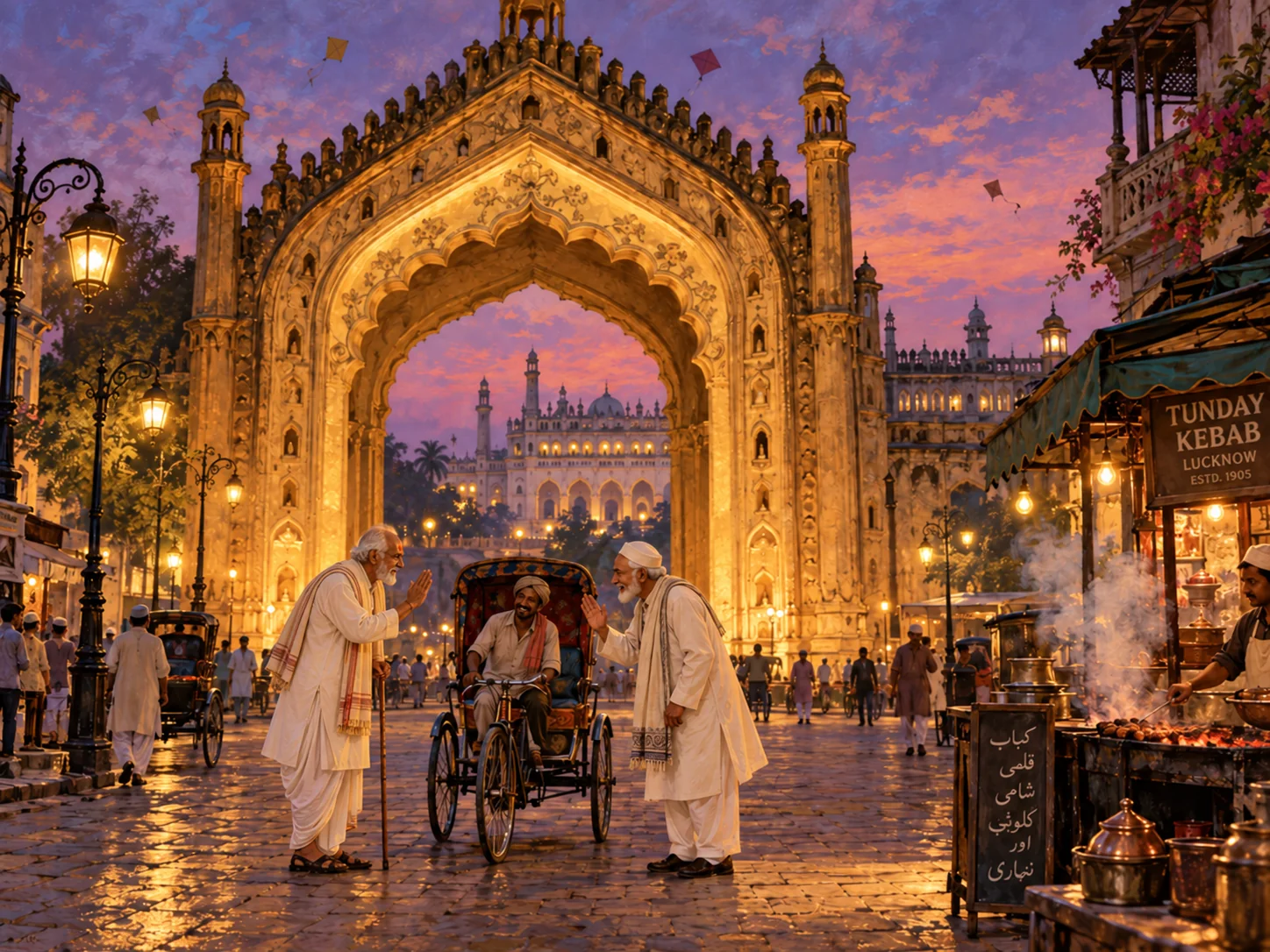
The word Lucknow uses for itself is tehzeeb, which dictionaries translate as culture, or refinement, and which in practice means a whole grammar of manners. You greet people with adab, a slight bow with the hand raised towards the forehead, rather than namaste or salaam, a greeting that belongs to no religion and so to everyone. You say aap to the rickshaw puller. You say hum, we, instead of main, I, when you speak of yourself, which to outsiders sounds either royal or absurd and to Lucknowis sounds simply correct: the self, in polite company, should not stand alone. You refuse food twice before accepting. You deliver an insult so courteously that the recipient thanks you for it and only works it out on the way home.
Two other words sit beside it. Nazakat is delicacy: of movement, of speech, of embroidery, of a kebab so soft it was supposedly invented for a toothless Nawab. Nafasat is refinement of taste. Together they describe a culture that valued the manner of doing a thing at least as much as the thing, and that is how you get the Lucknow gharana of kathak, where a dancer can tell an entire story with the flick of an eyebrow; the thumri, a light-classical song form polished at Wajid Ali Shah’s court; chikankari, white-on-white embroidery so fine it is sometimes described as shadow work; and the city’s food, cooked slowly in sealed pots, dum pukht, until the flavour has nowhere to go but inwards.
The last king of Awadh left Lucknow in 1856 for exile in Calcutta, and the song most associated with him, sung for more than a century and a half since by everyone from courtesans to K. L. Saigal, is a bride’s farewell to her father’s house:
बाबुल मोरा नैहर छूटो ही जाय
bābul morā naihar chhūṭo hī jāy
Father, my father’s house is slipping away from me.
Whether Wajid Ali Shah wrote it about his own exile, as the city likes to believe, or whether it was an older song he made famous, nobody can now say for certain. Lucknow has always preferred the better story.Babul mora is almost universally attributed to Wajid Ali Shah; some musicologists think he may have set or reworked an older folk song.
A city of poets, and of arguments about poetry
Lucknow’s Urdu poetry developed as a rival to Delhi’s. When Delhi was sacked, first by Nadir Shah in 1739 and then repeatedly by everyone else, its poets drifted east to the Nawabs’ court, and the greatest of them, Mir Taqi Mir, arrived in 1782, disliked almost everything about the place, said so in verse, and stayed until he died in 1810. The Lucknow school came to be known for ornament, wordplay and sensuous detail, the Delhi school for inwardness; they insulted each other for a century. The city’s greatest poetic achievement, though, was the marsiya, the elegy for the martyrs of Karbala, which Mir Anis and Mirza Dabeer turned in the nineteenth century into something close to an Urdu epic. The Nawabs were Shia, and Muharram in Lucknow, the processions, the tazias, the recitations, remains one of the city’s defining sights, attended, as it always has been, by a good many Hindus.
In 1899 Mirza Hadi Ruswa published Umrao Jaan Ada, the story of a girl kidnapped and sold to a Lucknow courtesan’s house who becomes its most celebrated poet and dancer; it is often called the first Urdu novel, and it is still the book through which much of India imagines the old city. Premchand’s short story Shatranj ke Khiladi, the chess players, published in 1924 and filmed by Satyajit Ray in 1977, gave the other image: two noblemen so absorbed in their chess that they fail to notice the British annexing their kingdom. Lucknow has never quite decided whether that story is an affectionate portrait or an indictment. It is both, which is why it lasts.
What the manners hide
The professor has to interrupt here, because nostalgia is the city’s main industry and someone has to audit it.
Tehzeeb was, originally, a court culture, and courts rest on hierarchy. The same exquisite manners that required you to say aap to a servant also required the servant to stand while you sat. The courtesans whose poetry the city celebrates were, many of them, girls who had been trafficked into the courtesans’ houses as children. The Nawabs’ extravagance was paid for by peasants in the countryside of Awadh, one of the most oppressive landlord systems in India, and the taluqdars, the great landlords the British left in place after 1857, were abolished only with the zamindari abolition of 1951. And the same Shia–Sunni devotion that produced the marsiya produced, in the twentieth century, recurring sectarian clashes over rival public recitations, serious enough that processions were banned for decades. Lucknow’s courtesy has always had a back entrance.
The modern city has added its own layers. It is a Hindi city now as much as an Urdu one: Amritlal Nagar wrote here, and Yashpal, and Srilal Shukla, whose Raag Darbari, set in a village a few hours away, is still the best book ever written about how power works in UP. It is a city of universities and research institutes, of the Central Drug Research Institute and a medical college founded in 1911, of La Martiniere, built with a French adventurer’s fortune, and Isabella Thoburn, one of the first colleges for women in Asia. It is a city of new ring roads and a metro and, in Gomti Nagar, of the vast pink-stone parks Mayawati built as memorials to Dalit leaders, lined with rows of stone elephants, her party’s symbol. When I was a teenager we laughed at the elephants. I laugh less now. They are, among other things, the first public monuments in the city’s history built to honour people whom the old tehzeeb would have kept standing at the door.
What Lucknow gave me, and I will come back to this, was the belief that the way you say a thing is part of what you are saying. I still think that is true. I also think a city that believes it so completely should be the first to ask who was doing the serving while everyone else was being polite.
Kashi, where they come to die
Mark Twain, who was not easily impressed by anything holy, visited Varanasi in 1896 and wrote that it was older than history, older than tradition, older even than legend, and looked twice as old as all of them put together. Archaeologists would quibble; there has been continuous settlement on the site for about three thousand years, which makes it one of the oldest living cities on earth but not older than legend. Anyone who has stood on the ghats at dawn will forgive Twain the exaggeration.
Varanasi has three names and uses all of them. Varanasi, the official one, is taken from the two small rivers, the Varuna and the Assi, between which it lies. Banaras is the one most people in UP actually say. Kashi, the oldest, means the city of light, and it is the one used by people who have come to the city for the reason most pilgrims have always come: to die in it.
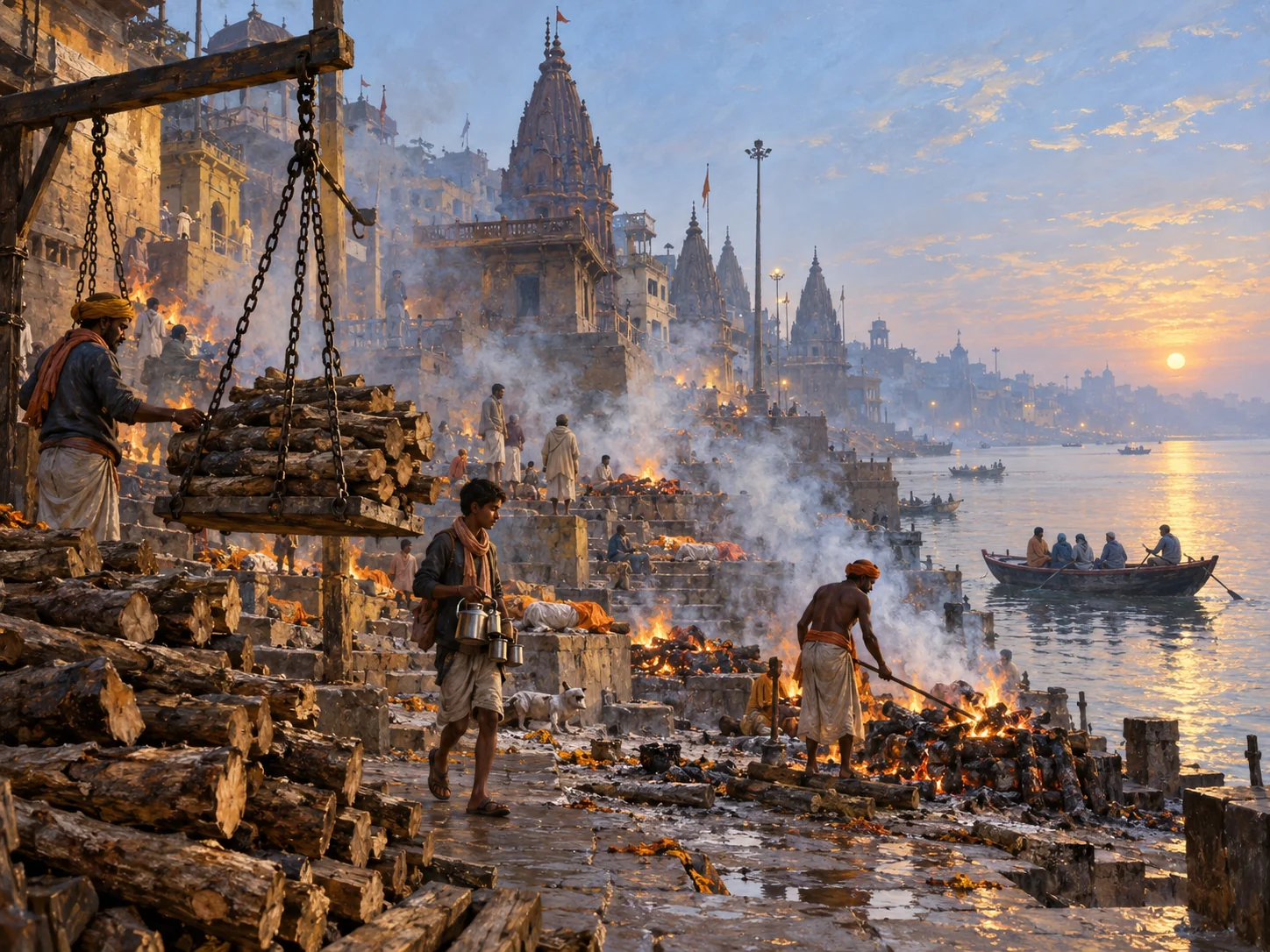
The belief is simple and very old. Shiva, who is said to have made Kashi his home, whispers into the ear of anyone who dies within the city the mantra that frees them from the cycle of rebirth. To die in Kashi is to attain moksha, liberation. So people come, old and ill, to wait. Since 1958 a charitable house near the river, the Kashi Labh Mukti Bhawan, has given the dying a room for up to about two weeks; if death has not come by then, they are gently asked to go home and try again another time. On the burning ghats at Manikarnika and Harishchandra, the pyres have not gone out, the city says, in thousands of years. The wood is weighed on scales, priced by the kilo. The Doms, the community who have tended the fires for centuries, and who were long subjected to untouchability by the same religion whose most sacred rite they perform, keep the flame.
The first time I watched a body burn at Manikarnika I was a child, and I remember being told not to be frightened because the man was lucky. I did not understand then that this was the most important thing anyone had told me about the city. Varanasi does not hide death. It weighs it, prices it, argues over it, sings about it and cooks lunch beside it. It is the only place I know where the question every other city is organised to avoid is the city’s main business.
The poets of the ghats
For a city devoted to one god, Varanasi has produced an astonishing number of people who argued with him.
Kabir was a weaver, born into a Muslim weaving family in the fifteenth century, and the legend is that he was found as a baby by a pond at Lahartara, on the edge of the city. He mocked the Brahmin and the mullah with equal enthusiasm, the idol and the mosque, the pilgrimage and the fast, and insisted that God was neither in Kashi nor in Kaaba but inside the person looking for him. His couplets, the dohe, are still the most quoted verses in north India, recited by schoolchildren and politicians who would have infuriated him. At the end of his life, the story goes, he left Kashi for Maghar, a town near Gorakhpur where it was believed that anyone who died would be reborn as a donkey, precisely to show that the place of death meant nothing. When he died, his Hindu and Muslim followers quarrelled over whether to cremate or bury him; when they lifted the shroud, the legend says, they found only flowers, which they divided. In Maghar today a Hindu samadhi and a Muslim tomb stand side by side.
Ravidas, a leatherworker from a village just outside the city, from one of the communities the caste order branded as polluting, sang of a city without sorrow, Begampura, where there would be no tax, no fear and no second-class citizens. Forty of his hymns are in the Guru Granth Sahib, the Sikh scripture, and his birthplace at Seer Govardhanpur is now a place of pilgrimage for millions of Dalits. In the sixteenth century Tulsidas, living by the Assi ghat, wrote the Ramcharitmanas, the Ramayana retold in Awadhi, the language of ordinary people rather than Sanskrit, and in doing so made the story of Ram the common property of the entire Hindi-speaking world; it is still read aloud, in full, in homes and temples across north India. The Sanskrit pandits of Kashi, the story goes, were furious that the sacred story had been put into the vernacular. They lost.
There is an older story too, the one I like best. Adi Shankaracharya, the eighth-century philosopher of non-dualism, was walking to the river in Kashi when a man of the community the old texts called chandala, pushed to the very bottom of the caste order, crossed his path, and Shankara’s disciples told the man to get out of the way. The chandala asked whether it was his body that should move aside, or his self, and if the self, how the self of one man could be different from the self of another, when Shankara himself taught that they were one. Shankara, the story says, bowed to him, and wrote five verses, the Manisha Panchakam, declaring that whoever had realised that truth was his teacher, whatever his birth. The greatest intellectual of Hindu philosophy, corrected about caste by a man his own disciples had ordered out of the way, on the way to the Ganga, in Kashi. The city has been telling that story for twelve centuries and has not always listened to it.
Music, silk and the Malaviya problem
Varanasi is also the city of Bismillah Khan, a devout Shia Muslim who played the shehnai every morning at a temple on the Ganga, and who, the story in the city goes, turned down an invitation to settle in America because nobody could bring him the Ganga;The Bismillah Khan anecdote is widely reported in many versions, with different people doing the inviting. What is certain is that he lived in Varanasi until his death in 2006. of Ravi Shankar, born here in 1920; of the singers Siddheshwari Devi and Girija Devi, the queens of thumri; of the tabla of Kishan Maharaj. It is the city of the Banarasi silk sari, woven for centuries on handlooms mostly by Muslim weaving families, the Ansaris, for Hindu brides, a trade the powerloom and the cheap import have been slowly killing.
It is also a city of institutions. In 1898 Annie Besant, the theosophist, founded the Central Hindu College here; in 1916 Madan Mohan Malaviya, a lawyer and Congress leader, turned it into the Banaras Hindu University, one of the largest residential universities in Asia, where Jayant Narlikar grew up on the campus and the country’s engineers have been trained for a century. Malaviya was a liberal nationalist who presided over the Congress four times and a founder of the Hindu Mahasabha; he opposed untouchability and defended the old orthodoxy in the same career. He is a very Varanasi figure: reformer and conservative at once, and quite sure there is no contradiction.
In December 2021 the government opened the Kashi Vishwanath corridor, a broad stone passage from the river to the temple, cutting through lanes and demolishing hundreds of old houses and dozens of small shrines along the way. Pilgrims love it; the numbers have multiplied. Old Banarasis argue about it, the way they argue about everything. The Gyanvapi mosque still stands beside the temple, and the lawsuits over it still stand beside the mosque.
What Kashi gave me is harder to say than what Lucknow gave me. It was not a religion; I have been arguing with religion in these pages for years, and I am not about to stop. It was something closer to a posture: the idea that the most serious questions are asked out loud, on a riverbank, with other people’s funerals going on beside you and a boy selling tea through the smoke. Kabir, Ravidas, Tulsidas and the chandala who corrected Shankara all argued about God in the same few kilometres of river. None of them thought the argument was disrespectful. In Kashi, the argument is the prayer.
In Kashi, the argument is the prayer.
Purab: poppies, soldiers and ships
The east of Uttar Pradesh is called Purvanchal by the government and purab, simply the east, by everyone else. Ghazipur, Ballia, Mau, Azamgarh, Jaunpur, Varanasi, Gorakhpur, Deoria: a flat, crowded, flood-prone country of mango orchards, sugarcane, brick kilns and the Ganga and the Ghaghra, closer in speech and food and temper to western Bihar than to western UP. It is the poorest and most densely populated part of an already poor and crowded state. It is where I am from, in the sense in which Indians mean that question, which is not where you were born but where your people’s land is.
Ghazipur
Ghazipur sits on the north bank of the Ganga, about seventy kilometres downstream of Varanasi. Local tradition gives it two origins, one Hindu and one Muslim — an ancient Gadhipur, named for a legendary king, and a medieval renaming after a Muslim warrior, a ghazi — and like most such pairs of stories in UP they are told by different people, and both are probably partly true. The town’s most famous grave belongs to a man who had nothing to do with either: Charles Cornwallis, the British general who surrendered to George Washington at Yorktown, went on to be Governor-General of India, and died at Ghazipur in October 1805 while travelling upriver. His domed tomb is still there, beside the Ganga, looking faintly surprised.
Ghazipur’s real contribution to world history was a flower. In 1820 the East India Company opened a factory in the town to process opium from the poppy fields of the Ganga plain, and for the rest of the century Ghazipur opium, packed into balls and shipped downriver to Calcutta, went on to Canton, paid for Britain’s tea and helped cause two wars with China. The factory still runs, under the government, making legal opium alkaloids for the pharmaceutical industry. Amitav Ghosh’s novel Sea of Poppies begins in the poppy fields near Ghazipur, with a woman named Deeti, and follows her onto a ship.
The ship is the other half of the story. Between the 1830s and 1917, after the abolition of slavery in the British Empire, more than a million Indians were shipped as indentured labourers to work the sugar plantations of Mauritius, Fiji, Trinidad, British Guiana, Suriname, Natal and elsewhere. They were called girmitiyas, from their mispronunciation of the “agreement” they signed, often without being able to read it. The largest single group came from the Bhojpuri-speaking districts of eastern UP and western Bihar: Ghazipur, Ballia, Azamgarh, Basti, Gonda, Arrah, Chhapra. Their descendants are the reason Bhojpuri is spoken in Port Louis and Paramaribo, the reason several prime ministers of Mauritius, Trinidad and Guyana have had names that would not surprise anyone in Ballia, and the reason the Bhojpuri folk tradition is full of bidesia songs, sung by women whose husbands have gone bides, abroad, and not come back. Every family in the east has an uncle who went to Calcutta, a great-grandfather who went to Rangoon, a rumour about someone who went to Fiji. Migration is not a recent problem in Purvanchal. It is the oldest thing the region knows how to do.
The district has also given India a remarkable run of people who became something without leaving it behind. In 1890 a young Bengali monk named Narendranath Datta, not yet Swami Vivekananda, came to Ghazipur to meet a hermit called Pavhari Baba, the “air-eating” saint, who lived in an underground cell by the river and was said to eat almost nothing; Vivekananda nearly became his disciple, and held him ever after second only to Ramakrishna. The writer Rahi Masoom Raza was born in 1927 in Gangauli, a Shia village in the district, and wrote Aadha Gaon, Half a Village, about how Partition split it; he went on to write the dialogue for B. R. Chopra’s television Mahabharat, the serial that emptied India’s streets on Sunday mornings in 1988 and 1989, and never saw any contradiction in a Muslim from Ghazipur putting words into the mouth of Krishna. Nazir Hussain, born in the village of Usia and a veteran of the Indian National Army, persuaded India’s first president that his mother tongue deserved a cinema, and in 1963 made Ganga Maiyya Tohe Piyari Chadhaibo, the first Bhojpuri film. And in 1965, at Asal Uttar in Punjab, Company Quartermaster Havildar Abdul Hamid of Dhamupur, Ghazipur, destroyed several Pakistani Patton tanks with a jeep-mounted recoilless gun before he was killed, and was awarded the Param Vir Chakra; Rahi Masoom Raza wrote a book about him.
Gangauli is not far from my own village, near enough that it belonged to the same small world of market towns, bus routes and relatives’ weddings. I once visited Rahi’s ancestral home in passing, the way you visit things in the east: someone in the car mentions that this is where he was from, the car stops, you stand in front of an old house for a few minutes, and then you drive on to wherever you were actually going. I did not know then how much of what I would later believe about the east was already written in Aadha Gaon: that a village can be Shia and Hindu and Bhojpuri all at once, that it can mourn Karbala in Muharram and argue about land like everyone else, and that a line drawn by lawyers in Delhi and Karachi could cut straight through it. Rahi spent his life insisting that he was a son of the Ganga and of Ghazipur, and that nobody had the right to hand him a different country. Standing in front of his house, I understood, a little late, that he had been writing about my district all along. It is one of the quiet facts of Jahurabad’s politics that in 2012 its seat in the assembly was won by a woman born in Gangauli.
The district is soldier country. Gahmar, a village on the Ganga in Ghazipur, is often called the largest village in Asia, and it is said that almost every family in it has sent a son to the army, a tradition that goes back to the purbiya sepoys of the Company. The claims are the kind that villages make about themselves, and I have never seen a count I trust.Gahmar is regularly described as one of the largest villages in Asia, and its tradition of army service is real, but population figures depend on where the village is counted to end, and the proportion of families with a soldier is local pride rather than statistics. The fact underneath them is not in doubt: for two hundred years the east has exported soldiers, labourers and migrants because it could not feed all of its sons at home.
Jahurabad
My family’s village is in the north-east of the district, towards Ballia, and gives its name to an assembly constituency. The old records describe it as the seat of a jagir, an estate held under the Mughals and then the British by a family of Pathan landlords, and at the census of 1901 the village itself held about 1,270 people, of whom more than 550 were Muslims. I did not know this growing up. What I knew was what every child from such a place knows: the particular smell of the earth after the first rain, the hand-pump, the mango orchard where the older boys disappeared in the afternoons, the long evenings on a charpai while the men argued about land, marriages and elections, in exactly that order of seriousness. The constituency is now represented by Om Prakash Rajbhar, leader of a party built on the Rajbhar community, one of the backward classes that the old zamindari order kept at the bottom. In a hundred years, the village has gone from a Pathan landlord’s estate to a Rajbhar politician’s seat. That is a short sentence for a very long revolution.
Ballia, Mau and Rasra
Ballia, across the district line, is where the east keeps its pride. It gave India Mangal Pandey, Chittu Pandey’s three-day republic of 1942, and a prime minister, Chandra Shekhar, born in the village of Ibrahimpatti, a socialist who once walked four thousand kilometres across India and governed the country for seven months in 1990 and 1991. It gave Hindi one of its finest critics and novelists, Hazari Prasad Dwivedi. Its people will tell you all of this within ten minutes of meeting you, and will then tell you that the rest of India has never given Ballia its due, which, to be fair, is true.
Mau, to the north, was a weaving town, famous for its handloom saris and the Muslim weaving families who made them, until it became better known for its politics; it was carved out as a separate district in 1988, largely through the influence of one local politician, which is itself a very Purvanchal way for a district to be born. Rasra, in Ballia, is my mother’s town: a market town and railway stop, and for me the nanihaal, where a child from Lucknow was fed without limit, forgiven almost anything, and met at the station by uncles in a jeep that had seen better decades. Azamgarh, next door, where a good part of the extended family is scattered, gave the world the travelling scholar Rahul Sankrityayan and the poet Kaifi Azmi, and in the 2000s acquired, after a handful of its young men were accused in terror cases, a national reputation it has never deserved and never shaken off.
Dabangai
There is a word for the quality the east is known for, and it is not a compliment everywhere. Dabang means fearless, forceful, a little overbearing; dabangai is the habit of being so. It is the swagger of a man who says hum kaun hain, jaante ho?, do you know who I am, and expects you to. It is a lathi on the shoulder at a village wedding, a country pistol, a katta, fired into the air when the groom arrives, a dispute over a boundary ridge settled by who can bring more cousins. It is a politics of strongmen, bahubalis, which I will come to. It is the reason a certain kind of Bollywood film is always set in eastern UP or Bihar.
But it is also, and this is the part outsiders miss, a code. It is loyalty to your own, the refusal to be humiliated, the obligation to stand up when someone from your village is in trouble in a city where nobody else will. It is the courage that sent Shivpujan Rai walking towards a tehsildar’s revolver with a flag in his hand, and Abdul Hamid towards a Patton tank. It is what a poor, crowded, flooded, twice-colonised country produces in people who have learned that no one is coming to help. The line between that courage and plain thuggery is thin, and the east has crossed it more often than it likes to admit. It is still a line, and I have spent a good part of my life trying to stay on the right side of it.
The other UPs
I have been writing as if Uttar Pradesh were Lucknow plus Purvanchal plus Kashi, which is how it looks from my family’s charpai. It is not how it looks from Meerut, or Jhansi, or Sonbhadra. The state is at least five countries stitched together, and a person from the east can travel for a day inside it and arrive somewhere where he is, in every sense but the passport, a foreigner.
Cane country
Western UP, the upper Doab between the Ganga and the Yamuna and the districts north of Delhi, is the state’s richest farmland and, not coincidentally, its most self-confident. It is canal country: the British dug the Ganges Canal in the 1850s, and the Green Revolution of the 1960s arrived here early, with tube wells, fertiliser and high-yielding wheat. Its crop is sugarcane, and UP grows more of it than any other state; the cane goes to hundreds of mills whose late payments, the notorious cane arrears, have decided more elections in the west than any temple. Its dominant community of cultivators are the Jats, farmers of the western plains who have never considered themselves anyone’s subjects, and whose leader Charan Singh built the first non-Congress government in the state in 1967 and briefly became prime minister in 1979.
The west has its own tradition of protest, and it is louder than the east’s. In October 1988 Mahendra Singh Tikait of the Bharatiya Kisan Union brought hundreds of thousands of farmers from western UP to camp for a week on the lawns of the Boat Club in the heart of Delhi, with their tractors, bullock carts and hookahs, until the government negotiated. In November 2020, when the central government passed three laws to open up agricultural markets, the farmers of Punjab and Haryana marched on Delhi, and the farmers of western UP camped at the capital’s eastern gate, on the highway at a place that happens, by one of those coincidences UP specialises in, to be called Ghazipur. In January 2021, when the protest seemed about to collapse, Tikait’s son Rakesh Tikait wept on camera at the Ghazipur border, and by the next morning thousands of farmers from the villages of the west had arrived to sit with him. In October 2021, at Lakhimpur Kheri, a vehicle in a convoy linked to a Union minister’s son drove into a group of protesting farmers; eight people died that day, including four farmers and a journalist. In November 2021 the Prime Minister repealed the laws. Farmers from the state that had given him two landslides had helped to make him retreat.
The west also holds the state’s workshops: Moradabad’s brass, Aligarh’s locks, Firozabad’s glass bangles, made in furnaces where children worked for generations, Saharanpur’s carved wood, Meerut’s cricket bats and footballs, Agra’s shoes. And it holds the state’s newest face. NOIDA, the New Okhla Industrial Development Authority, was created in April 1976, during the Emergency, as an industrial suburb for Delhi; half a century later Noida and its neighbour Greater Noida hold glass towers, a film city, an airport at Jewar and one of the largest mobile-phone factories in the world. People in the east call Noida “UP” with the same hesitation people in Geneva feel about calling Geneva “Swiss”.
North of the cane country is Rohilkhand, once ruled by Afghan Rohillas, with Bareilly and the old Nawabi court of Rampur, whose Raza Library holds one of the finest collections of Indo-Islamic manuscripts in the world. North of that is the Terai, the forest-and-grassland strip along the Nepal border, where the Tharu people live and tigers still walk out of Dudhwa and Pilibhit into sugarcane fields, to the terror of everyone involved.
The dry south
Bundelkhand is UP’s other extreme. Seven districts in the south of the state, Jhansi, Lalitpur, Jalaun, Hamirpur, Mahoba, Banda and Chitrakoot, sit on a rocky plateau of granite and thin soil that the Ganga’s gifts never reached. It rains little, and unreliably, and the region has had some of the worst droughts in modern Indian history; in the 2000s and 2010s its villages emptied of young men who left for the brick kilns and building sites of Delhi and Punjab, and its farmers killed themselves in numbers that briefly made national news. The government’s great answer is the Ken–Betwa link, the first project in a national scheme to join rivers, which will carry water from the Ken into the Betwa at the cost of flooding part of a tiger reserve in Madhya Pradesh. Its foundation stone was laid in December 2024. Bundelkhand has heard promises before.
It was not always the poor relation. The Chandela kings who built Khajuraho ruled from here, and their fort at Kalinjar, near Banda, was one of the strongest in India. Its great folk epic, the Alha Khand, tells of two warrior brothers, Alha and Udal of Mahoba, who fought for the Chandela king against Prithviraj Chauhan in the twelfth century; it is still sung during the monsoon, at length, by singers who can go on for nights, and villagers say that when it is sung well, the listeners’ blood rises and fights break out. Chitrakoot, on the Mandakini, is where Ram, Sita and Lakshman are believed to have spent much of their exile. Jhansi had its Rani. And the ravines of the Chambal and the Betwa gave UP its dacoits, bandits who were half criminal and half folk hero, from Man Singh to Phoolan Devi to Dadua, killed by the state’s Special Task Force in 2007.
And there is the far south-east, which almost nobody mentions. Sonbhadra, on the borders of Madhya Pradesh, Chhattisgarh and Jharkhand, has coal, cement and giant power stations that light the north, and Adivasi communities, Gonds and others, who have lived on the land for longer than anyone has been keeping records and have rarely been asked about any of it. In July 2019, in the village of Ubbha, ten Gond villagers were shot dead in a dispute over land that their families had farmed for generations. It is also UP. It is simply not the UP anyone puts on a postcard.
When I say I am from UP, I mean a very particular part of it. I have learned to say so. The state is too big for anyone to speak for all of it, and the people who try usually turn out to be speaking for their own district.
Warp and weft
If you want to understand Uttar Pradesh through a single object, you could do worse than a piece of cloth. The state’s history is woven into it, quite literally: the Mughal court’s taste, the Nawabs’ extravagance, the weaver-saints, the colonial collapse of a great industry, Gandhi’s spinning wheel, the mills of Kanpur and their death, the women embroidering in back rooms for a pittance. Kabir was a weaver, and when he wanted to describe the human body and the soul that wears it, he reached for the thing he knew best:
झीनी झीनी बीनी चदरिया ॥ … दास कबीर जतन करि ओढ़ी, ज्यों की त्यों धर दीनी चदरिया ॥
jhīnī jhīnī bīnī chadariyā … dās kabīr jatan kari oṛhī, jyoṃ kī tyoṃ dhar dīnī chadariyā
Finely, finely woven is this sheet … Kabir wore it with care, and gave it back just as it was.
Chikankari
Lucknow’s is white. Chikankari is embroidery in white cotton thread on fine white cloth, originally muslin, now also cotton, voile, georgette and anything else that will sell. The city’s favourite story is that it came from Persia with Nur Jahan, Jahangir’s queen; the story is unprovable and probably romantic, but the craft certainly flourished under Mughal and then Nawabi patronage, and by the nineteenth century Lucknow was its capital.
It is made in stages, by different hands. A block-printer stamps the design onto the cloth in a fugitive blue dye that will wash out. The embroiderers, almost all of them women, work it with a vocabulary of stitches, traditionally counted at around thirty-two, whose names are a small poem in themselves: tepchi, a long running stitch; bakhia, the shadow-work stitch worked on the back of the fabric so that the thread glows through from behind; phanda and murri, tiny knots like grains of rice; and jaali, in which the threads of the cloth are teased apart, without ever being cut, to open a lace-like net inside the fabric itself. Then the washermen of the Gomti wash out the blue, and the piece is finished. A fine chikan kurta can take weeks. Lucknow chikankari received a Geographical Indication in 2008.
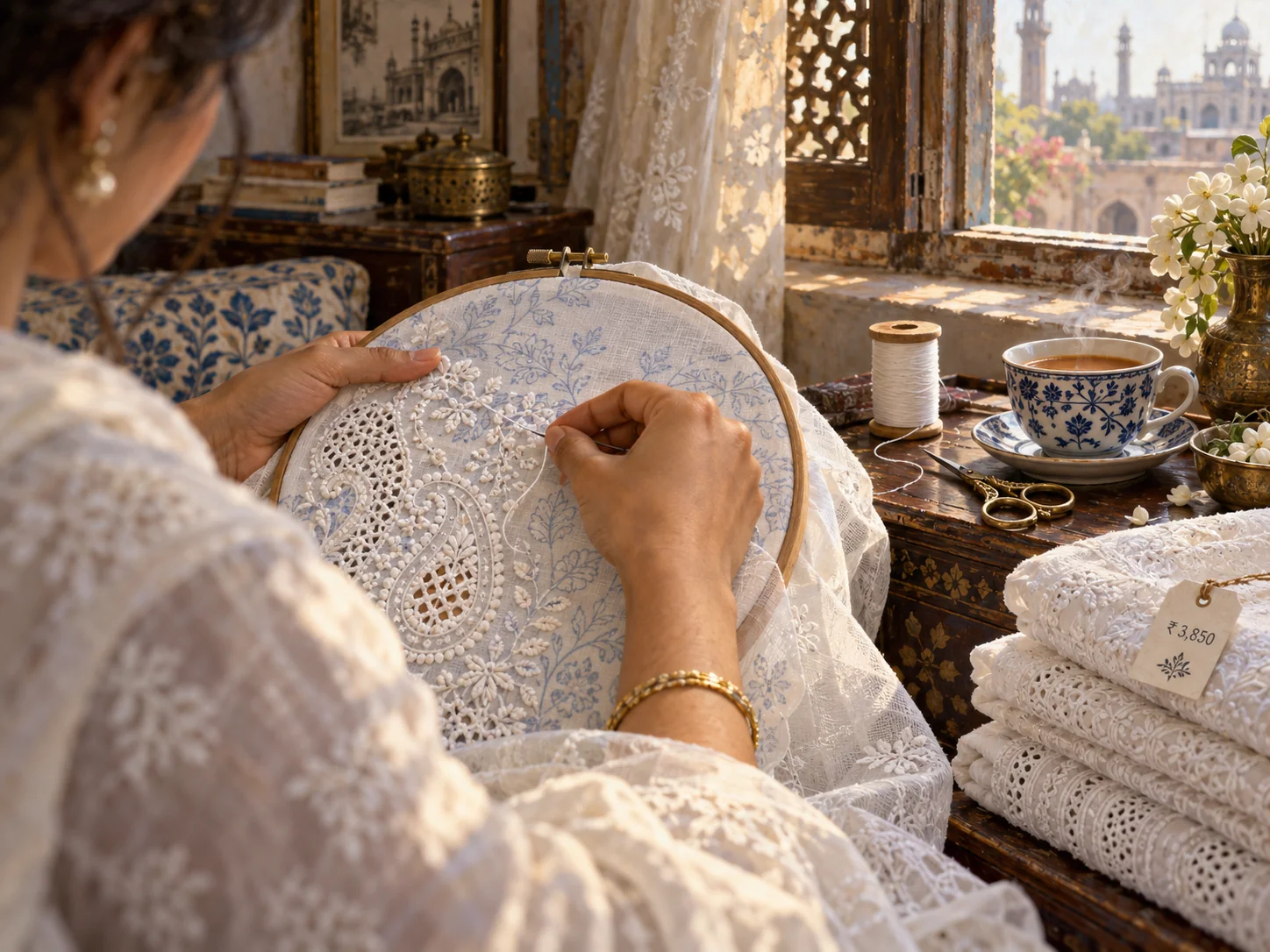
It is also, like so much of what Lucknow is proud of, built on women’s poverty. The embroiderers, mostly Muslim women working at home in the old city and the villages around it, are paid by the piece through chains of middlemen, and the money that reaches them is a sliver of what the kurta sells for in a Delhi boutique. Since the 1980s organisations like SEWA Lucknow have tried to organise them and cut out some of the middle; it is slow work. At weddings I wear a sherwani rather than chikan, but anyone who wears a chikan kurta, in Lucknow or in a Delhi boutique, is wearing somebody’s eyesight.
Banarasi
Varanasi’s is gold. The Banarasi sari is woven on handlooms in silk, with zari, thread wrapped in gold or silver, brocaded into it in patterns of creepers, flowers and paisleys; the heaviest, the kinkhwab, literally “little dream”, were so dense with metal that they were worn only by royalty. The weavers of the city’s Madanpura and Lohta neighbourhoods are mostly Muslim, from the Ansari community, and the saris they weave are, for a large part of Hindu north India, the thing a bride must wear. There is no better single emblem of the Ganga-Jamuni idea than a Hindu bride in Banarasi silk: she is wearing, on the most sacred day of her life, the work of Muslim hands. Banaras brocades and saris received a Geographical Indication in 2009.
And the industry is in trouble. Powerlooms in Surat and elsewhere, and cheap imported silk and synthetic copies, have undercut the handloom for decades; in the 2000s there were reports of weaving families in the city facing hunger and of weavers taking their own lives. The government’s schemes come and go. The looms get quieter.
The eastern looms, the carpets and the gold
Further east are the looms I grew up around. Mau and Mubarakpur, in Azamgarh, weave saris in silk and cotton that are sold across north India, often under the more famous Banarasi name. Tanda, in Ambedkar Nagar, weaves the cheap, cheerful cotton that becomes towels and gamchhas, the checked cotton cloth every man in the east wears on his shoulder or around his head. Between Varanasi and Prayagraj, in Bhadohi and Mirzapur, is India’s carpet belt, where hand-knotted rugs are made for export to Europe and America; Bhadohi’s carpets received their own Geographical Indication in 2010. In the 1980s and 1990s the belt became internationally notorious for child labour, and campaigns and labelling schemes followed; the problem shrank, though not everyone believes it vanished. In Lucknow and Bareilly, zardozi, heavy embroidery in gold and silver wire, decorates bridal wear and the robes of anyone who wants to look like a Nawab. Farrukhabad and Pilkhuwa print cotton by hand with carved wooden blocks. UP has a textile for every occasion from birth to death, and the shroud is made here too.
What the Company did to the looms
For most of recorded history, India was the world’s greatest producer of cotton cloth, and the Ganga plain was one of its heartlands. The collapse of that industry in the nineteenth century, when machine-made cloth from Lancashire flooded Indian markets under a tariff regime designed in London, is one of the central events of colonial economic history. Historians still argue about its exact scale and timing; nobody argues that it did not happen. Millions of weavers and spinners, many of them in the towns of the plain, lost their livelihoods and were pushed back onto the land, which is one of the reasons the villages of eastern UP were so crowded, and so ready to send their sons to the Company’s army or its ships.
That is the context of Gandhi’s spinning wheel. Khadi, homespun and handwoven, was not only a moral statement about simplicity. It was an economic argument about who should profit from Indian cotton, aimed directly at the mills of Lancashire and at the memory of the looms they had silenced. When Gandhi toured UP for khadi in 1929, he was speaking to districts that still remembered what they had lost.
Kanpur, the Manchester that closed
And then UP built its own Manchester.
Kanpur, the Cawnpore of the British, was a cantonment town on the Ganga that after 1857 became an industrial city. The Elgin Mills opened in 1864, the Muir Mills in 1874, the Cawnpore Woollen Mills, whose Lal Imli blankets warmed half of north India, in 1876. The army’s need for boots, saddles and harness made the city India’s leather capital, and tanneries spread along the river at Jajmau. By the early twentieth century Kanpur was one of the largest industrial cities in India, called, inevitably, the Manchester of the East, with Indian industrial houses like the JKs alongside the British firms, and a militant labour movement to match; its mill workers’ strikes were some of the fiercest in the country.
From the 1970s it came apart. The old mills, starved of investment, became “sick”, were nationalised to save jobs, lost money for decades and closed, one after another, through the 1990s and 2000s; Lal Imli, the most famous name of all, stopped producing and became a symbol of the city’s decline. Tens of thousands of mill workers lost their jobs. The tanneries stayed, and so did their effluent, of which more later. Kanpur remains a large and busy city, with IIT Kanpur, defence factories and a thriving small-business economy, but it never became the industrial capital it once promised to be, and a generation of its young men followed the old eastern road: out.
Kabir’s sheet is still being woven in UP, by Ansaris in Banaras, by women in Lucknow’s back rooms, by children, sometimes, in Bhadohi, by mill workers who no longer have a mill. Whether it will be given back just as it was is, I suppose, the question for all of them.
One language, two scripts, a dozen tongues
I grew up speaking at least three languages without being told that any of them was a language.
At home in Lucknow and at school we spoke what everyone called Hindi, which was full of Urdu words nobody noticed were Urdu, and in which people said hum for I and tehzeeb for manners. With my grandparents, and in the village, we spoke Bhojpuri, which people in Lucknow called a dialect, with the particular smile that people reserve for a relative who has done well abroad but still eats with his hands. And in the classroom, and later in every office I have ever worked in, there was English, the language of forms, exams and getting out. I have come to think of them as three selves. The Bhojpuri self is funnier and ruder than the others. The Hindustani self is the one that writes poetry, badly. The English self is the one writing this.
That tangle is not an accident of my family. It is the linguistic history of Uttar Pradesh in miniature, and it is one of the most consequential stories in modern India.
The tongues of the plain
The Ganga plain has never had one language. It has had a continuum of related speech that changes every few dozen kilometres, and a few of those forms were written down, polished and turned into literatures.
In the west, around Mathura and Agra, was Braj Bhasha, the language of Krishna devotion, of the blind poet Surdas, and of Raskhan, a sixteenth-century Pathan Muslim who wrote some of the most tender verses to Krishna in the language and asked, in one of them, to be reborn as anything at all in Braj — a cowherd, a bird, a stone — so long as it was there. In the middle was Awadhi, in which the Sufi poet Malik Muhammad Jayasi of Jais wrote his Padmavat in 1540, a love story that is also a mystical allegory, and in which Tulsidas, a generation later, wrote the Ramcharitmanas. That the two great classics of Awadhi were written by a Muslim mystic and a Hindu devotee, in the same language and within a few decades of each other, is the kind of fact UP ought to put on its number plates. In the east was Bhojpuri; in the south, Bundeli; around Kannauj, Kannauji.
And around Delhi and Meerut, in the far west of the state, was a plain, workmanlike speech called Khari Boli, the “standing” or “upright” dialect. Amir Khusrau, the thirteenth-century poet and musician, born at Patiali near Etah, is credited with some of the first verses in this Hindavi. Over the next five centuries, in the camps, bazaars and courts of the Delhi Sultanate and the Mughals, it absorbed an enormous Persian and Arabic vocabulary and became the common tongue of north India: Hindustani. Written in the Persian script, with a Persianised literary register, it became Urdu. Written in Devanagari, with a Sanskritised literary register, it became modern Hindi. At the level of the street and the kitchen and the film song, they remained, and remain, one language.
The split
How one language became two is a story in which UP played the central part.
In 1837 the British replaced Persian as the language of the courts in the North-Western Provinces with Hindustani written in the Persian script, which in practice meant Urdu. For a Hindu clerk or petitioner who had learned Devanagari, that was a barrier, and through the second half of the nineteenth century a movement grew in the province to have Hindi in Devanagari recognised as well. Its leading literary figure was Bharatendu Harishchandra of Varanasi, the father of modern Hindi prose and theatre, who wrote in 1877:
निज भाषा उन्नति अहै, सब उन्नति को मूल
nij bhāṣā unnati ahai, sab unnati ko mūl
The progress of one’s own language is the root of all progress.
In 1893 the Nagari Pracharini Sabha was founded in Varanasi to promote the script. In 1900 the Lieutenant-Governor, Antony MacDonnell, allowed petitions and court documents to be written in Devanagari alongside Urdu. The decision seems small. It was not. Many Muslim leaders, including the men who led Aligarh after Sir Syed’s death, saw it as the start of their displacement, and the Hindi–Urdu controversy became one of the tracks along which Hindu and Muslim politics in north India diverged. By the 1940s, in UP, you could often tell someone’s religion from the script they wrote their language in. In 1947 the new republic chose Hindi in Devanagari as its official language, and UP, in 1951, made Hindi its own. Urdu, the language of Lucknow’s poets and of a large part of its Muslims, had to wait until 1989 to be declared the state’s second official language, and it has been shrinking in UP’s schools ever since.
Premchand, the greatest writer UP has produced, lived through the split and refused to take sides. He began in Urdu, under the pen name Nawab Rai; his first collection of stories was confiscated and burned by the British soon after it appeared, as seditious; he then switched to Hindi, and wrote in both, sometimes the same story twice, for the rest of his life. Godaan, his last complete novel, about a poor peasant’s lifelong wish to own a cow, is the closest thing the Hindi language has to a national epic of the village. I read it at school in Hindi. I discovered only much later that half the words in it I had assumed were Hindi were Urdu, and that Premchand would have found the question of which was which uninteresting.
The heartland
Independence gave UP a new linguistic role, and a new resentment to go with it. The “Hindi heartland”, which in practice means UP and its neighbours, became the base from which Hindi was pushed as a national language, and the south, Tamil Nadu above all, fought back so fiercely in the 1960s that the plan to make Hindi the sole official language was abandoned. Some of the condescension UP still meets in the rest of India has its roots here: the sense that the heartland tried to make everyone else speak its language, and that it speaks that language, when it comes to live in Chennai or Bengaluru, rather loudly.
Meanwhile the heartland’s own languages were being flattened by standard Hindi exactly as it hoped to flatten others. Bhojpuri, spoken by tens of millions in India and across the girmitiya diaspora, is still not among the twenty-two languages recognised in the Constitution, despite decades of demands. Its public face is now mostly a cinema and music industry of cheerful, often crude songs that the middle classes in Lucknow profess to despise and play at every wedding. Awadhi and Braj survive in villages, in the Manas recitations, in the songs women sing at weddings and childbirths. The grandchildren of the people I grew up with will probably speak none of them. I notice that I mind this more than I expected to.
The calendar and the stage
UP keeps two calendars. One is the government’s, with its Republic Day and its financial year. The other is older and much busier, a year so crowded with festivals, fairs, fasts, processions and recitations that the government’s calendar mostly exists to be interrupted by it.
Chhath
For people from the east, one festival stands above the rest, and it is not Diwali.
Chhath falls six days after Diwali, in the month of Kartik, and it is the festival of the Bhojpuri world: eastern UP, Bihar, the Nepal Terai, and now every city where Purvanchalis have gone to work. It is devoted to Surya, the sun, and to Chhathi Maiya, a mother goddess who protects children. It lasts four days. On the first, the women who will keep the vow, the vratins, bathe and eat a single pure meal. On the second evening they eat a sweet rice pudding, kheer, and a flatbread, and then begin a fast of some thirty-six hours, without food and without water. On the third evening, the whole family goes to the river, or a pond, or a tank dug for the purpose, and the women wade in up to their waists, holding flat winnowing baskets heaped with fruit, sugarcane, coconuts and thekua, hard sweet biscuits of wheat and jaggery, and offer them to the setting sun. They come back before dawn the next morning, stand in the cold water again in the dark, and wait for the sun to rise.
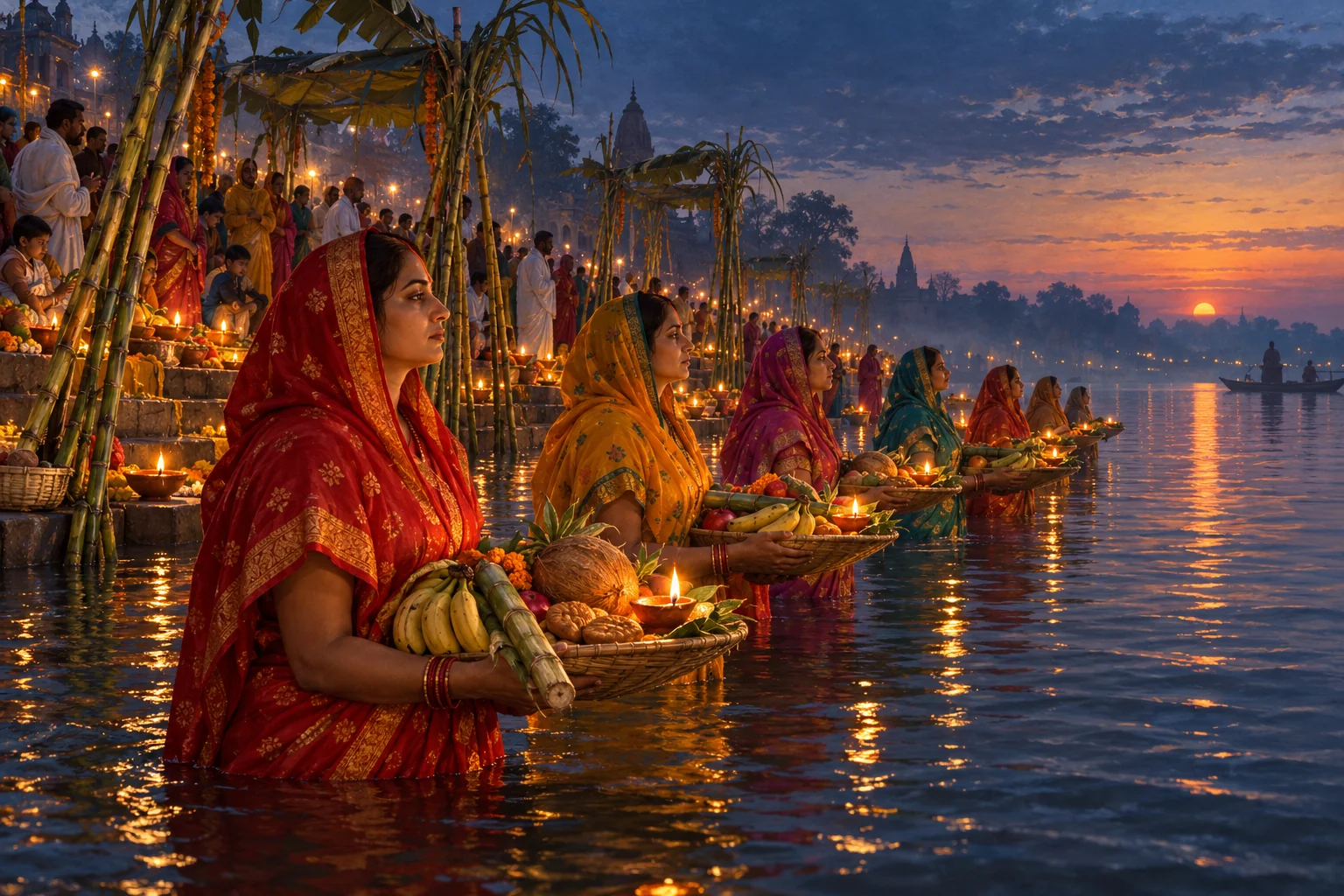
There are things about Chhath that make it unlike almost any other Hindu festival. It honours the setting sun before the rising one, which is to say it gives thanks for the end of the day as well as the beginning. It needs no priest; the women conduct it themselves. It is kept across castes, and its offerings are the humblest things a village produces: a bamboo basket, a sugarcane stalk, a radish, a lamp. Its songs, sung by the women on the way to the river, are among the most beautiful in the Bhojpuri language, and for a generation the voice of Chhath across the whole region was the Bihari folk singer Sharda Sinha, who died in November 2024, as it happens during Chhath itself.
Of all the rituals of my childhood, Chhath is the one I think of when I think of the women of my family: standing in the river, in the dark, fasting, silent, holding up a basket of fruit to a sun that has not yet come up, trusting completely that it will. If Kashi taught me that you argue with God out loud, Chhath taught me that you can also just wait for him in the water.
Chhath has followed the migrants. It is now celebrated on the Yamuna in Delhi, on the beaches of Mumbai and in the harbour of Port Louis, and politicians in Delhi and Mumbai, who would once have ignored it, now build ghats and declare holidays for it, because the Purvanchali vote has noticed who pays attention.
The rest of the year
The rest of the calendar is too full to list, so here are the ones that stayed with me.
Makar Sankranti, in January, is called simply Khichdi in the east, after the dish of rice and lentils that is cooked and given away; at the Gorakhnath temple in Gorakhpur, a fair grows up around the offering of khichdi to the saint. Holi in Braj lasts for weeks, from the Lathmar Holi of Barsana to the temples of Vrindavan drowned in coloured powder; in Varanasi, on the day before, some people play Holi at Manikarnika with the ash of the funeral pyres, which is the most Banarasi thing I can imagine. The monsoon brings kajri, songs of longing sung by women, above all in Mirzapur and Banaras, and swings hung from the branches of trees. In Kartik, fifteen days after Diwali, comes Dev Deepawali, when Varanasi lights a million lamps along every ghat for the gods who are said to come down to bathe; on the same full moon, Ballia holds the Dadri fair, one of the largest cattle fairs in India. Meerut has the Nauchandi fair, held for centuries near both a temple and a dargah. Lucknow has Muharram, Bada Mangal and Eid. Prayagraj has the Magh Mela every year and the Kumbh every twelve, which UNESCO inscribed in 2017 on its list of the intangible cultural heritage of humanity.
The greatest spectacle, for my money, is across the river from Varanasi at Ramnagar, where the Maharaja of Banaras has sponsored a Ramlila every autumn for some two centuries. It is not performed on a stage. It is performed across the whole town, over a month, with different neighbourhoods standing in for Ayodhya, the forest and Lanka, and an audience of thousands who walk from one scene to the next, many of them sadhus reciting the Ramcharitmanas from memory as the boy-actors speak. The Maharaja watches from the back of an elephant. In 2008 the Ramlila tradition of north India was inscribed on UNESCO’s list of intangible heritage. Ramnagar is its purest surviving form, and its most eccentric.
The village stage
The courts gave UP kathak and thumri. The villages gave it something louder.
Nautanki is UP’s folk musical theatre: melodrama sung in verse, to the beat of the nagada, a huge kettle drum, in open-air performances that go on until dawn. Its two great schools grew up in Hathras and Kanpur, and its stories range from the romances of the Persian tales to the martyrdom of Bhagat Singh. For a long time its women’s roles were played by men. Then came Gulab Bai of Kanpur, who in the 1930s became one of the first women to perform on the nautanki stage, ran her own company, and was awarded the Padma Shri in 1990. Nautanki has been dying for fifty years, killed first by cinema and then by television, and the word itself has come to mean, in everyday Hindi, a melodramatic fuss. But its rhythms are everywhere in Hindi film, which borrowed its heroes, its villains and its sense that a story is not finished until everyone has cried.
The east has its own forms. Birha is a folk song tradition of the Ahirs, the cattle-herding Yadav community of eastern UP, sung in competition, with singers improvising verses on everything from the Ramayana to the latest scandal; one of its great modern exponents, Hiralal Yadav of Varanasi, received the Padma Shri in 2019. Chaiti is the song of spring, sohar the song of childbirth, and the women’s wedding songs, the gaari, are affectionate and extravagantly obscene insults aimed at the groom’s family, the one occasion when the bride’s side is allowed to say what it really thinks. Across the border in Bihar, Bhikhari Thakur, a barber by caste, created in the early twentieth century the bidesiya theatre, plays about the men who go away to Calcutta and the women they leave, and the troupes of launda naach, in which men dance women’s roles, carried his plays across the Bhojpuri world. In Bundelkhand, as I have said, they sing the Alha in the rains.
And everywhere there is the mushaira and the kavi sammelan, the poetry gathering, Urdu and Hindi, which in UP can still fill a field with thousands of people until three in the morning, applauding a well-turned couplet the way other countries applaud a goal. There are few places left on earth where poets are rock stars. UP is one of them.
The table
Every Indian abroad eventually becomes a bore about food, and I held out longer than most. Geneva broke me. There are things you can find here, and things you cannot, and the things you cannot are the ones that come back at three in the morning.
Lucknow’s slow kitchen
The food of Lucknow is the food of the Nawabs, which is to say it is patient. Its great technique is dum, cooking in a pot sealed with dough over a low fire, so that meat and rice and spices steam slowly in their own juices. Its great ambition is softness. The galouti kebab, minced meat so fine it barely holds together, flavoured with dozens of spices, is supposedly the invention of a court cook for a Nawab who had lost his teeth; the family shop in the old city’s Chowk that made it famous, Tunday Kababi, was founded in 1905 by a one-armed cook, tunda meaning one-armed, and has fed Lucknow ever since. The kakori kebab is named after the same small town just outside the city where the revolutionaries robbed the train in 1925, which gives Lucknow the unusual distinction of having named both a kebab and a conspiracy after one village. Then there is the Awadhi biryani, lighter and more fragrant than its Hyderabadi cousin, the nihari eaten with kulcha on winter mornings, the saffron-sweet sheermal bread I have never found in Switzerland, the layered warqi paratha, the kormas.
And in winter, only in winter and only early in the morning, makhan malai: milk whipped and left out overnight under the dew until it becomes a foam so light that it disappears the moment it touches the tongue, flavoured with saffron and cardamom and eaten from a leaf. It is sold from carts in the old city before the sun gets high enough to melt it. There is no better description of Lucknow’s nazakat than a food that cannot survive being looked at for too long. Varanasi makes the same thing and calls it malaiyo; the two cities have argued for two centuries about who invented it.
Banaras for breakfast
Varanasi eats standing up. Breakfast is kachori, fried bread stuffed with lentils, with a sharp potato curry, and a hot jalebi to follow; the evening is tamatar chaat, a spicy, sour tomato mash served in a clay cup. The lassi comes in kulhars, unglazed clay cups you smash afterwards, thick enough to stand a spoon in. The langda mango, which Banarasis consider the only mango, and the Banarasi paan, betel leaf folded around lime, catechu, areca nut and whatever else the paanwala feels you deserve, both received Geographical Indications in 2023, which Banarasis regarded as long overdue. At Holi and Shivratri there is thandai, milk with nuts and spices, and some of it has bhang in it. Shiva is said to approve. Visitors should be cautious.
The food of the east
And then there is the food of the east, which is the food of poor people made with great intelligence, and which I love more than all the kebabs of Lucknow put together.
Its crown is litti chokha: balls of wheat dough stuffed with sattu, roasted gram flour mixed with garlic, ginger, green chilli, mustard oil and pickle masala, baked in the embers of a cow-dung fire until the crust cracks, broken open, soaked in ghee, and eaten with chokha, a mash of fire-roasted aubergine, potato and tomato with raw onion and mustard oil. It is the food of a field worker’s lunch, of a wedding, of a winter night round a fire, and there is nothing in Europe that tastes remotely like it. Sattu itself, stirred into cold water with salt, lemon and roasted cumin, is the summer drink of the east, what a labourer drinks at noon to survive the heat, and what I was given as a child when the loo, the hot wind, came off the plain in May. There is dal-bhaat-chokha, the everyday meal of lentils, rice and mash; dal ki dulhin, dumplings of dough simmered in lentils, whose name means “the bride of the dal”; rasiyaw, rice cooked in jaggery for festivals; thekua for Chhath; roasted gram and puffed rice with jaggery for the journey.
And the rest of the state
Agra has petha, translucent candied ash gourd, sold by the kilo to tourists who come for the Taj and leave with sugar. Mathura has peda, milk sweets offered to Krishna. Meerut has gajak and rewri, sesame and jaggery brittles for the winter. Malihabad, outside Lucknow, has the dasheri mango, whose orchards Josh Malihabadi grew up among. Allahabad has its guavas, with pink flesh in the good years. Rampur has a court cuisine of its own. Kannauj, which does not make food, makes attar, perfume distilled in copper stills the way it was made in the Mughal age, including mitti attar, which smells exactly like the first rain on dry earth.
Food in UP is never only food, of course. It is caste: who may enter the kitchen, who may touch the water pot, who eats with whom, and in the villages of my childhood those rules were still enforced, even if in Lucknow they had softened into habits. It is religion: the meat of one community is the taboo of another, and in recent years what was once a matter of private diet has become a matter for the police. And it is migration: the litti stalls of Delhi, Mumbai and Dubai are run by men from Ballia and Buxar, and Purvanchal travels in their tiffin boxes. I have never yet found a decent litti outside the Bhojpuri world. Some things, it seems, refuse to emigrate.
The roll call
Every state in India has a list of the famous people it has produced, and every state recites it at the slightest provocation. UP’s is unusual not because it is long, though it is, but because of how many of the names on it belong to the whole country, and how few Indians realise that they came from the same state that they are busy being rude about.
The poets
Mirza Ghalib, the greatest poet in the Urdu language, was born in Agra in 1797; Delhi claims him because he lived and died there, and Agra has never quite forgiven it. Agra also produced Nazir Akbarabadi, a poet the literary establishment of his day thought vulgar because he wrote about ordinary things — Holi, Diwali, kites, bears, the poverty of old age, the price of flour — and who is now read as the first poet of the Indian street. Akbar Allahabadi wrote satirical verse about the Anglicised gentlemen of his own class that is still funny a century later. Firaq Gorakhpuri, born Raghupati Sahay in Gorakhpur, taught English literature at Allahabad, wrote Urdu ghazals of great tenderness and won the Jnanpith, India’s highest literary prize, in 1969. Josh Malihabadi, from the mango town of Malihabad outside Lucknow, was called the poet of the revolution, emigrated to Pakistan in 1958 and regretted it. Majaz, Kaifi Azmi, Shahryar, and in our own time Munawwar Rana, whose poems about his mother were recited at every mushaira in the state until his death in 2024.
In Hindi, the list is even longer and I will stop sooner. Jaishankar Prasad of Varanasi, whose Kamayani is the great philosophical epic of modern Hindi. Suryakant Tripathi ‘Nirala’ and Sumitranandan Pant, who, with Prasad and Mahadevi Verma, made the romantic Chhayavad movement, much of it in and around Allahabad. Maithili Sharan Gupt of Jhansi district, the national poet of the freedom movement. Harivansh Rai Bachchan, who taught English at Allahabad, wrote a doctorate on Yeats at Cambridge and a long poem, Madhushala, about a tavern that is not really a tavern, and whose son is the most famous Indian alive; I share a first name with that son, as do a statistically improbable number of UP boys of my generation, and I have been making the same apology for it since school. Kedarnath Singh, born in a village in Ballia, who won the Jnanpith in 2013. Dushyant Kumar of Bijnor, whose ghazals in Hindi became the anthem of every protest against the Emergency.
The storytellers
Premchand of Lamhi, just outside Varanasi, is the father of the modern Hindi and Urdu short story and I have said enough about him. Srilal Shukla’s Raag Darbari, about a village college, a cooperative society and a local strongman, remains the funniest and bleakest account of power in rural UP. Kashinath Singh’s Kashi ka Assi is Varanasi in all its abusive, argumentative glory. Qurratulain Hyder, born in Aligarh, wrote in Aag ka Darya, the River of Fire, a novel that runs from the age of the Buddha to Partition and is sometimes called the greatest novel in Urdu. Intizar Husain of Bulandshahr, Rahi Masoom Raza of Gangauli, Rahul Sankrityayan of Azamgarh, who walked to Tibet and brought back manuscripts, Hazari Prasad Dwivedi of Ballia. Most of them wrote, one way or another, about the same thing: the village, the city, the caste, the mosque and the temple, and what happens to people who try to leave.
The musicians and the screen
I have mentioned Bismillah Khan, Ravi Shankar, Girija Devi and Birju Maharaj. Add the composer Naushad of Lucknow, who scored Mughal-e-Azam and Baiju Bawra and made Hindustani classical music the grammar of Hindi film song; the ghazal singer Talat Mahmood of Lucknow; and Begum Akhtar of Faizabad, to whom I will return. UP gave Hindi cinema Amitabh Bachchan, born in Allahabad in 1942, Naseeruddin Shah of Barabanki, the director Muzaffar Ali, whose Umrao Jaan of 1981 is still the most beautiful film ever made about Lucknow, and the writer Javed Akhtar, who grew up in Lucknow and Aligarh. It also gave Bollywood its favourite setting: the eastern UP small town of guns, weddings, local elections and unexpected philosophy, which the Mumbai film industry has spent twenty years mining for everything from Omkara to a web series called, with admirable frankness, Mirzapur.
The scientists
This is the list people are most surprised by. The Sushruta Samhita, one of the foundational texts of Indian surgery, with its famous description of rebuilding a nose from a flap of cheek skin, is traditionally said to have been composed by a physician teaching in Kashi. Harish-Chandra, born in Kanpur in 1923 and educated at Allahabad, went on to the Institute for Advanced Study in Princeton and became one of the most important mathematicians of the twentieth century, the architect of the theory of representations of Lie groups. Meghnad Saha, whose ionisation equation let astronomers read the temperatures of stars from their spectra, spent fifteen years as a professor at Allahabad and founded the National Academy of Sciences there in 1930. Birbal Sahni founded one of the world’s first institutes of palaeobotany in Lucknow in 1946. Jayant Narlikar, the cosmologist who with Fred Hoyle proposed a rival to the Big Bang, grew up on the campus of the Banaras Hindu University, where his father taught mathematics. IIT Kanpur, founded in 1959, trained a large part of the generation that built India’s software industry and Silicon Valley’s too.
The list is interesting less for its length than for its geography: Allahabad, Kanpur, Varanasi, Lucknow, the old university towns of the plain, most of which have since declined. UP produced a remarkable scientific class in the first half of the twentieth century and then spent the second half watching it leave. Allahabad University, which people used to call the Oxford of the East without irony, is now known mostly for the civil service coaching industry that has grown up around it. That, too, belongs on the roll call.
The thinkers
Finally, the people whose ideas still run the country, which is to say its politics. Ram Manohar Lohia of Akbarpur, the socialist who argued that caste, not only class, was India’s central inequality, and whose disciples, Mulayam Singh Yadav among them, built a political movement on that argument. Acharya Narendra Dev, the Buddhist scholar-socialist who taught at Lucknow and Varanasi. Deendayal Upadhyaya, born near Mathura, the ideologue of the Jana Sangh whose “integral humanism” is the official philosophy of today’s BJP; he was found dead beside the tracks at Mughalsarai station, near Varanasi, in 1968, and in 2018 the station was renamed after him. Sir Syed Ahmad Khan at Aligarh, the founders of the Darul Uloom at Deoband and of the Nadwatul Ulama in Lucknow, Ahmad Raza Khan of Bareilly: the men who shaped how the Muslims of South Asia think about modernity and faith. The socialists, the Hindu nationalists, the Muslim modernists and the Muslim traditionalists all trace their intellectual genealogy to the same few hundred kilometres of the Ganga plain. When people say that UP decides India’s politics, they usually mean the eighty seats. They should also mean the ideas.
The present tense
The roll call does not end with the dead, and it would be a very Lucknow mistake to write as if it did.
The writer I feel closest to, of all the living ones, is Varun Grover. He was born in Himachal, grew up in Lucknow and studied engineering at IIT-BHU in Varanasi, which is to say he is, like me, an engineer who was formed by exactly the two cities this essay is about, and then did something more interesting with it. He wrote the lyrics of Gangs of Wasseypur and the screenplay of Masaan, won a National Award for the song Moh Moh Ke Dhaage, co-wrote Sacred Games, did stand-up comedy that got him into trouble, and in 2023 made his first film as a director, All India Rank, about a boy in 1990s Lucknow sent away to Kota to be ground into an engineer by the coaching factories. I watched it with the uncomfortable feeling of a man reading his own school report. His short protest poem of 2019, written during the citizenship protests, about refusing to show one’s papers, was chanted in streets across the country within weeks. He writes the way Lucknow speaks when it is being honest: soft, funny, and with a knife somewhere in the second line.
The biggest literary prize ever won in Hindi went to a writer from UP. Geetanjali Shree, born in Mainpuri in 1957, won the International Booker Prize in 2022 for Ret Samadhi, translated by Daisy Rockwell as Tomb of Sand, a novel about an eighty-year-old widow who, after her husband’s death, refuses to get out of bed, then gets up and goes to Pakistan. It was the first book translated from any Indian language to win the prize. It is also, among many other things, a book about how UP families argue, which is to say constantly, lovingly and at tremendous length.
In Hindi poetry, the kavi sammelan circuit has produced a new generation of stars, of whom Kumar Vishwas of Pilkhuwa, near Hapur, is the most famous, filling stadiums with romantic verse and political sarcasm; the lyricist Manoj Muntashir of Amethi has written some of the biggest Hindi film songs of the last decade. The storyteller Neelesh Misra of Lucknow turned radio narration into an art form and founded a rural newspaper, Gaon Connection. In classical music, the great Rampur-Sahaswan singer Rashid Khan of Badayun died in January 2024 far too young, and the folk singer Malini Awasthi of Kannauj has spent her career carrying kajri, chaiti and sohar from village courtyards to national stages. In cinema, beyond Anurag Kashyap and Vishal Bhardwaj, there are the director Tigmanshu Dhulia of Allahabad, who made Paan Singh Tomar and Haasil, a film about student politics at Allahabad University that people from UP still quote to each other; Anubhav Sinha, whose Mulk and Article 15 took on the state’s communal and caste violence directly; and the actor Nawazuddin Siddiqui, from Budhana in Muzaffarnagar, who went from a farming family in western UP to Cannes, and whom the whole of Hindi cinema had spent years casting as the man in the background.
And there is the UP that others have written. Vikram Seth’s A Suitable Boy (1993), one of the longest novels in the English language, is set in the early 1950s in a fictional state called Purva Pradesh, whose capital, Brahmpur, on the Ganga, is an unmistakable blend of Varanasi, Allahabad and Lucknow; its central drama is the zamindari abolition I mentioned, and its hardest chapters are about a Hindu–Muslim riot at a temple beside a mosque. For many readers around the world, that fictional state is the only UP they know. It is, I have to admit, a very good likeness.
The state is still producing its roll call, and most of it is not famous yet. It is on YouTube in Bhojpuri, on Instagram in Awadhi, in coaching-centre hostels in Prayagraj and Kota, in the notebooks of girls in Ballia who will write the next Aadha Gaon. If I have left out your favourite, the comments are open, and UP has never needed an invitation to argue.
UP on screen
If you have never been to Uttar Pradesh, you have almost certainly seen it anyway. Hindi cinema has been living off the state for as long as it has existed, Indian streaming television has made its gangsters and village clerks into national celebrities, and Hollywood, when it wants to show a character finding himself in India, has a way of sending him to the Ganga.
The courtesan, the Nawab and the bride
For its first decades, Bombay cinema’s UP was Lucknow, and Lucknow was the courtesan’s house and the Nawab’s palace. Mughal-e-Azam (1960), set at Akbar’s court, with Naushad’s music, is the grandest of all Hindi films and the story of a prince who loves a dancer his father will not accept. Chaudhvin Ka Chand (1960) and Mere Mehboob (1963) are Lucknow love stories of veils, poetry and mistaken identities. Pakeezah (1972), made over fourteen years by Kamal Amrohi of Amroha, is the most extravagant tribute ever paid to the courtesan culture of the old city. Then, as the old world became history, came the films that looked back at it: Satyajit Ray’s Shatranj Ke Khiladi (1977), Shyam Benegal’s Junoon (1978), set in the rebellion of 1857 in Shahjahanpur, and Muzaffar Ali’s Umrao Jaan (1981). Muzaffar Ali also made Gaman (1978), about a young man from a village near Lucknow who drives a taxi in Bombay and cannot afford to go home, which is the truest film about the bhaiya I know.
The biggest UP story Bollywood ever told, though, is one most people do not know came from UP at all. In 1982 Rajshri Productions made Nadiya Ke Paar, a gentle village romance in Awadhi-inflected Bhojpuri, adapted from a novel called Kohbar Ki Shart by Keshav Prasad Mishra, which is set in villages of Ballia district. In 1994 Rajshri remade it, with Madhuri Dixit, Salman Khan, fourteen songs and a dog called Tuffy, as Hum Aapke Hain Koun..!, and it became one of the most successful Indian films of all time, the first Bollywood film reported to have grossed more than a hundred crore rupees. The film that taught a generation of middle-class Indians how to have a wedding began as a story about Ballia. The novel, I am told, has a devastating ending. The film removed it.
The badlands
From the 2000s, the Bollywood image of UP changed from the Nawab’s palace to the small town with a gun. Vishal Bhardwaj, who grew up in western UP, set Omkara (2006), his Othello, among the political strongmen of the Meerut region, and it may be the best Shakespeare adaptation in any language this century. Ishqiya (2010) went to Gorakhpur. Bunty Aur Babli (2005) sent two small-town con artists out of Fursatganj and Kanpur. And Dabangg (2010), set in a fictional UP town called Lalganj, gave the country Chulbul Pandey, a corrupt, swaggering, sunglasses-wearing, utterly lovable UP policeman, and made the word I have been using throughout this essay into a box-office brand. It was one of the biggest hits of the decade. The rest of India, it turned out, loved dabangai on screen as much as it disliked it in the carriage.
Then Anurag Kashyap, who grew up in eastern UP, made Gangs of Wasseypur (2012), a five-hour, two-part gangster epic about three generations of coal-mafia families. It is set in Dhanbad, in Jharkhand, not UP, but it was shot largely in and around Varanasi, including the old fort at Ramnagar, and its world of feuds, railway scrap contracts, country pistols and folk songs is instantly recognisable to anyone from Ghazipur or Mau. It premiered at Cannes and changed what Indian crime films were allowed to be. After it came Raanjhanaa (2013) and Masaan (2015) in Varanasi, Masaan following the son of a family of Doms who burn the dead at the ghats and winning two prizes at Cannes; Mukkabaaz (2017) in Bareilly, about a boxer and caste; Article 15 (2019), a police thriller shaped by the Badaun case; and Gulabo Sitabo (2020), Amitabh Bachchan as a miserly old landlord in a crumbling Lucknow mansion.
Kaleen Bhaiya and Phulera
Streaming made UP a national obsession. Mirzapur, which began on Amazon Prime Video in 2018, follows the Tripathis, a family who control the carpet trade of Mirzapur and, behind it, the guns and the politics of the region; its patriarch, Akhandanand Tripathi, universally known as Kaleen Bhaiya, carpet brother, became one of the most quoted characters in Indian television. It is violent, lurid, and, to anyone from the east, uncomfortably accurate in its details, from the way a local don talks to a district magistrate to the way a wedding turns into a shooting. It also, I suspect, shaped how millions of young Indians who have never been to UP imagine it. Rangbaaz (2018) retold the story of Shri Prakash Shukla. Paatal Lok (2020) took its detectives to Chitrakoot.
And then, in 2020, came Panchayat, about a young engineering graduate from the city who, failing to get anything better, takes a government job as secretary of the village council in Phulera, a fictional village in Ballia district. It is gentle, funny and quietly devastating about the boredom, the pettiness, the kindness and the stubborn dignity of village life, and it became one of the most loved Indian series ever made. I watched the first season in Geneva in a single night, and when a character complained about the bus from Ballia, I laughed so hard my neighbour knocked on the wall. For once, the east was on screen and nobody was shooting anyone.
The world’s Ganga
Outside India, UP on screen mostly means two things: the Taj Mahal and the ghats of Varanasi.
The Taj is everywhere. In Slumdog Millionaire (2008), which won eight Oscars, the young brothers Jamal and Salim pass themselves off as tour guides at the Taj, inventing its history for gullible foreigners and stealing shoes from the visitors while they are inside; it is the funniest sequence in the film and a fair portrait of the Agra tourist economy. In Mira Nair’s The Namesake (2006), the hero’s parents take him to the Taj, and the visit becomes the moment he begins to understand them. Victoria & Abdul (2017), with Judi Dench, told the real story of Abdul Karim, a young Muslim clerk from Agra who was sent to wait at table at Queen Victoria’s Golden Jubilee in 1887 and became her munshi, her teacher of Hindustani and her closest confidant, to the fury of the entire British court.
Varanasi is where Hollywood sends people to be changed. In The Curious Case of Benjamin Button (2008), David Fincher’s film about a man who ages backwards, there is a brief montage in which Brad Pitt’s Benjamin, at the height of his youth and his loneliness, wanders through Asia; part of it was filmed in 2007 on the ghats of Varanasi by the director Tarsem Singh, with Pitt among the pilgrims, and the story in the city is that the star happily got a shave from a roadside barber between takes. Pitt later said that he had never seen anything like the place. It is, when you think about it, the perfect city for that film: a story about a man moving against the current of time, filmed in the city whose whole purpose is to release you from it.
Long before Hollywood, world cinema had found Varanasi. Satyajit Ray set much of Aparajito (1956), the second film of the Apu trilogy, on its ghats, where the boy Apu’s father dies; it won the Golden Lion at Venice. Deepa Mehta’s Water (2005), about the widows of Varanasi in the 1930s, was supposed to be filmed in the city in 2000 until protesters wrecked the sets and drove the production out; she finished it years later in Sri Lanka, and it was nominated for the Oscar for foreign-language film. Mukti Bhawan, released abroad as Hotel Salvation (2016), is about a father who announces that he is going to Varanasi to die, and a son who has to take him; it is funny, and it is the gentlest film I know about the belief I described earlier.
And UP has been at the Oscars in its own right, twice, through two documentaries about women. Period. End of Sentence., about women in a village in Hapur district who start making cheap sanitary pads on a small machine, won the Oscar for best documentary short in 2019. Writing with Fire, about Khabar Lahariya, a newspaper run by Dalit women journalists in Bundelkhand who report on rape, mining mafias and corrupt officials from their mobile phones, was nominated for best documentary feature in 2022. They are, I think, the truest films anyone has made about the state. Nobody in either of them gets shot, and nobody visits the Taj.
The sound that travelled
One more export, because it changed Western popular culture more than any film. In the 1960s, Ravi Shankar, born in Varanasi in 1920, taught the sitar to George Harrison, and Indian music entered the Beatles and, through them, the counterculture; Shankar played at Monterey and Woodstock and became, for a generation of Westerners, the sound of India. Half a century earlier, in 1915, Rabindranath Tagore’s English versions of Kabir, Songs of Kabir, had introduced the weaver of Varanasi to Western readers, and poets from Ezra Pound’s generation to Robert Bly’s have been translating him since. The weaver who mocked every pundit in Kashi now circulates on Instagram in English, usually misattributed, occasionally correct. He would have found this very funny.
Ganga, Jamuna, and the canal at Hashimpura
In Lucknow the phrase is Ganga-Jamuni tehzeeb: the culture of the two rivers, Hindu and Muslim, meeting at Prayag and flowing on together. Lucknowis use it the way the Swiss use the word “consensus”, as a description of how things are and a warning about how they had better stay. It is a real thing. It is also, like consensus, something that has to be made every day, and in UP it has been unmade, violently, more often than anywhere else in India.
UP has more Muslims than any other Indian state: the 2011 census counted about 38 million, a little under a fifth of the population, more than live in most Muslim-majority countries. It has more Hindu holy places of the first rank than any other state: Ayodhya, Mathura, Vrindavan, Kashi, Prayag. It produced both of the great rival schools of Sunni Islam in South Asia, the reformist Darul Uloom at Deoband, founded in 1866, and the devotional Barelvi movement of Ahmad Raza Khan of Bareilly; Lucknow’s Firangi Mahal gave the madrasas of the subcontinent their standard curriculum for two centuries. It has three of Buddhism’s four holiest sites. And it has, running through all of it, a deep layer of shared devotion that belongs to no single religion at all.
The shared shrines
That layer is easy to find if you look. At Dewa Sharif, near Barabanki, the shrine of the Sufi saint Haji Waris Ali Shah, Hindus and Muslims play Holi together in the courtyard every year, throwing colour at a Muslim tomb. In Lucknow’s Aliganj, the city’s best-loved Hanuman temple was, by the most common account, built in the eighteenth century by a begum of the Nawab’s household after a vow for a son was answered, and some old accounts say its spire once carried the Islamic crescent;Accounts of the Aliganj Hanuman temple differ on which begum built it and on whether its spire carried a crescent. Treat both as the city’s tradition. the festival of Bada Mangal, when the whole city sets up free food stalls on the Tuesdays of the month of Jeth, began there, and Muslims set up stalls too. In Varanasi, the Ramlila effigies are traditionally made by Muslim craftsmen, the saris for Hindu weddings are woven by Muslim families, and the shehnai that played at the temple every dawn for decades was Bismillah Khan’s. At the dargah of Ghazi Miyan in Bahraich, Hindu pilgrims came for centuries. Raskhan wrote for Krishna, Rahim wrote dohe on Ram, Rahi Masoom Raza wrote the words of the Mahabharat, Kabir mocked everyone equally.
I grew up inside a version of this without thinking about it. None of it felt like tolerance. Tolerance is what you extend to strangers. This was just the neighbourhood.
The breaking points
And yet. The same state has one of the longest and bloodiest records of communal violence in India, and a history of honesty requires the list.
In 1893, a wave of riots over cow slaughter swept the eastern districts, including Mau, one of the first mass Hindu–Muslim riots of the colonial era; the cow has been a trigger in the east ever since. In March 1931 Kanpur burned for days, and Ganesh Shankar Vidyarthi died in it. On the night of 22 December 1949 idols of Ram were placed inside the Babri Masjid in Ayodhya, a sixteenth-century mosque on a site that many Hindus believed was Ram’s birthplace; the district officials declined to remove them, the mosque was locked, and a legal dispute began that would last seventy years and reshape the republic.
The riots of independent India followed a grim pattern, often with the state’s own armed police, the Provincial Armed Constabulary, as a participant rather than a referee. In Moradabad in August 1980, police fired into a crowd of Eid worshippers at the Idgah, and the riots that followed killed scores, by some counts hundreds. On 22 May 1987, during riots in Meerut, men of the PAC rounded up Muslim men from the Hashimpura neighbourhood, drove about forty-two of them to the edge of a canalThe number killed at Hashimpura is given as forty-two in most accounts. A few men survived by pretending to be dead, and their testimony was central to the conviction thirty-one years later., shot them and threw the bodies into the water. It took thirty-one years for a court, the Delhi High Court in 2018, to convict sixteen former policemen of the killings; by then several of the accused, and many of the families, were dead. The next day, in the village of Maliana nearby, dozens more were killed.
Then came the mobilisation to build a Ram temple on the site of the Babri Masjid. In October and November 1990, the police of Mulayam Singh Yadav’s government fired on kar sevaks, Hindu volunteers, trying to reach the mosque, killing at least sixteen by the official count and many more by the movement’s. On 6 December 1992, in front of the police, political leaders and the cameras, a crowd of kar sevaks tore the mosque down with hammers and bare hands in a few hours. The riots that followed across India, in Mumbai above all, killed some two thousand people. In November 2019 the Supreme Court awarded the site to the Hindu side, while describing the placing of the idols in 1949 and the demolition in 1992 as illegal, and ordered land elsewhere for a mosque. On 22 January 2024 the Prime Minister consecrated the new temple. Four and a half months later, in the general election, the voters of the Faizabad constituency, which includes Ayodhya, elected the opposition’s candidate, a Dalit politician from the Samajwadi Party. UP rarely gives anyone the ending they expect.
The list does not end there. In September 2013 riots in and around Muzaffarnagar, in western UP, killed more than sixty people and drove tens of thousands of Muslims from villages where their families had lived for generations; many never went back. In September 2015, in Bisara village near Dadri, a mob killed Mohammad Akhlaq over a rumour that his family had beef in their fridge, and the word “lynching” entered India’s political vocabulary. In December 2019, protests against the new citizenship law left some twenty people dead in UP, most of them from police gunfire, according to reporting at the time. In November 2024 in Sambhal, a court-ordered survey of the old Jama Masjid, on a petition claiming it stood on a temple, led to clashes in which at least four men were killed. In Varanasi the Gyanvapi mosque and in Mathura the Shahi Idgah remain in court, each with a petition claiming the land beneath it. The palimpsest on the Allahabad pillar was left alone for two thousand years. The palimpsests in stone and brick are being litigated, surveyed and, sometimes, fought over.
It is not only religion. Caste has its own list: the Dalit villagers killed by upper-caste men at Shabbirpur near Saharanpur in 2017, the young Dalit men from western UP who formed the Bhim Army in response and whose leader now sits in Parliament. And it is not only between communities. The Shia–Sunni tensions of Lucknow, the Barelvi–Deobandi quarrels, the upper-caste rivalries that fuel the gangs of the east: UP has always had enough conflict to go round.
What the rivers actually do
Here is what I have come to think, having read far more about this than I did as a boy eating sevaiyan.
Ganga-Jamuni tehzeeb is not a myth, and it is not a guarantee. It is a practice, kept alive by people who have a reason to keep it: weavers and traders who need each other’s custom, neighbours who need each other’s help, poets who need each other’s words. It survives where those reasons survive. Riots, in UP as elsewhere, have rarely erupted spontaneously from ancient hatreds; again and again, the commissions of inquiry and the historians have found an organised spark, an election, a procession routed down the wrong lane on purpose, a rumour spread on purpose, and a police force that chose which side to stand on. The rivers meet at Prayag because of geography. The cultures met because people worked at it. When people stop working at it, or are paid to stop, the confluence becomes a border.
The rivers meet at Prayag because of geography. The cultures met because people worked at it.
Bahubalis: guns, votes and encounters
In Ghazipur, when I was growing up, there was one name that people lowered their voices to say, and it belonged to a man who was, for most of that time, in jail.
Mukhtar Ansari was born in 1963 in Mohammadabad, the same small town where the eight men of Sherpur were shot in 1942. His family was, by any measure, distinguished. His paternal grandfather, Mukhtar Ahmed Ansari, was a doctor, a president of the Indian National Congress and a founder and chancellor of the Jamia Millia Islamia in Delhi. His maternal grandfather, Brigadier Mohammad Usman, was killed in the first war over Kashmir in 1948 and decorated with the Mahavir Chakra. A former Vice-President of India, Hamid Ansari, is his uncle. The family home in Mohammadabad was known simply as the Phatak, the gate, and the story in the town is that the poor who knocked on it rarely went away empty-handed.
Mukhtar played cricket for his college in Ghazipur, went into student politics, and by the 1990s was fighting a gang war across Ghazipur, Mau and Varanasi with a rival, Brijesh Singh, over the railway, coal and government contracts that are the real economy of the east’s crime. He was elected to the state assembly from Mau five times, twice for Mayawati’s BSP, the last three times from inside prison. In November 2005, while he was in jail, Krishnanand Rai, the BJP legislator who had taken the Mohammadabad seat from his brother, was ambushed on a road near the town and killed with six others; the police reportedly counted some sixty bullet holes in Rai’s body. Mukhtar spent the rest of his life in prison. He was convicted in eight cases after 2022, including, in 2023, over the murder of Rai, and died of a cardiac arrest in Banda jail on 28 March 2024, aged sixty. His family said he had been slowly poisoned; the post-mortem said heart attack; a magisterial inquiry was ordered. Thousands followed his body to the family graveyard in Mohammadabad. A few weeks later his brother Afzal was elected to Parliament from Ghazipur.
I tell the story not because it is exceptional but because it is not. Almost every district in eastern UP has its version: a family with a proud history, a young man with charisma, a contract worth fighting over, a caste or community rival, a murder, an election won, a prison cell with air coolers, a funeral attended by thousands. The Ansari–Rai feud was, on one level, a Muslim family against a Bhumihar one, and it was very easy for politicians to make it into a religious story. It was, on another level, simply two gangs fighting over money, and the religion was paint.
How crime learned to vote
The word for such men in UP is bahubali, the strong-armed one, and they were a political invention before they were a criminal one.
In the 1970s and 1980s, as the Congress lost its grip on UP, politicians began to rely on local strongmen to deliver votes, sometimes at gunpoint, and the strongmen noticed that they no longer needed the politicians. In 1985 Hari Shankar Tiwari of Gorakhpur, the leader of the Brahmin side of a violent Brahmin–Thakur rivalry that had begun in the Gorakhpur University student union, is said to have become the first man in India to win an election from inside a jail. After that the model spread. In the 1990s a young gangster in Gorakhpur called Shri Prakash Shukla became so dangerous, and was rumoured to have taken a contract on the Chief Minister himself, that the state, under Kalyan Singh’s BJP government, set up a Special Task Force largely to hunt him. Its first chief, Ajay Raj Sharma, handpicked the officers, among them an SSP named Arun Kumar, and on 22 September 1998 they shot Shukla dead in Ghaziabad, the STF’s first famous encounter. In Allahabad Atiq Ahmed won the city West seat five times and, in 2004, the Phulpur Lok Sabha seat that Jawaharlal Nehru once held. In Pratapgarh the Kunda seat has been held since 1993 by a former royal known to everyone as Raja Bhaiya.
The political scientist Milan Vaishnav, in a 2017 book called When Crime Pays, argued that Indian voters choose candidates with criminal records not out of ignorance but because, where the state is weak and courts are slow, a man who can get things done by any means is a rational choice; he is also often from their own caste, and will protect them in a world where no one else will. UP is the textbook case. In the assembly elected in 2022, about half the members had declared criminal cases against themselves, according to the Association for Democratic Reforms, and a large share of those were serious. That is not a fringe. That is the chamber.
Four chief ministers and their strongmen
Every government in Lucknow for thirty years has promised to end gunda raj, and every one has, sooner or later, found a strongman it could live with. The only fair way to judge them is side by side.
Mulayam Singh Yadav, Netaji to his party, was chief minister three times: 1989 to 1991, 1993 to 1995 and 2003 to 2007. He built the Samajwadi Party on the backward classes and Muslims who had been at the bottom of the old order, and many of them remember his governments as the first in which the police station did not automatically take the landlord’s side. His opponents remember something else. His last term, above all, became a byword for criminals under political protection. In January 2005 Raju Pal, a newly elected BSP legislator in Allahabad, was shot dead in the street; the man accused of ordering it was Atiq Ahmed, then a Samajwadi MP. Within days of Mulayam’s return to power in 2003, his government moved to drop the anti-terror charges that Mayawati had brought against Raja Bhaiya, until the courts stopped it. By 2007 gunda raj was the main charge against him, and Mayawati had the slogan for it: chadh gundon ki chhati par, mohar lagegi haathi par, climb on the chest of the goons and stamp the elephant.
Mayawati won that election outright, and her government of 2007 to 2012 is remembered, even by many who dislike her, as the one that most visibly jailed strongmen, including her own. In 2002, in an earlier term, she had sent Raja Bhaiya to jail under the anti-terror law. In 2007, weeks into her new term, she had Umakant Yadav, a BSP MP from Azamgarh accused of grabbing a farmer’s land, arrested by the Director General of Police, Vikram Singh, at the gate of her own residence. That July the Special Task Force, under a young SSP named Amitabh Yash, killed the Chitrakoot dacoit Dadua, who had ruled the ravines of Bundelkhand for a quarter of a century. When one of her own legislators, Shekhar Tiwari, and his men beat a public works engineer named Manoj Gupta to death in December 2008, the MLA was arrested and is serving a life sentence. And yet the same Mayawati fielded Mukhtar Ansari for Varanasi in the 2009 Lok Sabha election, from jail, and called him a messiah of the poor; he was expelled only in 2010, after mobile phones were found in his cell.
Akhilesh Yadav, chief minister from 2012 to 2017, came in promising a cleaner Samajwadi Party. Before the 2012 election he had kept the western UP strongman D. P. Yadav out of it, and in June 2016 he forced the cancellation, three days after it was announced, of the party’s merger with Mukhtar Ansari’s Quami Ekta Dal; the fight with his uncle Shivpal over it helped split the party. His government built some of the most lasting pieces of police infrastructure in the state: the 1090 Women Power Line in 2012, a helpline through which women could report harassment without walking into a police station, and the UP 100 emergency service in 2016, which put police response vehicles on a single number. But his term also contained the Muzaffarnagar riots of 2013; the killing in March 2013 of Zia-ul-Haq, a deputy superintendent of police, in Kunda, after which Raja Bhaiya, by then a minister in Akhilesh’s own cabinet, resigned when he was named in the FIR, a case the Supreme Court sent back to the CBI for further investigation in 2023; and, in June 2016, Jawahar Bagh in Mathura, where an armed sect that had occupied a public park for two years killed the city’s superintendent of police, Mukul Dwivedi, and a station officer, Santosh Yadav, during the eviction, in a clash that left more than twenty dead. In 2017 the BJP campaigned on law and order and won more than three hundred seats.
Put the four records side by side and the pattern is less about party than about power. Each government jailed some strongmen and sheltered others; each was harder on the strongmen of its rivals than on its own; and the same few names, Raja Bhaiya, Atiq Ahmed, Mukhtar Ansari, passed through all of them, sometimes in the cabinet, sometimes in a cell. The police officers who did the fighting served every government in turn. Amitabh Yash, who led the Dadua operation under Mayawati, came back to run the Special Task Force under Adityanath.
The state’s reply
Since 2017 the government of Yogi Adityanath has answered the bahubali with a strongman of its own: the state.
The policy has two instruments. The first is the encounter. According to the UP police’s own figures, released at the end of 2025, between March 2017 and December 2025 the police carried out more than 16,000 operations described as encounters, in which nearly eleven thousand accused people were injured, often with bullets to the legs, and 266 were killed, along with eighteen policemen. In 2025 alone, 48 people were killed, the highest in any year of the government. The police say every one was in self-defence. The National Human Rights Commission issued notices to the state as early as 2017, after the Chief Minister was quoted as saying that criminals would be jailed or killed in encounters. The second instrument is the bulldozer. For years, the homes and properties of people accused of crimes, and sometimes of people accused of taking part in protests, were demolished, often within days and usually on the grounds that they had been built illegally. In November 2024 the Supreme Court held that demolishing someone’s home because they are accused of a crime, without due process, is unconstitutional, and laid down procedures to stop it.
The officers became public figures in a way UP had not seen before. Prashant Kumar, a 1990-batch IPS officer from Bihar, was made additional director general for law and order in May 2020 and acting Director General of Police from January 2024 to May 2025, promoted over thirteen officers senior to him; press profiles credit him with more than three hundred encounters. Amitabh Yash’s Special Task Force pursued the gangs of the east and killed, among others, Asad Ahmed in 2023. The government makes its case in numbers. It says that heinous crimes, dacoity, robbery, murder, rioting, kidnapping and rape, fell by some 85 per cent between 2016 and 2024, and robberies by more than 80 per cent; that dozens of named mafia leaders and hundreds of their associates were charged under the Gangsters Act; and that property worth more than ₹14,000 crore was seized from them. The National Crime Records Bureau’s figures broadly bear out a fall in several kinds of violent crime, while also showing, in some years, a rise in murders linked to firearms and gang rivalry. The early “anti-Romeo squads” of 2017, sent to patrol parks and colleges against the harassment of women, were welcomed by some and denounced by others as moral policing of couples.
The spectacles that defined the policy are well known. In July 2020 Vikas Dubey, a Kanpur gangster whose men had ambushed and killed eight policemen at his village of Bikru, was arrested in Ujjain and killed the next day on the way back to UP when, according to the police, the car carrying him overturned and he tried to escape. In April 2023 Atiq Ahmed’s teenage son Asad was killed in an encounter, and two days later Atiq and his brother, handcuffed and surrounded by police, were shot dead in Prayagraj by three young men posing as journalists, live on television, as Atiq was answering a reporter’s question.
Many people in UP, and not only supporters of the government, will tell you that the streets feel safer, that businesses no longer pay protection to the local don, that women can travel after dark in towns where they could not before. Some of that is borne out by the crime figures and some of it is not; much of it is a feeling, and in politics feelings count. Many others will tell you that a state which kills people it has decided are guilty has simply become the biggest bahubali of all, and that the list of the dead is not distributed evenly across castes and religions. I do not think the argument can be settled by the number of bodies on either side of it. A state that answers the gun with the gun has made the gun the argument, and in UP, where the gun has always been the argument, that is not reform. It is continuity in a uniform.
A state that answers the gun with the gun has made the gun the argument.
The man in the next berth on the night train, the one who knew all the strongmen, is the heart of this. He was not a criminal. He was a schoolteacher, or a clerk, or a contractor, and he knew the strongmen because in the east you had to, the way you had to know which ghat floods first. The bahubali exists because ordinary people need someone to call when the police will not come, the court will take twenty years and the landlord has a gun. Take away the need and the strongman withers. Kill the strongman and leave the need, and another one will be along by the next election.
Devi and ghoonghat
On the eighth or ninth day of Navratri, in homes all over UP, families invite little girls from the neighbourhood, wash their feet, tie a red thread on their wrists, feed them puri, black chickpeas and halwa, touch their feet and send them home with a coin and a gift. The ritual is called kanya pujan, the worship of the maiden: each girl, for that morning, is the goddess.
It is a lovely ritual, and a hard one to watch once you know the numbers. Some of the same households that wash the feet of nine girls on Ashtami have, on the evidence of every census, preferred for generations not to have daughters at all. UP is a state where women are worshipped with extraordinary sincerity and treated, in daily life, with an equally extraordinary lack of it. Both of those are true, and neither cancels the other.
The goddesses
The state is crowded with them. Ganga herself is Ganga Maiya, Mother Ganga; you do not bathe in her, you are received. On the Vindhya hills above Mirzapur sits Vindhyavasini, one of the most powerful goddess shrines in the north. In Kashi the goddess Annapurna feeds the city and Shiva himself, in one of her best-known images, holds out his bowl to her for alms. Sita is Ayodhya’s daughter-in-law, and in the villages of Awadh the wedding songs still weep for her exile. In Braj it is Radha, not Krishna, whom devotees in Vrindavan greet — Radhe Radhe is the local hello — and at Barsana, her village, the women celebrate Holi by beating the men of the neighbouring village with long bamboo sticks while the men hide behind shields: the Lathmar Holi, the one day of the year when UP officially lets women hit men, and does so with great enthusiasm.
The goddess in UP is not a gentle abstraction. Durga kills a buffalo demon; Kali drinks blood. The tradition has always known that the feminine can be ferocious. What it has been less willing to accept is that an actual woman, a daughter-in-law, say, might be.
What the history records
The history is, as usual, both better and worse than the ritual.
The early Buddhist texts remember, at Shravasti, a laywoman called Visakha, a merchant’s daughter-in-law who defied her father-in-law, funded a great monastery and was consulted by the Buddha himself; Buddhism, whatever its own hesitations, created an order of nuns whose poems, the Therigatha, are among the oldest writing by women anywhere. The Mughal court gave Agra Nur Jahan, who issued coins in her own name, ran much of the empire for her husband Jahangir, and built her father’s tomb, the jewel-box of Itmad-ud-Daula, which anticipated the Taj. Awadh had Bahu Begum of Faizabad, the Nawab’s widow, whose private fortune was so large that the East India Company’s Warren Hastings had her household coerced into surrendering much of it; the abuse of the “Begums of Oudh” became one of the charges in his impeachment in London. In 1857 the rebellion in Lucknow was led, in her son’s name, by Begum Hazrat Mahal; Jhansi’s was led by Lakshmibai; and alongside them fought women the textbooks took a century to notice. Jhalkari Bai, a woman of the Kori weaving caste, is said to have disguised herself as the Rani to draw off British troops. Uda Devi, a Pasi woman, climbed a pipal tree at the Sikandar Bagh in Lucknow and is said to have shot dead a number of British soldiers before she was killed; the British officers who found her body recorded their astonishment that the sniper had been a woman. Both are now heroines of Dalit politics, and Mayawati put up their statues. Azizunbai, a courtesan of Kanpur, is remembered as having ridden with the rebels, armed, in men’s clothes.
Against that, the patriarchy of the plain was deep and in some places murderous. In 1789 Jonathan Duncan, the Company’s Resident at Benares, reported that among certain Rajput clans in Jaunpur and the surrounding districts it was customary to kill infant daughters at birth, and found villages in which almost no girls survived; the practice persisted long enough that the British passed a Female Infanticide Prevention Act for the region in 1870. Purdah, among the Muslim upper classes and the Hindu ones who imitated them, kept respectable women indoors and silent; the ghoonghat, the veil drawn over a married woman’s face in the presence of her husband’s elders, still marks the village daughter-in-law across the state. Girls were married as children. Widows, above all upper-caste widows, were forbidden to remarry, shaved, dressed in white and, in their thousands, sent to live out their lives on alms in Vrindavan and Kashi. The courtesans whose music Lucknow celebrates were, as I have said, often girls who had been trafficked as children.
The women who walked out
What makes UP’s twentieth century remarkable is the number of women who walked out of that world and held the door open for others.
Rashid Jahan, a doctor from an Aligarh family, co-wrote Angaaray, Embers, in 1932, a collection of Urdu stories so frank about sex, religion and the lives of women that it was banned within months and its authors were threatened; she spent the rest of her short life treating poor women and organising progressive writers. Ismat Chughtai, born in Badayun in 1915, wrote Lihaaf, The Quilt, a story about a neglected begum and her maidservant, and was tried for obscenity in Lahore in 1944; she refused to apologise, won, and went on to write for a further forty years with exactly the same lack of apology. Mahadevi Verma, the great poet of the Chhayavad movement, published in 1942 a book of essays on the condition of Indian women, Shrinkhala ki Kadiyan, The Links of the Chain, that is still one of the sharpest feminist texts in Hindi, and ran a college for women in Allahabad for decades. Subhadra Kumari Chauhan, born in Allahabad, wrote the poem about the Rani of Jhansi that every Hindi-speaking child still learns by heart. Qurratulain Hyder won the Jnanpith in 1989. Akhtaribai Faizabadi, the singer the world knows as Begum Akhtar, grew up in the milieu of the courtesans, gave up singing in public after her marriage because her husband’s class considered it improper, fell seriously ill, and was told by her doctors that she should sing again. She did, and became the queen of the ghazal.
In politics the list is even more striking for a state so often dismissed as backward. Sarojini Naidu became India’s first woman governor, of UP, in 1947, and died in office in Lucknow. Vijaya Lakshmi Pandit of Allahabad became the first woman president of the United Nations General Assembly in 1953. In 1963 Sucheta Kriplani became Chief Minister of UP, the first woman to head any Indian state. Indira Gandhi, born in Allahabad, sat for Rae Bareli. And in 1995 Mayawati, the daughter of a clerk from a Dalit family, became the first Dalit woman to lead any Indian state, and went on to do it four times; whatever one thinks of her statues and her governments, a Dalit woman ruling the state of the Nawabs and the Brahmins of Kashi was a revolution the old order had not imagined.
Some of the women who broke free did it violently. Phoolan Devi, a Mallah girl from the ravines of Jalaun, married off at eleven, abused, kidnapped by dacoits and, by her account, gang-raped by upper-caste men in the village of Behmai, returned in February 1981 at the head of her own gang; twenty-two Thakur men of the village were lined up and shot. She surrendered in 1983, spent eleven years in jail without trial, was elected to Parliament from Mirzapur in 1996 and was shot dead outside her Delhi home in 2001. She is a heroine to some and a murderer to others, and she is both. In 2006, in Banda in Bundelkhand, a woman named Sampat Pal started the Gulabi Gang, women in pink saris carrying lathis, who confront abusive husbands and corrupt officials in person. The state that gave India its most celebrated sari-clad goddess with a weapon also gave it the first sari-clad women’s militia with bamboo sticks. There is a pattern there.
And now
The present is mixed, and the numbers need care, because UP is so large that its absolute totals almost always look terrible.
In 2023, according to the National Crime Records Bureau, UP registered about 66,000 crimes against women, more than any other state and nearly fifteen per cent of the national total; measured as a rate per head, it ranked thirteenth of twenty-eight states, below several states with far better reputations. Reported crime depends on whether women go to the police and whether the police write it down, so neither the total nor the rate tells the whole story. The cases that defined the decade tell another. In Unnao in 2017, a teenage girl accused a sitting BJP legislator, Kuldeep Singh Sengar, of raping her; her father died in police custody after being beaten, and it took a self-immolation attempt outside the Chief Minister’s house and the Supreme Court’s intervention before Sengar was convicted in 2019. In Hathras in September 2020, a nineteen-year-old Dalit woman was assaulted in a field and died of her injuries two weeks later; the police cremated her body in the middle of the night, without her family’s consent, and in 2023 a court convicted one of the four accused of culpable homicide and acquitted the other three; none was convicted of rape.
The demography is improving slowly. The 2011 census counted 912 women for every thousand men in UP, and only 902 girls for every thousand boys under six. In the National Family Health Survey of 2019–21 about one in six women in UP aged twenty to twenty-four had been married before eighteen, still too many, but a fraction of the rate a generation before. Far fewer women than men work for pay, one of the lowest shares in the country, and a woman in a village in the east still often cannot leave the house without a reason and a male relative.
And yet something has shifted, and you can see it at the polling booth. In the sixth phase of the 2024 general election, women in UP voted at about 57 per cent against 51 per cent for men. Every party now designs schemes for women voters, from free gas cylinders to cash transfers, because they have noticed who turns up. In 2022 the Congress fought the state election on the slogan ladki hoon, lad sakti hoon, I am a girl, I can fight, and gave forty per cent of its tickets to women; it won two seats. The women voted anyway, mostly for someone else. They are no longer a bloc that follows the men of the household, and every politician in Lucknow knows it.
The young women I knew growing up in Lucknow are doctors, engineers, civil servants, entrepreneurs. The Indian cricketer Deepti Sharma grew up in Agra, playing with the boys. In Lucknow and Agra, cafés run by survivors of acid attacks serve coffee to people who would once have looked away. The goddess is still worshipped. The daughter-in-law still draws the ghoonghat in the village. And the daughter is, more and more often, simply leaving: for college, for Delhi, for work, for a life. UP has always been good at worshipping women. It is only now, slowly and against resistance, learning to get out of their way.
UP has always been good at worshipping women. It is only now learning to get out of their way.
The road to Delhi
Every Indian political journalist has written the sentence, and so, it seems, must I: the road to Delhi runs through Lucknow. It is a cliché because it is true.
Of the fourteen people who have served as India’s prime minister, not counting caretakers, nine were either born in UP or sat in Parliament for a UP constituency: Jawaharlal Nehru for Phulpur, Lal Bahadur Shastri, born at Mughalsarai, for Allahabad, Indira Gandhi for Rae Bareli, Charan Singh for Baghpat, Rajiv Gandhi for Amethi, V. P. Singh for Fatehpur, Chandra Shekhar for Ballia, Atal Bihari Vajpayee for Lucknow, and Narendra Modi, a Gujarati who chose, in 2014, to stand from Varanasi, precisely because he understood the sentence. No party has ever governed India comfortably without doing well in UP, and every party that has done very well in UP has governed India.
Three revolutions
The state’s political history since independence is, roughly, three revolutions and their consequences.
The first was the Congress’s, and it was a revolution of continuity. For twenty years UP was run by Nehru’s colleagues — Govind Ballabh Pant, Sampurnanand, Chandra Bhanu Gupta, Sucheta Kriplani — on a coalition of upper castes, Dalits and Muslims, held together by the prestige of the freedom movement and the patronage of the state. It began to crack in 1967, when Charan Singh, the voice of the Jat and middle peasant of western UP, walked out and formed the first non-Congress government. It broke in 1975, when on 12 June Justice Jagmohanlal Sinha of the Allahabad High Court, hearing a petition by the socialist Raj Narain, set aside Indira Gandhi’s election from Rae Bareli for electoral malpractice. Thirteen days later she declared the Emergency. In 1977, when elections came, Raj Narain beat her in Rae Bareli. The most consequential judgment and the most consequential defeat in Indian democratic history both came out of UP within two years.
The second revolution was of caste, and it had two wings. The first grew from Lohia’s socialism, argued that the backward classes — the Yadavs, Kurmis, Lodhs and dozens of others who worked the land that upper castes owned — should have power in proportion to their numbers, and found its leader in Mulayam Singh Yadav, a wrestler and schoolteacher from Etawah who founded the Samajwadi Party in 1992. It was given national force when V. P. Singh, in 1990, implemented the Mandal Commission’s recommendation of reservations for the Other Backward Classes in central government jobs. The second wing was Dalit. Kanshi Ram, a Punjabi Dalit government chemist, founded the Bahujan Samaj Party in 1984 with the argument that the Dalits and the most marginalised of the backward classes, a clear majority of Indians, had only to organise to rule. In UP they did. In 1993 the two wings joined to defeat the BJP; in 1995, after a notorious incident in which SP workers besieged Mayawati in a Lucknow guest house, they split and remained enemies for a quarter of a century. In 2007 Mayawati won an outright majority on the most unlikely coalition in Indian politics, Dalits and Brahmins together, the top and bottom of the ladder against the middle. Whatever else it achieved, the caste revolution changed who sat in the assembly in Lucknow more thoroughly than anything since independence. It is why my village’s constituency is represented by a Rajbhar and not a Pathan zamindar.
The third revolution was Hindu nationalism, and UP was its heartland in every sense. The Ram temple movement, launched in the 1980s, turned Ayodhya into the centre of national politics. The BJP formed its first government in UP under Kalyan Singh in 1991, and was in power when the mosque came down in 1992. For the next twenty years the party struggled in a state divided among castes. Then, in 2014, the BJP and its allies won seventy-three of UP’s eighty Lok Sabha seats, stitching together upper castes with the non-Yadav backward classes and the non-Jatav Dalits whom the SP and BSP had, in their own ways, taken for granted. In 2017 it won the assembly with more than three hundred seats and made Chief Minister Yogi Adityanath, the head priest of the Gorakhnath monastery in Gorakhpur, a monk in saffron who now governs more people than all but five of the world’s countries. He won again in 2022, the first chief minister to be re-elected after a full term in more than three decades.
The elephant turns
And then, in June 2024, UP surprised everybody again. The Samajwadi Party, now led by Mulayam’s son Akhilesh, campaigned on a formula it called PDA, pichhde, Dalit, alpsankhyak, backward classes, Dalits and minorities, and on fears that the constitution and reservations were at risk. It won thirty-seven seats to the BJP’s thirty-three, including, as I mentioned, Faizabad, and those losses in UP were a large part of why the BJP lost its outright majority in Parliament for the first time in a decade. The next assembly election is due early next year. Everyone in Lucknow is already arguing about it, which is to say that everyone in Lucknow is doing what they always do.
The point is not who wins. It is that UP has, in eighty years, produced both of the great ideas that now fight for the country’s soul: the idea that India is at heart a Hindu nation, and the idea that India is at heart a society of castes, each of which must be given its share. Both were made on this plain. Both have governed it. Both, in their purest forms, frighten the other half of the state, and the state keeps oscillating between them like a very large and very sensitive instrument. When people outside UP complain that it decides India’s politics, they are right. They should also understand that UP’s politics is India’s argument with itself, turned up to full volume.
UP’s politics is India’s argument with itself, turned up to full volume.
Ganga Maiya’s burden
The river has come up in almost every section of this essay, as a goddess, a highway, a border, a place to die and a place to wait for the sun. It is time to talk about it as what it also is: a river, and a very sick one.
The Ganga flows for more than a thousand kilometres through Uttar Pradesh, a longer stretch than in any other state, and on the way it receives the sewage of Kanpur, Prayagraj, Varanasi and hundreds of towns, the effluent of tanneries, sugar mills, distilleries and paper factories, the runoff of fertiliser from the richest farmland in India, and the ashes, and sometimes the unburned remains, of the dead. The Yamuna, which joins it at Prayagraj, arrives already carrying the waste of Delhi and much of Haryana, and at Agra and Mathura it is, for much of the year, less a river than a slow stream of effluent with foam on it. The Supreme Court had to intervene in the 1990s, in a case brought by the lawyer M. C. Mehta, to create a protected zone around the Taj Mahal and close or move polluting industries, because the air was turning the marble yellow.
The worst stretch has long been Kanpur, where the tanneries of Jajmau, the heirs of the city’s leather industry, discharged chromium-laden waste into the river for decades, and where campaigners have photographed the water turning colours no river should be. Varanasi, the holiest stretch of all, takes in the drains of a city of more than a million people; the Assi, which gave the city half its name, is now effectively a sewer.
The cleanups have been announced with great ceremony. In 1986 Rajiv Gandhi launched the Ganga Action Plan in Varanasi. In 2014 the new government made the river a national mission, Namami Gange, with a budget of thousands of crores, new sewage plants, rebuilt ghats and a minister for the river. Some of it has worked: there are more treatment plants, some drains have been diverted, the ghats are cleaner than I remember them. Much of it has not. Measurements of faecal bacteria downstream of the big cities still often exceed, by a very large margin, the standard considered safe for bathing, and millions bathe anyway, because the river is not only water. The most moving figure in this story, for me, was Veer Bhadra Mishra, the hereditary high priest of Varanasi’s Sankat Mochan temple, who was also a professor of hydraulic engineering at the Banaras Hindu University, and who spent the last decades of his life campaigning, with data, for the river his temple worshipped. He saw no contradiction between measuring the coliform count and bowing to the goddess. Neither do I. You can believe the river is a mother and also insist that nobody pour sewage into their mother.
You can believe the river is a mother and also insist that nobody pour sewage into her.
Flood, sand and poison
In the east, the rivers are not only polluted; they move. The Ganga, the Ghaghra, the Rapti and the Gandak flood almost every monsoon, and in Gorakhpur, Ballia and Ghazipur the floods are not news but a season. The rivers also eat land. In Ballia, whole villages on the banks have been swallowed by erosion over the decades, and their people rebuilt further back, again and again. The new land the rivers deposit, the sandbanks and silt islands called diara, is fertile and unclaimed and fiercely contested, and some of the east’s oldest feuds, and a few of its gangs, began as fights over diara that did not exist the year before.
The water under the ground is not safe either. Ballia and the neighbouring districts sit on some of the worst arsenic contamination of groundwater in India, poison leached naturally from the sediments of the plain into the hand-pumps that villages switched to, in the name of safety, from the old open wells. The skin lesions it causes are a familiar sight in parts of the district. The heat is getting worse: in June 2023, during a heatwave, dozens of people died over a few days in and around the district hospital in Ballia, and the state argued for weeks about whether the heat had killed them.
And there is the memory nobody in the east likes to talk about. In May 2021, at the height of the second wave of the pandemic, bodies began to wash up on the banks of the Ganga at Buxar in Bihar and at Gahmar and elsewhere in Ghazipur, and shallow graves were found in the sand along the river at Unnao and Prayagraj. Families who could not find wood, or afford it, or reach a crematorium, had given their dead to the river, or to the sand. For people who believe what I described in the section on Kashi, it was not only a public health disaster. It was a spiritual one. The river that was supposed to carry the dead to liberation had been asked to carry more than it could bear.
The air, finally. In winter the whole Ganga plain lies under a brown lid of smoke from crop burning, brick kilns, traffic and a hundred million cooking fires, and cities like Ghaziabad, Noida, Kanpur and Lucknow regularly appear on lists of the most polluted places on earth. In Geneva I check the air quality in Lucknow the way other people check the weather at home. It is not a habit I recommend.
The Gangetic river dolphin, a blind, ancient creature that finds its way by sound, still survives in parts of UP’s stretch of the river, and in 2009 India made it the national aquatic animal. It is, I think, the right symbol. It cannot see the water it lives in. It has to listen for what is there. So, increasingly, do we.
The elephant nobody invites
In the mid-1980s the demographer Ashish Bose, looking at the states that were dragging down India’s development figures, coined an acronym from their initials: Bihar, Madhya Pradesh, Rajasthan, Uttar Pradesh. BIMARU. It was a pun, bimar meaning sick in Hindi, and like all good puns it stuck far longer than its author intended. Forty years later, people still use it, usually without knowing where it came from and always knowing what it means.
The numbers behind it have not gone away. In 2024–25 UP’s income per person was about ₹1.09 lakh, roughly half the national average, the second lowest of the large states after Bihar. By one estimate, the state’s output per head is comparable to Nepal’s. And yet UP has the third-largest economy of any Indian state, because there are so many people in it; it grows about a fifth of India’s food grains and is the country’s largest producer of sugarcane and milk. The state is rich in total and poor per person, which is what you get when you divide a large cake among a very large family.
Bhaiya
The poverty has a human shape, and the rest of India sees it every day.
For two centuries the east of UP has sent its young men away to work: to the jute mills of Calcutta, the docks of Bombay, the plantations of Mauritius, the building sites of Delhi and, now, the gig economy of every city in India. The census of 2011 found UP to be the largest source of people living in another state. In Mumbai and Delhi, the word for such a migrant is bhaiya, brother, which on the face of it is affectionate and in practice is often not. In 2008, supporters of Raj Thackeray’s party in Maharashtra beat up north Indian taxi drivers and candidates arriving for railway exams, on the grounds that they were taking Marathi jobs. In March 2020, when the country locked down with four hours’ notice, millions of those migrant workers, suddenly jobless and homeless, began walking home along the highways, many of them to UP and Bihar, and some of them died on the way. The images of that spring are, I think, the truest portrait India has of what the phrase “UP-Bihar” means to the rest of the country: people it depends on and does not see until they leave.
The condescension is real: the joke about paan-stained walls, the assumption that anyone from UP is either a politician’s nephew or a gangster’s. It is also, I should admit, reproduced inside the state with great efficiency. Lucknow looks down on Purvanchal, Purvanchal looks down on Bihar, the city looks down on the village, the upper caste on everyone. Nobody in UP has ever needed outsiders to teach them how to feel superior.
What is changing
The state is changing faster than its reputation, though not as fast as its governments claim.
The NITI Aayog’s multidimensional poverty index, which counts deprivations in health, education and living standards rather than income, found that the share of UP’s population in poverty fell from about 38 per cent in 2015–16 to about 23 per cent in 2019–21, one of the largest falls in the country. Expressways now cross the state; one of them, the Purvanchal Expressway, opened in 2021, runs from Lucknow to Ghazipur, and turns the journey of my childhood, the long night train full of opinions, into a five-hour drive. Noida, on Delhi’s edge, has become one of the largest mobile-phone manufacturing hubs on earth. Ayodhya and Varanasi are building for tens of millions of pilgrims; the Kumbh at Prayagraj in early 2025, which the state claimed drew more than six hundred million visits, was one of the largest gatherings in human history, and a stampede on its busiest night killed at least thirty people, a reminder that scale in UP is always both an achievement and a danger.
Other things are changing more slowly. In August 2017, dozens of children died over a few days at the government medical college in Gorakhpur, amid a dispute over unpaid bills for the hospital’s oxygen supply; the region had for decades been the epicentre of encephalitis outbreaks that killed thousands of children. The great universities of Allahabad and Lucknow have declined into feeders for the civil service coaching industry, and recruitment exams are regularly cancelled because the papers leak; in 2024, a police constable exam taken by nearly five million candidates had to be scrapped. For many young people in UP, the most realistic route to a good life is still a government job, and the second most realistic is a train ticket.
Why the elephant is an elephant
I have called UP an elephant, and I want to be precise about why.
An elephant is enormous and slow to turn. It is also powerful, intelligent, social, capable of great gentleness, and, when frightened or provoked, of great destruction. It remembers. It is sacred in one tradition and a working animal in another. And it is very, very hard to ignore. The rest of India has often wished UP were smaller, quieter, better behaved, more like Kerala or Karnataka. It is not going to be. It is going to be the elephant: carrying the country’s heaviest load, deciding its politics, feeding its cities, filling its armies and its railway stations, and occasionally trampling something precious. The question for UP, and for India, is not how to make the elephant smaller. It is how to get it to move in a useful direction without anyone being crushed. Mayawati, of all people, understood the symbolism perfectly. Her party’s symbol is an elephant, and she filled Lucknow with stone ones, so that nobody could pretend not to have seen them.
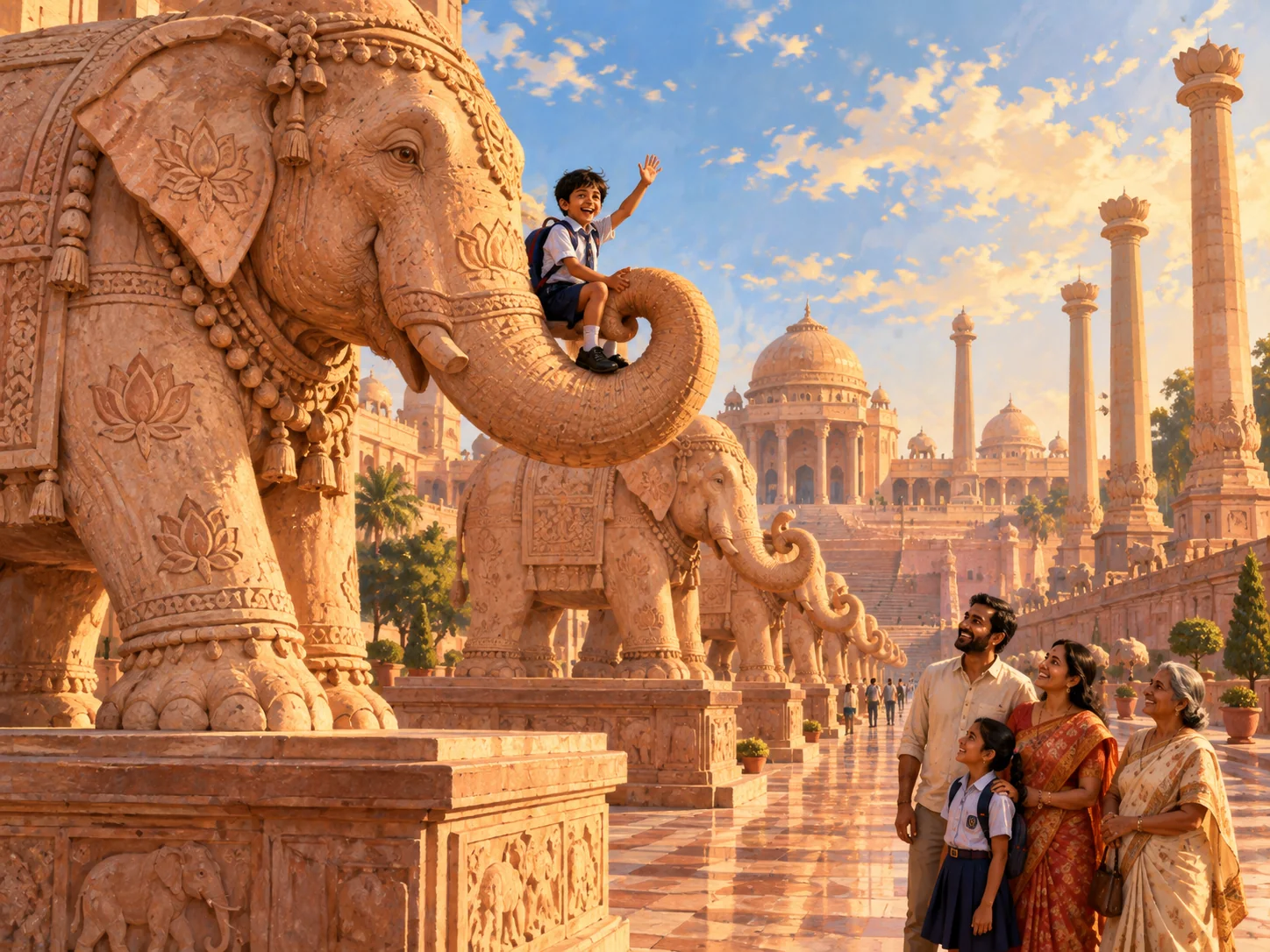
What UP made of me
I have lived outside Uttar Pradesh for longer now than I lived in it: in the Netherlands, in the laboratories and cleanrooms of three countries, and now in Geneva, where I design very small chips that listen to very faint signals from the brain. Nobody here has heard of Jahurabad. Almost nobody has heard of Ghazipur. And yet I notice, more every year, that the man at the bench and the man at the end of the bar was assembled, piece by piece, on the plain between the Gomti and the Ganga. There are three pieces, and they do not always get along.
The swagger
The first is the east’s: dabangai.
I did not know I had it until I left. Where I come from, if you are brushed aside, you do not leave; you stand there until the person brushing you aside gets tired. That is dabangai at its best: a refusal to be made small, inherited from people who had been made small by landlords, colonisers and floods for a very long time and decided, collectively, that they were done with it. It is why I have always found it easy to walk into rooms full of people cleverer than me, and why I will stand up for a student who is being treated unfairly before I have finished working out whether it is wise.
It has a shadow, and I know its shape. It is the voice that says hum kaun hain, jaante ho? It is the temper that rises before the argument has been understood, the need to be known and deferred to, the instinct that a slight must be answered rather than absorbed. The east turns that instinct into feuds and funerals. I have watched it do so. A good part of growing up, for me, has been learning to keep the courage and leave the swagger on the platform at Rasra.
The courtesy
The second is Lucknow’s: nazakat, adab, tehzeeb.
Lucknow taught me that the manner of saying a thing is part of the thing. I still address people older than me, in any language, with a formality that my Swiss colleagues find either charming or faintly ridiculous; I still find it physically difficult to walk through a door before someone else; I still believe, against a good deal of evidence from the internet, that you can disagree with someone completely and leave them feeling honoured. Most of what I know about writing an argument I learned not from any style guide but from listening to old men in Aliganj insult each other so politely that both left smiling. Every essay on this site, I have realised while writing this one, is an attempt to say something sharp in a tone that Lucknow would approve of.
Lucknow also taught me, by accident, to distrust its own nostalgia. The pehle aap culture I love was built by people who could afford to be gracious because someone else was doing the work. I try to keep both halves of that in view. The courtesy is worth keeping. So is the question of who is serving the tea.
The river
The third is Kashi’s, and it is the hardest to name.
I do not mean religion, exactly. Readers of this site know I have spent years arguing with God, through Dostoevsky, through a prisoner’s essay and a politician’s book, and I have no intention of stopping. I mean something Varanasi taught me without anyone intending it: that the largest questions — what a life is for, what death is, whether any of it means anything — are not embarrassing, and are not private, and should be asked out loud, by the river, in company, in the middle of ordinary life. That a city can hold the burning of the dead and the selling of tea on the same stone steps without finding either strange. That Kabir could mock every religion in the city and still be its most beloved saint. That a man the caste order had shut out could correct Shankaracharya, and Shankaracharya could bow.
My work is, in the end, about listening to signals: electrical whispers from neurons, far fainter than the noise around them, that only mean something if you are patient enough to find the pattern. I sometimes think Kashi prepared me for it. The city is nothing but noise — bells, horns, chanting, cows, arguments, loudspeakers — and underneath it, if you sit on the ghats long enough, there is a very quiet signal. I have never been sure what it is. I have never stopped listening for it.
Back in the pause
So, back to the dinner in Geneva, and the pause after I say where I am from.
I used to fill it quickly, with the train time to Delhi, or a joke, or an apology. I do not any more. I let it sit, because I have come to think that the pause is the most honest description of Uttar Pradesh available. It is the sound of a whole country hesitating: between pride and embarrassment, between the Ganga-Jamuni and the canal at Hashimpura, between Kabir and the bulldozer, between the Begum who would not take a British pension and the young woman in Hathras whose family was kept away while the police cremated her in the night, between the eight men at the Mohammadabad tehsil and the gunmen who killed Krishnanand Rai on a road a few kilometres away. UP contains all of that at once, and it does not resolve. It is not supposed to. It is too big to resolve.
The night train still runs, though the expressway has taken most of its passengers. I took it again, the last time I was home, for no reason except that I wanted to hear the language change after midnight. It did, on schedule. The man in the next berth asked where I lived now, and when I said Switzerland he nodded as if that were a village near Rasra, and told me about his nephew in Dubai, and his cousin in Surat, and a great-uncle who, the family says, went to Fiji and was never heard from again. Then he asked what I did, and I tried to explain chips that listen to the brain, and he listened with great courtesy, and at the end he said that it sounded like a good government job. In UP, that is the highest praise available, and I took it.
At dawn the Ganga appeared beside the tracks. Somebody at the window touched their forehead, as somebody always does, and a boy came down the corridor with a kettle, shouting the price of tea. The river was wide and brown and slow and utterly indifferent to all of us, the way it has been to every empire that ever tried to own it. I thought of Kabir, the weaver who stood in the marketplace of the holiest city in India and refused to take anyone’s side but everyone’s:
कबिरा खड़ा बाज़ार में, माँगे सबकी खैर । ना काहू से दोस्ती, ना काहू से बैर ॥
kabirā khaṛā bāzār meṃ, māṃge sabkī khair | nā kāhū se dostī, nā kāhū se bair ||
Kabir stands in the marketplace, wishing everyone well: a friend to none in particular, an enemy to none at all.
That is not a bad thing to inherit from a state. It is certainly more than the pause lets on. The elephant is still standing in the room. I am rather proud that it is mine.
Sources
- StatisticsTimes: Uttar Pradesh population projection, 2026 (Technical Group on Population Projections)
- Data Commons: Uttar Pradesh population, 2026
- Census 2011: Uttar Pradesh summary (population, sex ratio, literacy)
- Uttar Pradesh (Wikipedia)
- Economy of Uttar Pradesh (Wikipedia)
- StatisticsTimes: Uttar Pradesh economy and per capita income, 2024–25
- Business Standard: UP and Bihar’s per capita income still trails the national average (2026)
- Zahurabad, Ghazipur (Wikipedia, drawing on the district gazetteer)
- Zahoorabad Assembly constituency (Wikipedia)
- Shivpujan Rai and the eight martyrs of Sherpur (Wikipedia)
- PARI: Sherpur — big sacrifice, short memory
- Pavhari Baba (Wikipedia)
- Rahi Masoom Raza (Wikipedia)
- The Wire: Rahi Masoom Raza, the scholar who strayed into Bollywood
- Nazir Hussain (Wikipedia)
- Mukhtar Ansari (Wikipedia)
- ThePrint: Ghazipur’s Robin Hood to dreaded don — the many faces of Mukhtar Ansari
- Tribune: Jailed gangster Mukhtar Ansari dies of cardiac arrest (2024)
- Afzal Ansari (Wikipedia)
- ThePrint/PTI: UP police killed 48 in encounters in 2025, highest since 2017
- India TV: UP encounter figures, March 2017 to December 2025
- Tribune: NHRC notices to UP over encounters, 2017–18
- Milan Vaishnav, When Crime Pays: Money and Muscle in Indian Politics (Yale, 2017)
- Association for Democratic Reforms: analysis of winners, UP assembly election 2022
- Supreme Court on “bulldozer justice”, November 2024 (LiveLaw)
- Delhi High Court convicts 16 former PAC men for Hashimpura (2018)
- M. Siddiq v. Mahant Suresh Das (the Ayodhya judgment, 2019)
- NCRB 2023 figures on crimes against women, UP (Organiser summary)
- Tribune: NCRB 2022, UP highest absolute cases
- Deccan Herald: women’s turnout exceeds men’s in phase 6, 2024 (UP 57.12% vs 51.31%)
- NFHS-5 state fact sheet: Uttar Pradesh
- NITI Aayog: National Multidimensional Poverty Index 2023
- States Reorganisation Commission report, 1955 (with K. M. Panikkar’s note)
- Allahabad pillar (Wikipedia)
- Lion Capital of Ashoka (Wikipedia)
- Hindi–Urdu controversy (Wikipedia)
- Indian indenture system (Wikipedia)
- Female Infanticide Prevention Act, 1870 (Wikipedia)
- Uda Devi (Wikipedia)
- Begum Hazrat Mahal (Wikipedia)
- Mark Twain, Following the Equator (1897), on Benares (Project Gutenberg)
- Amitav Ghosh, Sea of Poppies (2008)
- Shahid Amin, “Gandhi as Mahatma: Gorakhpur District, Eastern UP, 1921–2”, Subaltern Studies III (1984)
- Awadh Kisan Sabha and Baba Ramchandra (Wikipedia)
- Jamia Millia Islamia: history (Wikipedia)
- Mahatma Gandhi Kashi Vidyapith (Wikipedia)
- Progressive Writers’ Movement (Wikipedia)
- Allahabad Address, 1930 (Wikipedia)
- 2020–2021 Indian farmers’ protest (Wikipedia)
- Bundelkhand (Wikipedia)
- Ken–Betwa link project (Wikipedia)
- Chikan embroidery (Wikipedia)>)
- Banarasi sari (Wikipedia)
- Bhadohi carpets (Wikipedia)
- Economy of Kanpur and the Lal Imli mills (Wikipedia)
- Chhath (Wikipedia)
- UNESCO: Ramlila, the traditional performance of the Ramayana
- UNESCO: Kumbh Mela
- Nautanki and Gulab Bai (Wikipedia)
- Ramnagar, Varanasi (Wikipedia)
- Nadiya Ke Paar and Kohbar Ki Shart (Wikipedia)>)
- The Caravan: the tragic novel that spawned a bubblegum Bollywood hit
- Screen: Gangs of Wasseypur shot around Varanasi
- 3DVF: Brad Pitt in Varanasi for Benjamin Button
- Victoria & Abdul and Abdul Karim (Wikipedia)>)
- Writing with Fire (Wikipedia)
- Period. End of Sentence. (Wikipedia)
- Namami Gange (Wikipedia)
- Veer Bhadra Mishra (Wikipedia)
- Arsenic contamination of groundwater in India (Wikipedia)
- Sarnath (Wikipedia)
- Mulagandha Kuti Vihara (Wikipedia)
- Central University of Tibetan Studies, Sarnath (Wikipedia)
- 14th Dalai Lama: exile in India, Mussoorie 1959–60 (Wikipedia)
- ThePrint: how the UP Special Task Force was born, and the hunt for Shri Prakash Shukla
- 2007 Uttar Pradesh Legislative Assembly election (Wikipedia)
- Raghuraj Pratap Singh, “Raja Bhaiya” (Wikipedia)
- Umakant Yadav (Wikipedia)
- Dadua (Wikipedia)
- Shekhar Tiwari (Wikipedia)
- Quami Ekta Dal and the 2016 merger row (Wikipedia)
- Business Standard: Akhilesh Yadav launches the 1090 women’s helpline
- The Wire: Supreme Court asks CBI to investigate further in the Zia-ul-Haq case
- 2016 Mathura clash (Wikipedia)
- ThePrint: Prashant Kumar made acting DGP over 13 senior officers (2024)
- Deccan Herald: UP government says heinous crimes fell 85 per cent in eight years
- ThePrint: gun violence and gang-rivalry murders rise in UP while violent crime falls (NCRB)