Today is the fifteenth of August, India’s Independence Day, and I am spending it in Geneva, a city that became Swiss by choice in 1815 and still votes on something every few months. Two weeks ago Switzerland celebrated its own national day. This summer was so hot and dry that the fireworks were called off for fear of fires, and Lake Geneva got light shows instead. I spent the day on the Fronalpstock, above Stoos in the canton of Schwyz, walking the ridge and listening to alphorns. From the summit you look down on Lake Lucerne and across the water to the Rütli, the meadow where, by tradition, men from three valleys swore the oath that the first of August commemorates. Schwyz gave the country its name. It is a good place to think about what it means for people to decide things together.
In November the United States, where I also lived for a while, will hold its midterm elections on a Tuesday chosen in 1845 for the convenience of farmers.
I have lived under three very different answers to the same question: how do you turn what millions of people want into a law? India answers it by asking almost a billion adults to choose a representative, once every five years, in a single enormous event. The United States answers it through a layered machine of states, districts and electors, designed by men who distrusted the very majority they were empowering. Switzerland answers it by asking its citizens directly, several times a year, about specific laws, and treating parliament as one voice among several.
I want to look at the three side by side: where each system came from, what it assumes about the people it serves, why it works where it works and fails where it fails, and what it has done to women, who in each of the three were the largest group to be left out and, in different ways, still are. I am not going to propose fixes. Every country that has tried to import another’s electoral system has discovered that the system was the least transferable part of the arrangement. What I want to understand is why each one fits its country, and where the fit pinches.
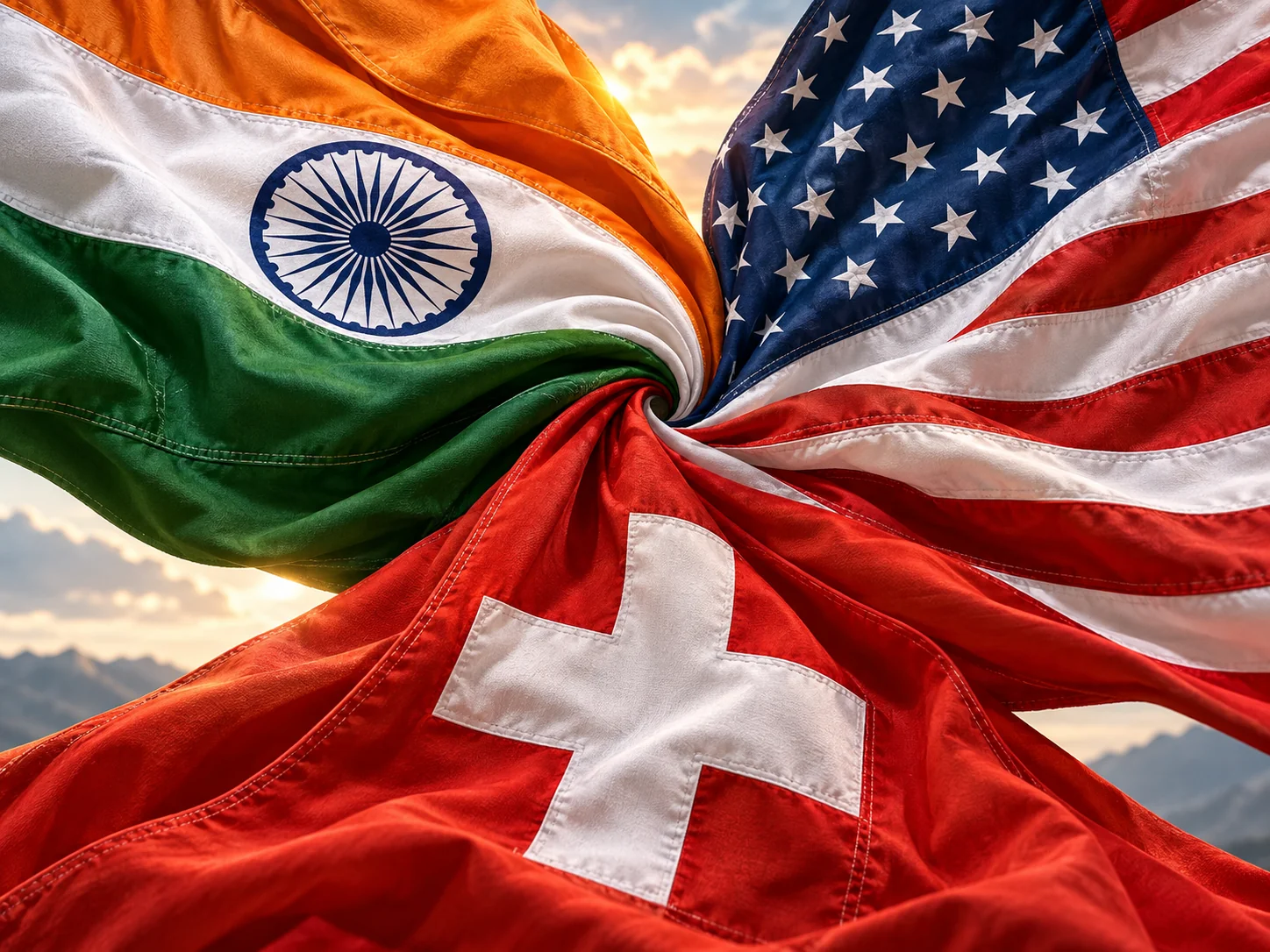
What I am comparing
A brief map, and then I will try not to get lost in it.
India elects the Lok Sabha, the lower house of Parliament, in 543 single-member constituencies. Whoever gets the most votes in a constituency wins it, even without a majority: the system known as first past the post. The party or coalition that controls the Lok Sabha forms the government. The upper house, the Rajya Sabha, is elected indirectly by the state legislatures. An independent Election Commission runs the whole thing, nationally.
The United States elects a House of Representatives of 435 members, also by first past the post in single-member districts, and a Senate of 100, two per state regardless of population. The president is chosen separately, through an Electoral College in which each state’s weight is its number of representatives plus its two senators. There is no national election authority. Elections are run by the states, and in practice by thousands of counties and towns.
Switzerland elects a National Council of 200 members by proportional representation, canton by canton, and a Council of States of 46, two for most cantons. Parliament then elects a seven-member Federal Council that governs collectively; there is no prime minister and no president in any strong sense. But the defining feature is that the people are a legislature too. Any law parliament passes can be challenged by 50,000 signatures and sent to a national vote. Any 100,000 citizens can propose a change to the constitution and force a vote on it. Every constitutional amendment must be approved by a majority of voters and a majority of cantons.
That is the machinery. The interesting part is why it looks like this.
India: everyone at once
The most radical decision in the history of Indian democracy was made before the first vote was cast. The Constitution that came into force on 26 January 1950 gave the vote to every adult, man or woman, rich or poor, literate or not, on the same day. There was no ladder: no property qualification to be lowered decade by decade, no literacy test, no staged extension of the franchise. The country went, in a single step, from a colonial electorate of a propertied minority to universal adult suffrage.
It is hard to overstate how reckless this looked at the time. The census of 1951 found that about 18 per cent of Indians could read. For women the figure was under 9 per cent. The first general election, held over four months from October 1951 to early 1952, asked about 173 million people, most of them poor and most of them unable to read a ballot, to choose a government. Turnout was about 45 per cent.
The man who made it work was Sukumar Sen, a civil servant appointed as the first Chief Election Commissioner in 1950. Because most voters could not read names, each party was given a picture: a pair of bullocks, a hut, a lamp. At first each candidate had a separate ballot box marked with their symbol, so that a voter could put the paper in the box with the right picture. More than 224,000 polling booths were set up. It was, at the time, the largest election ever held, and it was held in a country that had been partitioned in bloodshed four years earlier.
The choice of first past the post was less radical. It was the system the British had used and the one India’s political class knew. What India added to it was a set of guarantees for the people most likely to be shut out: constituencies reserved for Scheduled Castes and Scheduled Tribes, in which only candidates from those communities may stand, although everyone in the constituency votes. Today 84 Lok Sabha seats are reserved for Scheduled Castes and 47 for Scheduled Tribes.
The man who understood best what all this could and could not do was B. R. Ambedkar, who chaired the committee that drafted the Constitution. In his last speech to the Constituent Assembly, on 25 November 1949, he warned:
On the 26th of January 1950, we are going to enter into a life of contradictions. In politics we will have equality and in social and economic life we will have inequality. In politics we will be recognizing the principle of one man one vote and one vote one value. In our social and economic life, we shall, by reason of our social and economic structure, continue to deny the principle of one man one value.
That paragraph is the key to Indian democracy. The founders did not give the poor the vote because the country was ready for it. They gave it because they believed the vote was the one lever the poor could pull against a society that was not ready at all.
The United States: a machine built to check the majority
The American system was designed by people with the opposite anxiety. India’s founders feared that ordinary people would be excluded. America’s founders, in Philadelphia in 1787, feared what ordinary people might do if they were not.
Almost every oddity of the American system is a compromise between competing fears. The small states feared domination by the large ones, so they got a Senate in which every state has two seats regardless of size. Some delegates feared a president chosen directly by an excitable national majority; others feared one chosen by Congress and beholden to it. The Electoral College was the compromise: each state would choose electors, in whatever way it liked, and the electors would choose the president. The slave-holding states wanted their enslaved populations counted for representation without granting those people any rights, and the Constitution’s three-fifths clause counted each enslaved person as three-fifths of a person when apportioning seats in the House, and therefore votes in the Electoral College.
The result was not a democracy in the modern sense. Senators were chosen by state legislatures until the Seventeenth Amendment introduced direct election in 1913. The right to vote was left to the states, which restricted it by property, race and sex. The story of the American franchise is a story of amendments prying it open one group at a time: the Fifteenth Amendment in 1870, forbidding denial of the vote by race, which the Southern states then nullified in practice for nearly a century; the Nineteenth in 1920, for women; the Twenty-fourth in 1964, abolishing poll taxes in federal elections; the Voting Rights Act of 1965, which finally put federal force behind the Fifteenth; the Twenty-sixth in 1971, lowering the voting age to eighteen.
That history explains why the American system has no single owner. There are more than 10,000 election jurisdictions in the United States, some with a few hundred voters and the largest with more than five million. The rules on who may register, how, when and where to vote, and how votes are counted differ from state to state and often from county to county. Congressional districts are redrawn every ten years, mostly by state legislatures, which means that in many states the politicians draw the lines of their own contests. In 2019, in Rucho v. Common Cause, the Supreme Court held that partisan gerrymandering, however “incompatible with democratic principles”, was a political question outside the reach of federal courts. Six years earlier, in Shelby County v. Holder, it had struck down the formula that decided which jurisdictions, mostly in the South, had to get federal approval before changing their voting rules.
The size of the House has been frozen at 435 since the Permanent Apportionment Act of 1929, although the population has nearly tripled since. The Senate’s structure means that California, with nearly forty million people, has the same two senators as Wyoming, with fewer than six hundred thousand. And five times, in 1824, 1876, 1888, 2000 and 2016, the person who became president did not win the most votes.
Switzerland: the people as a chamber of parliament
Switzerland’s system was built out of a different fear again: the fear of being ruled from above at all.
The modern federal state dates from 1848, after a short civil war in 1847 between Catholic and Protestant cantons. The new constitution created a federal government but kept most power in the cantons, and the cantons themselves had long traditions of self-government, some of them including the Landsgemeinde, the open-air assembly at which the citizens of a canton gather in the town square once a year and decide its laws by a show of hands. Two cantons, Glarus and Appenzell Innerrhoden, still govern themselves that way.
Direct democracy at the federal level came in stages. In 1874 a revised constitution introduced the optional referendum: if enough citizens object to a law parliament has passed, it goes to a popular vote. Today that takes 50,000 signatures collected within 100 days. In 1891 came the popular initiative, which lets citizens propose an amendment to the constitution: 100,000 signatures in 18 months, and the country must vote on it. Proportional representation for the National Council followed in 1919, after a popular initiative forced it through.
The Swiss government counts roughly 240 popular initiatives that have gone to the vote since 1891. About two dozen have passed. That low success rate is misleading, because the initiative’s real power lies elsewhere: parliament, knowing a vote is coming, often drafts a counter-proposal that takes some of the initiative’s demands and passes that instead. The optional referendum works the same way in reverse. Because almost any law can be challenged, the parties that write laws have an incentive to include anyone who could collect 50,000 signatures against them.
This is the origin of the most distinctive feature of Swiss government: concordance. From 1959 to 2003, the seven seats on the Federal Council were shared among the four largest parties by a fixed arrangement known as the magic formula: two, two, two and one. There is no government and opposition in the British or Indian sense. Everyone large enough to cause trouble through a referendum is brought inside. The result is a government that almost never changes and a people that constantly overrules it.
Today about 5.6 million Swiss citizens can vote. They are called to the polls about four times a year, and more than nine in ten of them now vote by post, from the kitchen table, weeks before the official day.
Scale, and what it permits
The most obvious difference between the three systems is size, and I think it explains more than any other single factor.
In 2024 India had about 978 million registered voters. The election was held in seven phases between April and June. There were about 10.5 lakh, or 1.05 million, polling stations, staffed by roughly 15 million officials, with more than 5.5 million electronic voting machines. About 65.8 per cent of voters turned out, well over 600 million people. Machines have been used in every constituency since 2004, partly because counting paper ballots on this scale took days and invited fraud.
The United States had around 245 million eligible voters in 2024, and about 64 per cent of them voted, the second-highest turnout in more than a century, after 2020.
Switzerland’s entire electorate is smaller than the number of voters in several Indian states.
Scale determines what is possible. In the past few years Switzerland has asked its citizens about the purchase of fighter jets, the rules on hunting wolves, a thirteenth monthly pension payment and the widening of motorways, and it can do so because the whole country is smaller than the city of Delhi and its voters are among the most educated and best informed in the world. Every household receives an official booklet setting out the arguments for and against each proposal. The machinery is cheap enough, and the voters are close enough to the issues, that asking them directly is feasible.
India cannot do this, and not only for logistical reasons. The Indian election is a single enormous act of consent, repeated every five years, in which the people choose who will govern them and then, for the most part, let them. It is closer to hiring a government than to co-writing its laws. That is not a defect. It is the only form of democracy that could possibly operate at the scale of a billion people in a country with the literacy India had in 1951. The genius of the Indian system has always been logistics, not deliberation: the ability to put a voting machine within a couple of kilometres of almost every voter in the country and get the results counted in a day.
The United States sits in between, and the American system is the one most clearly strained by its size. Its structure was designed for thirteen states and about four million people. It now serves 50 states and over 330 million. Features that were modest compromises at the founding, like the equal representation of states in the Senate or a House whose size was fixed a century ago, have grown into large distortions simply because the country grew around them.
The genius of the Indian system has always been logistics, not deliberation.
Why they work
It is fashionable to talk about all three democracies as being in crisis. I want to start with the ways in which each of them works, because each one does something the other two cannot.
India’s works because it includes. The most remarkable fact about Indian elections is who votes. In most Western democracies, the rich vote more than the poor and the educated more than the uneducated. In India it has often been the other way round. The political scientist Yogendra Yadav described a “second democratic upsurge” from the late 1980s onward, in which lower castes, poorer and rural voters entered politics in large numbers and began to turn out at rates matching or exceeding those of urban, upper-caste voters. For a great many Indians the vote is the one moment when the state treats them as equal to everyone else, and they use it.
It also works because it can throw governments out. Since 1977, when the voters removed Indira Gandhi’s government after the Emergency, Indian elections have repeatedly defeated incumbents at the national and state levels, and the losers have left office. That is not a small thing in the region India sits in.
America’s works because it is hard to capture. The fragmentation that makes American elections so confusing also makes them resilient. No single official, no single agency and no single party controls how Americans vote. After the 2020 election, when the outgoing president tried to overturn the result, the effort ran into thousands of local officials of both parties, state courts and state legislatures that refused to go along. A centralised system would have had one point of failure. The American system has ten thousand, which also means it has ten thousand points of resistance.
Switzerland’s works because it forces agreement. A government that knows any law can be put to a national vote cannot afford to legislate for its own supporters alone. Concordance, the permanent sharing of power among all the major parties, is not a cultural quirk of the Swiss. It is a rational response to the referendum. The result is policy that changes slowly and rarely swings, and a government that very few citizens see as illegitimate, because they can always overrule it.
Why they fail
Each system’s failures are the side effects of its strengths.
India’s inclusion comes with distortion. First past the post rewards the largest party far beyond its share of the vote. In 2014 the BJP won about 31 per cent of the national vote and 282 seats, an outright majority of the Lok Sabha. In 2019 it won about 37 per cent and 303 seats. In 2024 it won a similar share, about 36.6 per cent, and only 240 seats, because the opposition consolidated. The same vote share produced very different outcomes depending on how opponents arranged themselves. That is not unique to India, but in a country this diverse it means that a party can govern alone with the support of little more than a third of voters.
The system has also become extraordinarily expensive to enter. The Association for Democratic Reforms found that 93 per cent of the MPs elected in 2024 were crorepatis, declaring assets of more than ten million rupees, in a country where most people earn a small fraction of that. It also found that 251 of the 543 winners, 46 per cent, had declared criminal cases against themselves, up from 30 per cent in 2009. The poorest voters turn out in the largest numbers to choose among candidates who are overwhelmingly rich, and often under investigation.
America’s resilience comes with paralysis and minority rule. The same structure that makes the system hard to capture makes it hard to govern through. A party can win the presidency without the most votes, control the Senate on behalf of a minority of the population, and draw House districts that entrench its position. First past the post in single-member districts also produces a two-party system, as political scientists have long observed it tends to, and in a country as large and varied as the United States, two parties must each contain coalitions so broad that they barely cohere. The fragmentation of election administration means that the experience of voting, how long the queue is, which identification you need, how early you can vote, depends heavily on where you live.
Switzerland’s consensus comes with exclusion and slow motion. The first problem is who takes part. Average turnout in federal votes over the past few years has been just under 50 per cent, which means that a typical national decision is made by about a quarter of the citizens. And the citizens are not the whole population: about 27 per cent of the nine million people living in Switzerland do not hold a Swiss passport and cannot vote at the federal level at all, although some cantons and communes, including Geneva’s communes after eight years of residence, let them vote locally. A country that prides itself on asking the people asks only some of them.
The second problem is what a majority can do to a minority. In 2009, 57.5 per cent of voters approved a constitutional ban on building new minarets, in a country where Muslims had no say in the matter and very few minarets existed. In 2014 an initiative “against mass immigration” passed by 50.3 per cent, a margin of about 19,500 votes, and put the country’s agreement on free movement with the European Union in question. Direct democracy is excellent at expressing what the median voter wants. It has no built-in protection for those the median voter does not like.
The third problem is speed, and it is the one that matters most for the rest of this essay. When every major change needs a popular majority, change arrives only when the majority is ready for it. Sometimes that is a virtue. Sometimes it means that the rights of half the population wait for the other half to approve them.
Trusting the count
A vote is only as good as the belief that it was counted. Each of the three countries has had to earn that belief in its own way, and each has a different weak point.
India counts faster than anyone. On 4 June 2024, the votes of more than 600 million people were counted in a single day, and by evening the country knew the result. That is possible only because the ballots are electronic. The machines have been challenged repeatedly, and every major party has at some point, usually after losing, suggested that they could be tampered with. Since 2019 every machine has been paired with a printer, the VVPAT, first tried in 2013, that shows the voter a paper slip of their choice, so that a sample of paper records can be checked against the electronic count. In April 2024 the Supreme Court rejected a petition to go back to paper ballots or to count every paper slip, and warned against “baseless apprehensions” about the Election Commission. India’s trust in the count rests on the Commission itself, an institution that has been accused of many things but, for most of its history, has been widely believed to count honestly.
Switzerland’s trust rests on paper and on habit. Almost everyone votes by post, and the counting is done by local officials, often volunteers, in each commune. Results arrive on the Sunday afternoon of the vote. When Switzerland tried to move to online voting, it tested the system in public: in 2019 it invited hackers from around the world to attack the Swiss Post e-voting system, and researchers found serious flaws in the source code. The government stopped the trials. They restarted in 2023 in three cantons, for a small number of voters, mostly Swiss living abroad. A country that votes four times a year decided it would rather be slow and certain than fast and doubtful.
The United States has the hardest version of the problem, because it has no single counter. Each state counts in its own way and at its own speed, and several do not begin processing postal ballots until election day. In 2020 it took four days before the major news organisations could call the presidential result. The losing candidate then claimed the election had been stolen, and his campaign and its allies filed dozens of lawsuits, which failed almost without exception, many of them in front of judges he had appointed. The count held. But trust in it, among a large part of the country, did not recover, and the American system has no single institution with the standing to settle the question the way the Indian Election Commission or the Swiss communes do.
What strikes me is that trust in the count does not track the technology. India trusts machines, Switzerland trusts paper and post, and the United States uses both, yet it is the United States where doubt has done the most damage. The count is a technical problem. Trust in it is a political one.
What it costs, and who pays
Elections cost money, and the question of whose money shapes a system as much as any rule about ballots.
The two largest are also the two most expensive in the world. The Centre for Media Studies estimated that the 2024 Indian general election cost about 1.35 lakh crore rupees in total, parties, candidates and the state together, more than double its estimate for 2019. OpenSecrets estimated that the 2024 federal election cycle in the United States cost about 15.9 billion dollars, also a record. In both countries most of that money is spent by parties and candidates, and in both the question of where it comes from is only partly answered. India’s electoral bond scheme, which allowed anonymous donations to parties through banks, was struck down by the Supreme Court in February 2024. In the United States, since the Supreme Court’s Citizens United decision of 2010, outside groups can spend without limit on political advertising.
The consequence for the voter is visible in who stands. When 93 per cent of Indian MPs are crorepatis, the first filter on who represents a billion people is not the voter but the cost of entry.
Switzerland had, until very recently, almost no rules at all. For most of its history there was no requirement to disclose who funded parties or referendum campaigns, which is striking in a country where campaigns on specific laws are constant and where a well-funded campaign can shape the outcome of a vote. Federal transparency rules came into force only on 23 October 2022: campaigns spending more than 50,000 francs must disclose their finances, and donors giving more than 15,000 francs must be named. In direct democracy, where citizens decide laws themselves, the question of who pays for persuading them matters even more than in a representative system. It is one of the odder facts about the most democratic country in Europe that it took until 2022 to ask it.
What makes a system fit
Why did these three countries end up with these three systems, and why do the systems more or less hold? I think five factors matter more than any design choice.
Development. India chose a system that asked the least of each voter, one choice every five years, marked with a symbol, because in 1951 it could not ask for more. Switzerland chose a system that asks a great deal of each voter, dozens of decisions a year on detailed questions, and it can do so because its citizens are wealthy, highly educated and have the time to read the booklet. The American system asks something in between, but it asks it unevenly, which is why turnout there still tracks income and education in a way it does not in India.
Culture. Each system encodes a founding memory. India’s encodes the memory of exclusion: a colonial state in which Indians had no say, and a social order in which most Indians had no standing, so the founders put everyone in at once. America’s encodes the memory of a distant king and the fear of any power, including a popular majority, that could act without restraint, so the founders divided power until it could barely move. Switzerland’s encodes the memory of village and valley self-government and the suspicion of anyone who claims to decide on the citizens’ behalf, so the Swiss kept the right to decide for themselves.
Social divides. Every one of these countries is divided, and each system is shaped around its divisions. India’s deepest divides are caste, religion and language, and its answer was reserved constituencies and a federal structure built partly along linguistic lines. America’s deepest divide was race, and for most of its history its electoral system was built to preserve that division rather than bridge it; much of the twentieth-century history of American voting is the story of dismantling what the nineteenth century built. Switzerland’s divides are language and religion: German, French, Italian and Romansh; Catholic and Protestant. Its answer was proportional representation and concordance, so that no language group and no confession could simply be outvoted in government. The famous “Röstigraben”, the divide between German- and French-speaking Switzerland, still shows up in referendum results, most memorably in 1992, when the country rejected joining the European Economic Area by 50.3 per cent, with the French-speaking cantons voting largely in favour and the German-speaking ones against.
Climate and geography. This sounds trivial and is not. The American election date was set by the agricultural calendar. The Indian election is shaped by heat and monsoon: it is usually held in spring, before the rains, across weeks rather than days, because security forces and officials have to move across a subcontinent. In 2024, the final phase was held on 1 June, in a heatwave, and dozens of polling staff died of heatstroke; in Uttar Pradesh alone the state’s chief electoral officer reported 33 deaths on the last day of voting. Switzerland’s direct democracy grew in small Alpine communities where people could physically gather in one place, and the Landsgemeinden that survive are held outdoors in spring. Geography made Swiss democracy intimate and Indian democracy heroic.
International position. Each system also reflects where the country stands in the world. India’s democracy was, from the start, a claim made to the world: that a poor, newly independent, enormously diverse country could govern itself by consent. That claim has been one of India’s main sources of standing ever since. The United States, as a superpower, has discovered that its elections are of interest to everyone, including hostile governments, and the question of foreign interference has become part of its domestic politics. Switzerland’s neutrality and its refusal to join the European Union are expressed and defended through the referendum: its relationship with Europe has been set, again and again, by popular votes, which gives the Swiss people a direct say over foreign policy that citizens of almost no other country have.
Who else is left out
Women are the largest group each of these systems once excluded, and I will come to them. But every system draws a line somewhere, and where it draws the line tells you what it believes a voter is.
Prisoners. India bars everyone in prison from voting, convicted or not. Section 62(5) of the Representation of the People Act applies equally to someone serving a sentence and to someone who has been arrested and is waiting, sometimes for years, for a trial; more than four lakh undertrial prisoners could not vote in 2024. Yet a person facing criminal charges can stand for Parliament, and nearly half of the current Lok Sabha does. In India, it is easier to be a candidate with a criminal case against you than a voter behind bars.
The United States leaves the question to the states, and 48 of them take the vote away from people with felony convictions in some form, some only while they are in prison, some for much longer. The Sentencing Project estimated that about four million Americans could not vote in 2024 because of a felony conviction. Only Maine and Vermont, along with the District of Columbia, let people vote from prison.
Switzerland does neither. Being in prison does not affect a Swiss citizen’s right to vote.
Emigrants. This is the line that touches me personally. An Indian citizen living abroad can register to vote, but can vote only in person, at the polling station in their home constituency, with their passport. There is no postal vote for overseas Indians. An Indian living in Geneva who wants to vote in a general election has to be in India on the day.
The Swiss abroad vote by post, and a few cantons now let some of them vote online. Of about 800,000 Swiss citizens living abroad, a little over 220,000 are registered. Americans abroad have been able to vote absentee by federal law since 1986.
Residents who are not citizens. Switzerland’s case I have described: about a quarter of the people who live here have no federal vote. India and the United States draw the same line, citizenship, but because far fewer of their residents are foreigners, it excludes proportionally far fewer people.
Put together, these lines say something about each system’s idea of a voter. India’s is a person who is physically present: in the constituency, at the booth, out of prison, with a mark on their finger. Switzerland’s is a member of a community of citizens, wherever they are and whatever they have done, but only a member. America’s is whatever each state decides it should be. Each definition leaves out a different group of people, and none of them leaves out nobody.
The women
Every one of these systems was designed by men, and in each of them women were the largest group of people to whom the promise of the vote did not, at first, apply. What happened next differs sharply, and the differences say a great deal about the systems themselves.
India: the vote first, the power much later
Indian women did not have to fight for the vote in the way that American and Swiss women did. Some had it in limited form under British rule: in 1921 the Madras Presidency became the first province to let women vote, on the same property and education qualifications as men, which in practice meant very few of them. The Constitution then gave every adult woman the vote at the same moment as every adult man. In 1951, most of the women who were enfranchised could not read.
That early gift has not translated into power, and it has taken decades even to translate into participation. In 1962 women’s turnout was about 47 per cent, far below men’s. By 2014 it had risen to about 66 per cent. In 2019, for the first time in a general election, women voted at a slightly higher rate than men, and in 2024 they did so again: 65.78 per cent against 65.55 per cent.
And yet the rolls have been missing women. Prannoy Roy and Dorab Sopariwala estimated in their book The Verdict that about 21 million eligible Indian women were not registered to vote in 2019, roughly the entire electorate of a state like Jharkhand. Women who marry and move to their husband’s village, as many rural Indian women do, often fall off one roll without being added to another.
In Parliament, the change has barely happened. The 2024 Lok Sabha has 74 women, 13.6 per cent of its members, fewer than the 78 elected in 2019. Fewer than one in ten candidates was a woman. Parties, which choose candidates, have simply not chosen them.
India has tried to force the issue through quotas. The 73rd and 74th Amendments of the early 1990s reserved one-third of seats in village councils and municipal bodies for women, and millions of women have since been elected to local office. But the reform brought with it a phenomenon so common that it has its own name: the sarpanch pati, the “sarpanch’s husband”, who runs the village council while his wife holds the title. In 2023 Parliament passed the Nari Shakti Vandan Adhiniyam, reserving a third of the seats in the Lok Sabha and state assemblies for women. It will take effect only after the next census and a redrawing of constituencies, which means the women it promises are, at the earliest, a general election away.
India gave women the vote before it gave them literacy, and the vote before it gave them power. The system includes them as voters as fully as it includes anyone. It has barely begun to include them as representatives.
The United States: a century of fighting, a ceiling still in place
American women fought for the vote for more than seventy years. The first women’s rights convention met at Seneca Falls in 1848. The territory of Wyoming gave women the vote in 1869, partly as a way to attract settlers and publicity. Montana elected Jeannette Rankin to Congress in 1916, four years before most American women could vote for her. The Nineteenth Amendment was ratified in 1920.
But the Nineteenth Amendment did not reach everyone it described. In the Southern states, Black women were kept from voting by the same poll taxes, literacy tests and violence that kept Black men from voting, and they were not effectively enfranchised until the Voting Rights Act of 1965. For many American women the date that matters is not 1920 but 1965.
Since then, women have become the more reliable voters. In every presidential election since 1980, a higher proportion of eligible women than eligible men has voted, and there are now millions more women registered than men.
Representation has lagged far behind. The 119th Congress has 155 women, 26 senators and 129 representatives, a record, and still only about 28 per cent of its voting members. The United States has never had a woman president. In 2016 a woman won the popular vote and lost the Electoral College. The Equal Rights Amendment, which would have written sex equality into the Constitution, passed Congress in 1972 and failed to be ratified by the necessary 38 states before its deadline in 1982.
The American system gave women the vote through the same slow, amendment-by-amendment process through which it gave everyone else the vote, and it has kept them out of its highest office through the same winner-take-all structure that shapes everything else about it.
Switzerland: the men decided
Switzerland is the country I live in, and its record is the one I find hardest to explain to people who know it only as the model democracy.
Swiss women could not vote in federal elections until 1971. On 1 February 1959, the men of Switzerland voted on whether to give women the vote, and 67 per cent of them said no. Some cantons moved first: Vaud and Neuchâtel gave women the vote at cantonal level in 1959, and Geneva, the city I am writing from, on 6 March 1960. At the federal level, it took until 7 February 1971, when 65.7 per cent of the male electorate voted yes.
Even then, the cantons could keep their own rules. Appenzell Ausserrhoden let women vote in cantonal matters only in 1989. Appenzell Innerrhoden refused to do so at all, and its men went on voting in the town square by show of hands. On 27 November 1990 the Federal Supreme Court ruled that the canton was violating the federal constitution, and women voted at its Landsgemeinde for the first time in the spring of 1991.
This is where direct democracy’s structural weakness becomes most visible. In a representative system, a parliament can extend the vote to a group that does not yet have it. In the Swiss system, the question of whether women should vote was put, repeatedly, to the men who already could, and the men could say no. The people as a legislature meant, for a very long time, the men as a legislature. The same institution that makes Swiss democracy so legitimate in the eyes of those inside it made it unusually hard for those outside it to get in.
Swiss women have not forgotten. On 14 June 1991, twenty years after federal suffrage, around half a million women took part in a national strike, the largest public mobilisation in the country since the general strike of 1918. On 14 June 2019 they did it again, with a similar number, demanding equal pay, recognition of unpaid work and more representation.
And here is the paradox that runs through all three countries. In the 2019 federal election, women won 42 per cent of the seats in the National Council. In 2023 that fell to 38.5 per cent. Switzerland, which enfranchised women last, has by far the highest share of women in its lower house of the three. India, which enfranchised them first, has the lowest.
What each system does to women follows its general logic. India’s system includes everyone as a voter and lets parties decide who governs; the parties have decided that governing is mostly a job for men. America’s system includes people slowly, through struggle, and its winner-take-all offices, above all the presidency, remain the hardest to reach. Switzerland’s system, where the people decide directly, excluded women for as long as the voting majority wanted it to, and then, once they were in, proportional representation gave parties an incentive to put women on their lists, and voters an easy way to choose them.
What the three have in common
Put the three side by side and the differences are so large that it is tempting to say they have nothing in common. I think they have one thing, and it is the most important thing about each of them.
Each system is built around a fear, and each system’s failures are the side effects of guarding against that fear.
India feared exclusion, the exclusion of the poor, the illiterate and the low-caste from a state that had always ignored them. So it put everyone in at once and built an enormous, efficient machine to ask them all. The price is a system that asks people very little between elections, rewards whoever can assemble the largest coalition, and has become the preserve of the rich, while the poor turn out in their hundreds of millions to choose among them.
America feared tyranny, of a king, of a central government, and of a majority. So it divided power until no one could easily seize it. The price is a system in which a minority can win, in which the lines of districts are drawn by those who run in them, and in which the right to vote has had to be won group by group against the resistance of the structure itself.
Switzerland feared being governed from above. So it kept the final say for the citizens themselves. The price is a system in which the citizens can refuse to share that say with anyone else: with the quarter of the population who are not citizens, and, for most of the twentieth century, with women.
I said at the start that I would not propose fixes, and I will keep to that. But I have come to think that the most useful question to ask of any electoral system is not whether it is democratic. All three of these are, in their different ways. The useful question is: who is it protecting, and from what? The answer tells you both why the system works and whom it will leave out. On the evidence of the three countries I have lived in, the people each system was designed to protect have usually been well protected. The people it was not designed for have had to fight their way in, and in all three, for a very long time, that meant women.
Sources
- Election Commission of India: General Election 2024 statistics
- 2024 Indian general election (Wikipedia)
- 1951–52 Indian general election (Wikipedia)
- ORF: The first CEC who shaped India’s elections
- Ambedkar’s speech to the Constituent Assembly, 25 November 1949
- Literacy in India (Wikipedia)
- Women’s suffrage in India (Wikipedia)
- Outlook: excerpt from The Verdict on missing women voters
- Factly: women MPs in the 18th Lok Sabha
- ADR: criminal and financial background of the 2024 winners
- Factly: BJP vote share 2019 and 2024
- Al Jazeera: heatstroke deaths among polling staff, June 2024
- Deccan Herald: the lone voter in the Gir forest
- Women’s reservation: the 106th Amendment
- Britannica: why US elections are held on Tuesdays
- House History: the Permanent Apportionment Act of 1929
- Shelby County v. Holder (Wikipedia)
- Rucho v. Common Cause (Wikipedia)
- US presidential elections in which the winner lost the popular vote (Wikipedia)
- Pew Research: voter turnout in 2020 and 2024
- NASED: election administration FAQs
- CAWP: gender differences in voter turnout
- CAWP: women in the 119th Congress
- Women’s suffrage in Wyoming (Wikipedia)
- House History: Jeannette Rankin/)
- CRS: the Equal Rights Amendment
- Swissinfo: how Swiss direct democracy works
- Popular initiative in Switzerland (Wikipedia)
- Swiss National Museum: the magic formula
- Swissinfo: postal voting in Switzerland
- Landsgemeinde (Wikipedia)
- ch.ch: turnout in the 2023 federal elections
- Swissinfo: women in parliament after the 2023 elections
- Avenir Suisse: nearly three in ten without a Swiss passport
- Swissinfo: foreigners in Geneva get limited voting rights
- 2009 Swiss minaret referendum (Wikipedia)
- 2014 Swiss immigration initiative (Wikipedia)
- Swiss Federal Department of Foreign Affairs: popular votes on Europe
- Women’s suffrage in Switzerland (Wikipedia)
- Swissinfo: Appenzell Inner Rhodes, the last canton
- Swiss National Museum: the women’s strike of 1991
- 2019 Swiss women’s strike (Wikipedia)
- Switzerland Tourism: Stoos and the Fronalpstock
- None of the above (India) (Wikipedia))
- Mysore Paints and Varnish (Wikipedia)
- Swissinfo: the canton where voting is compulsory
- Supreme Court Observer: the 2024 VVPAT judgment
- Swiss Federal Chancellery: public intrusion test, 2019
- ch.ch: e-voting trials in some cantons
- Business Standard: 2024 Lok Sabha polls pegged as costliest ever
- OpenSecrets: 2024 election spending
- Swiss Federal Audit Office: transparency in political funding
- Drishti IAS: disenfranchisement of undertrials
- The Sentencing Project: Locked Out 2024
- Swissinfo: who can vote in Switzerland, and who can’t
- Swiss abroad (Wikipedia)
- Swissinfo: Glarus decides to grant the vote from 16