On one shelf in my flat, Jon Lee Anderson’s Che Guevara: A Revolutionary Life stands next to Gandhi’s An Autobiography, or The Story of My Experiments with Truth. I put them there as a joke. Two thick books about two men who wanted to change the world, one with a rifle and one with a spinning wheel, pressed spine to spine as if they had agreed to share a flat.
The joke has not aged well, mostly because it keeps being right. Every time I have reread one of them I have found myself arguing with the other. This is an attempt to write down where that argument has got to.
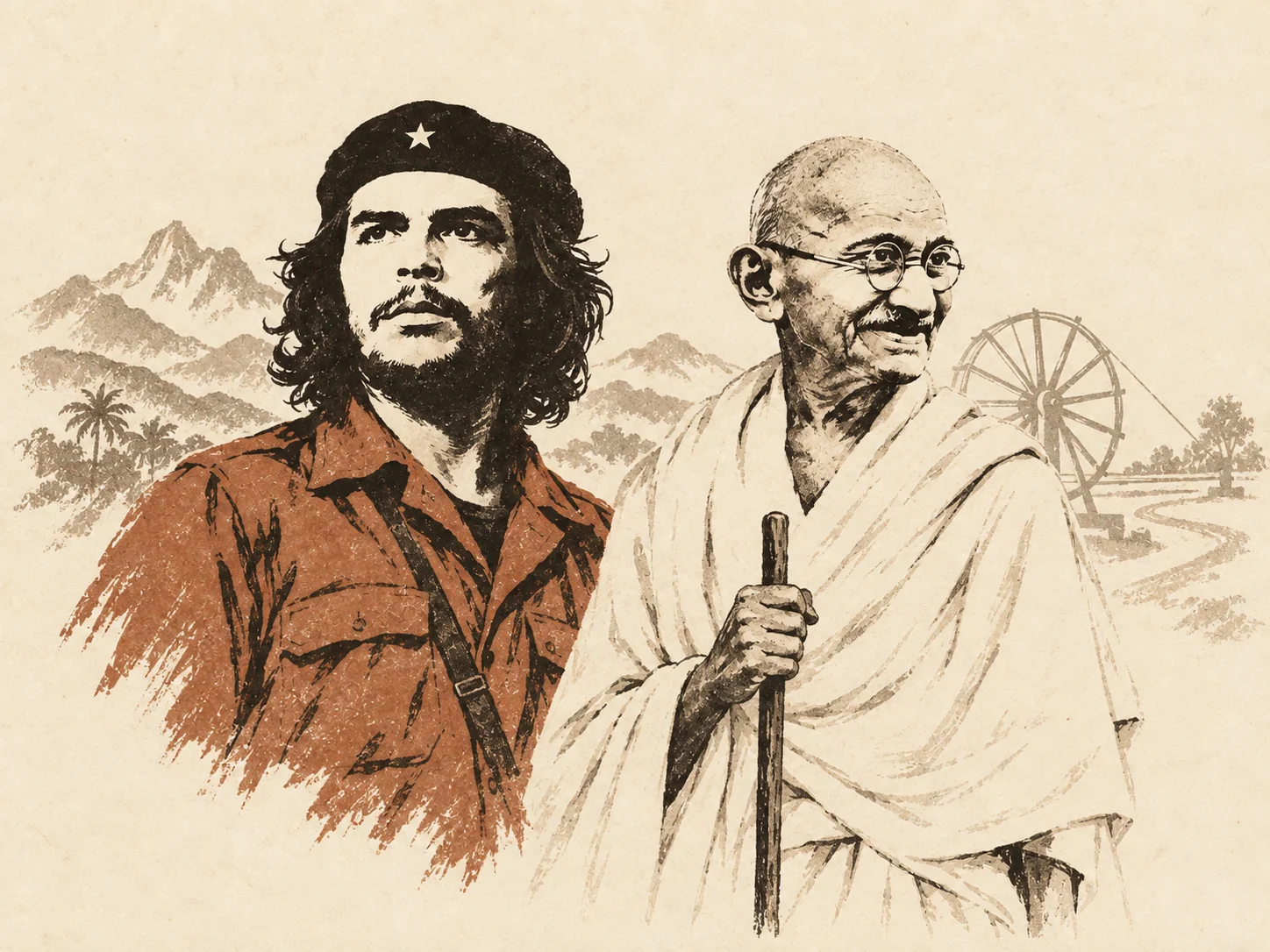
One rule before I start. Everything in this essay comes from those two books and nothing else.That rule matters more than it sounds. Both men have been buried under several libraries of commentary, quotation and poster. I wanted to know what I actually learnt from the two books on my shelf, not what I absorbed from everywhere else. That has a consequence worth stating: the two books are not the same kind of evidence. Gandhi is his own witness, so when I say Gandhi admits something, there is nobody else in the book to accuse him. Anderson is a biographer working from Che’s diaries, letters and the people around him, so his Che is judged from outside. And Gandhi’s book stops around 1920, long before the parts of his life most people know. Everything he did afterwards is, for the purposes of this shelf, off the shelf.
Two men who could have stayed comfortable
The first thing I noticed, reading them close together, is how similar the starting positions are.
Gandhi was trained as a barrister in London. By his own account he spent his first months there trying to become an English gentleman, buying the clothes and taking lessons in dancing, the violin and elocution, before deciding it was a waste of money and his brother’s patience. Back in India he was so shy that in his first case in a Bombay court he stood up to cross-examine a witness, could not think of a single question, sat down, and handed the fee back.
Che was trained as a doctor in Buenos Aires. He grew up in a comfortable if chaotic Argentine family, with asthma so severe that the family moved to the hills of Córdoba for his lungs. He played rugby anyway, carrying an inhaler.
Neither was born into the fight. Both walked into it, and in both books you can point to the moment.
For Gandhi it is the train at Pietermaritzburg in South Africa, where he was put off a first-class carriage because a white passenger objected to sharing it with him. He spent a winter night shivering in the station waiting room, and he describes that night as the point where he decided whether to go home or stay and resist. He stayed.
For Che it is Guatemala in 1954. Anderson follows him there after years of drifting up the continent, including the motorcycle journey with Alberto Granado and the weeks at the leper colony at San Pablo in the Peruvian Amazon. In Guatemala he watched the elected government of Jacobo Árbenz fall to an invasion backed by the United States, and afterwards took refuge in the Argentine embassy. Anderson is clear about the conclusion Che drew: Árbenz had failed because he had not armed the people or purged the army, and a revolution that did not defend itself with force would be overthrown.
So both books begin with the same discovery, made by two young professionals who could have gone home: comfort is not neutral. Somebody pays for it. Here they are both right, and it is the part of them I have never argued with.
Where both are right
A conviction is something you do to yourself first. Gandhi calls his life a series of experiments, and he means it literally. He experiments on his diet for decades, on his household, on his sexuality with the vow of brahmacharya he took in 1906, and on his work, moving his newspaper and his family onto a farm settlement at Phoenix where everyone did manual labour. Che, in Anderson’s account, does the same. He refused to let his asthma excuse him from anything, and in government he spent his Sundays cutting cane and working on building sites as unpaid voluntary labour, the minister alongside the workers.
It is easy to find this admirable and hard to imitate. What I take from both is narrower and more practical: if I believe something is right, the first place it should show up is in how I behave, not in what I argue.
Money is a bad measure of a life. Gandhi read John Ruskin’s Unto This Last on an overnight train to Durban, could not sleep, and got off the train a different man. He summarises what he took from it: that the good of the individual is contained in the good of all, that a lawyer’s work has the same value as a barber’s, and that a life of labour is the life worth living. Half a century later and a hemisphere away, Anderson shows Che, as minister of industries in Cuba, arguing that workers should be driven by moral rather than material incentives, and writing about the “new man” socialism was supposed to produce. As president of the national bank he signed the banknotes simply “Che”, which says a good deal about his opinion of money.
Write down your failures. Both men kept an honest record. Gandhi’s book is full of confessions: stealing as a boy and writing out a confession for his father, eating meat in secret, the shame of the night his father died. Che’s Congo diary, which Anderson quotes, opens by calling itself the history of a failure. I have come to think this is the most underrated thing the two share. People who are trying to change the world are usually the least willing to admit what went wrong. These two, at least on paper, were not.
Both books begin with the same discovery: comfort is not neutral. Somebody pays for it.
Where they part, and where I think Gandhi is right
The shelf joke is really a joke about one question: what are you allowed to do to another person for a cause?
Gandhi’s answer, even in his early South African years, is almost stubbornly gentle. His first big case in South Africa was a commercial dispute, and instead of winning it in court he persuaded both parties to settle by arbitration. He says it taught him that the real work of a lawyer is to bring together people who have been torn apart. When he organised resistance in South Africa, the movement needed a name, and the one that stuck was satyagraha, holding firmly to truth. It is a method built on suffering yourself rather than inflicting suffering on others.
Che’s answer, in Anderson’s book, is different, and Anderson does not soften it. In the Sierra Maestra in 1957 a peasant guide named Eutimio Guerra was discovered to have been leading the army to the rebels. Anderson quotes Che’s own diary: Che shot him himself. After the victory, Che commanded the fortress of La Cabaña in Havana, where revolutionary tribunals tried and executed officials of the old regime. Near the end of his life he wrote, in a message to the Tricontinental conference, about hatred as an element of struggle.
On this I have stopped being even-handed. I think Gandhi is right, and I think Che’s own story is the best evidence for it.
The clearest test is what each man did when his own people turned violent. In 1919 Gandhi called a nationwide protest against the Rowlatt Act, violence broke out, and he called it off. He described his mistake as a “Himalayan miscalculation”: he had asked people to break laws before they had learnt the discipline that makes lawbreaking civil. He would rather stop than win badly.
Che never stopped. His manual on guerrilla warfare set out the idea that a small armed band could create the conditions for revolution instead of waiting for them. In Bolivia, in 1967, Anderson shows exactly how that went. The peasants he had come to liberate did not join him, the Bolivian Communist Party withheld its support, and the army was kept informed by the people in the valleys. He was captured and executed at La Higuera on 9 October 1967.
Gandhi’s method needs the consent of the people it claims to act for. Che’s method assumed it could do without that consent, and in the end it could not. That is the argument the two books settle between them, and I did not expect them to settle it so cleanly.
Where Che is right and Gandhi is wrong
It would be a dishonest essay if the verdict only ran one way.
What Guatemala taught Che was that power which feels threatened will defend itself, and good faith alone will not move it. The younger Gandhi of the autobiography did not believe that. He writes openly about how loyal he was to the British Empire. In the Boer War he raised an Indian ambulance corps for the British. In 1918, back in India, he toured villages trying to recruit Indians to fight for the Empire in the First World War, and made himself seriously ill doing it. He believed that by behaving well inside the Empire, Indians would earn fair treatment from it.
Che, reading the same situation, would have told him he was wrong, and on the evidence of this shelf alone Che would have had a point. The one experience that shakes Gandhi’s faith in that period is the Zulu rebellion of 1906, when his ambulance corps ended up nursing wounded Zulus whom white soldiers had flogged and left untreated. He writes that it was no war but a man-hunt. Even then, what follows is a change in himself, the vow, rather than a change in his view of the Empire.
There is also a quieter place where Gandhi’s own account catches him out. In 1918 he led the mill workers of Ahmedabad in a strike, and when they began to waver he fasted. The strike was settled, but he concedes that the fast was not pure: the mill-owners were his friends, and his fasting put pressure on them that had nothing to do with the merits of the case. Nonviolence can still be coercion. I find it striking that the person who says so is Gandhi.
Where both are wrong
The hardest chapters in both books are not about politics. They are about the people who lived with these men.
Gandhi’s autobiography contains a scene in Durban that I have never been able to read comfortably. He insisted that his wife, Kasturba, clean the chamber pot of a guest from a caste considered untouchable. When she did it in tears and under protest, he shouted at her and started dragging her towards the gate to throw her out of the house. He tells the story against himself and calls it cruelty. He also admits that he denied his sons a proper schooling in the name of his principles, and that they may have reason to resent it.
Anderson’s Che is not much better at home. He left his first wife, Hilda Gadea, and their daughter; he left Aleida March and four more children to go to the Congo and then to Bolivia, writing farewell letters to be read after his death. The letter to his children asks them, above all, to feel any injustice done to anyone anywhere in the world. It is a beautiful sentence, and the children it was written to grew up without him.
Both men treated the people nearest to them as part of the experiment. Both books, to their credit, let you see the cost. This is the one lesson I take from them with no argument at all: a principle that has to be paid for by your family is a principle you should examine twice.
What I have kept
After years of rereading, I have ended up with something like a working rule, and it comes from both of them.
From Che I keep the capacity to be angry. Anderson’s Che could not look at an injustice and walk past it, whether in a leper colony in Peru or in Guatemala City, and I think a life without that reflex is a smaller life.
From Gandhi I keep the method. When I am angry about something and want to do something about it, the question I now ask is the one his book keeps asking: what does this require me to do to the person in front of me? If the answer is something I would not accept being done to me, the cause is not a good enough reason. In his closing chapter he says the way to truth is through ahimsa, and that a person has to put himself last among his fellow creatures to get anywhere near it.
The books are still next to each other, and I have stopped thinking of it as a joke. One of them explains why you should care. The other explains how to act on it without becoming what you are fighting. I need both, and I find I read them in that order.