A warning before boarding. What follows is an attempt to understand marriage in a society of more than 1.4 billion people, with thousands of castes and communities, every major religion on earth, twenty-two languages listed in the Constitution and hundreds more spoken, and laws, customs and cinema that pull in different directions at once. There is nowhere else quite like it, and nothing true about Indian marriage is true everywhere in India. Every generalisation below has a village, a community or a family that contradicts it. Read it the way you would listen to the argument on the train: with interest, with patience, and with a pinch of salt.
Anyone who has travelled overnight in an Indian train knows the moment. The lights in the three-tier AC coach have been dimmed, the berths are made up, someone is peeling an orange, someone else’s phone is playing a devotional song a little too loudly, and the conversation has already covered the delay, the price of onions and the state of Indian cricket. Then it finds the young person in the compartment. Where are you from, what do you do, and, inevitably: are you married? And if the answer is no, the follow-up that every young Indian has heard from aunties, colleagues, cab drivers and complete strangers: love or arranged?
An Indian train compartment is a moving parliament, and on this question it becomes a constitutional convention. Everyone has a position, a precedent and an anecdote. There is usually someone’s grandmother, ready to defend the marriage her parents chose for her when she was barely more than a child. There is often a young professional who explains that theirs was “love-cum-arranged”. And there is almost always someone in an upper berth, apparently asleep, who turns over at exactly the right moment to announce that love marriages never last. Nobody is neutral. Nobody thinks it is a private question.
This essay is my attempt to answer that question properly, and only from inside India. It is not about whether Indian marriage is better or worse than marriage somewhere else. It is about how India itself has arranged, argued about, legislated and filmed the choice of a spouse, from the oldest law books to the matrimonial apps, and what each way of choosing has given and cost the people who live inside it.I have tried to stick to things I could check: legal texts, court judgments, national surveys and the reporting on them. Where the numbers are disputed, or where a figure everyone quotes turns out to come from somewhere other than where people think, I say so.
The oldest menu
The idea that Indian tradition simply means arranged marriage, and that love marriage is a modern import, is wrong from the start.
The Manusmriti, the law code composed around two thousand years ago that shaped so much of later Hindu practice, lists eight forms of marriage in a single verse:
ब्राह्मो दैवस्तथैवार्षः प्राजापत्यस्तथाऽसुरः । गान्धर्वो राक्षसश्चैव पैशाचश्चाष्टमोऽधमः ॥
brāhmo daivas tathaivārṣaḥ prājāpatyas tathā’suraḥ | gāndharvo rākṣasaś caiva paiśācaś cāṣṭamo ‘dhamaḥ ||
The Brahma, the Daiva, the Arsha, the Prajapatya, the Asura, the Gandharva, the Rakshasa, and the Paishacha, the eighth and the lowest. (3.21)
Four were approved. In the Brahma form a father gives his daughter, adorned, to a learned man of good conduct whom he has invited; in the Daiva, she is given to a priest; in the Arsha, the father receives a pair of cattle; in the Prajapatya, the couple are simply told to perform their duties together. Four were disapproved. In the Asura form, the groom pays for the bride. In the Rakshasa, she is carried off by force. In the Paishacha, the worst of all, she is taken while asleep or intoxicated.
And one of the eight, the Gandharva, was a marriage by mutual consent: two people who desire each other and marry, without asking anyone. The text defines it, and passes judgement in the same breath:
इच्छयाऽन्योन्यसंयोगः कन्यायाश्च वरस्य च । गान्धर्वः स तु विज्ञेयो मैथुन्यः कामसम्भवः ॥
icchayā’nyonyasaṃyogaḥ kanyāyāś ca varasya ca | gāndharvaḥ sa tu vijñeyo maithunyaḥ kāmasambhavaḥ ||
The union of a girl and a suitor by their own mutual desire is to be known as the Gandharva form; it is born of lust and aims at intercourse. (3.32)
It is the oldest name in Indian law for a love marriage, and the Manusmriti files it among the disapproved forms, alongside purchase and abduction, and describes it as born of kāma, lust.
The ancient literature knew love marriage well, and loved it. The most famous Gandharva marriage in Indian literature is that of King Dushyanta and Shakuntala, told in the Mahabharata and turned by Kalidasa into the most celebrated play in Sanskrit. They meet in a forest hermitage, fall in love and marry in secret, and the king then forgets her, through a curse, until a ring is found in the belly of a fish. Their son is Bharata, after whom the country’s own name, Bharat, is traditionally explained.
The epics also give us the swayamvara, the “self-choice”, in which a princess chooses a husband from among assembled suitors. The most famous, Draupadi’s, is less a choice than a contest: the suitors must string a great bow and hit a target, and Arjuna wins her. Even the choosing, in other words, was usually arranged.
So the tradition had both, and it had a clear preference. What it prized was not the absence of love but the presence of the family’s consent. That preference, far more than any single form of ceremony, is what has come down to the train compartment.
Caste, the real matchmaker
To understand why the family’s consent mattered so much, you have to understand what marriage was protecting.
In 1916, as a young graduate student at Columbia University, B. R. Ambedkar presented a paper called “Castes in India: Their Mechanism, Genesis and Development”. Its central argument was startlingly simple. Caste, he argued, is maintained above all by endogamy, the rule that people marry only within their own group. Take away endogamy and caste cannot reproduce itself. In his phrase, the superposition of endogamy on exogamy means the creation of caste.
A century later, genetics found the same machine from the other end. In 2013 a Harvard team led by Priya Moorjani and David Reich found that the two ancestral populations from which most Indians descend had mixed freely for thousands of years and then, from roughly 1,900 years ago, largely stopped. A 2016 study from the National Institute of Biomedical Genomics in Kalyani dated the shift among upper-caste groups to about seventy generations ago, around the time of the Gupta kings: the same centuries in which law books like the Manusmriti gained their authority. Endogamy is not the natural state of Indian society. It had a beginning, it is written into the genome, and what began can, in principle, end.
Read in that light, arranged marriage is not only a family custom. It is the machinery by which caste is carried from one generation to the next. A marriage arranged by parents, through relatives and community networks, within the right caste, sub-caste and often the right region and gotra, ensures that the boundaries hold. A marriage chosen by two individuals for love has no such guarantee.
The machinery still works. The India Human Development Survey found that in 2011–12 only about 5.8 per cent of marriages in India were between people of different castes, and that the figure had barely moved in four decades.This number is often reported as coming from the census. It does not; the census does not ask about caste in this way. It comes from the India Human Development Survey, run by the University of Maryland and the National Council of Applied Economic Research. In a country that has changed almost beyond recognition in those forty years, whom people marry has changed least of all.
This is why the question on the train is never quite as innocent as it sounds. “Love or arranged?” is often a polite way of asking something else: did you stay inside the lines?
Many Indias
Everything so far has been about the dominant tradition, which is Hindu, upper-caste and north Indian in its assumptions. India’s marriages are more various than that, and the variety matters, because it shows that none of this is inevitable.
Muslim marriage, the nikah, is in law a contract. It requires a proposal and an acceptance, ijab and qubul, freely given, before witnesses, and it requires a mehr, a sum the husband promises to the wife that is hers and enforceable in court. Many Muslim marriages are arranged by families like any other, but the legal theory is different at the root: a contract to which the bride is a party, not a gift of the bride from one family to another.
Sikh marriage, the Anand Karaj, in which the couple walk four times around the Guru Granth Sahib, was given its own legal recognition by the Anand Marriage Act of 1909, and in 2012 a system of registration under it, so that Sikhs need no longer register their marriages under Hindu law.
Then there is the north-east. The same survey that found only 5.8 per cent of Indian marriages crossing caste lines found that in Mizoram the figure was over half. Among the Khasi of Meghalaya, one of the few matrilineal societies in India, children take their mother’s name, the youngest daughter inherits the ancestral property and looks after her parents, and a husband traditionally moves into his wife’s family home. Every assumption the train compartment makes about who leaves home, whose name continues and who inherits, the Khasi make the other way round.
Even within the Hindu majority, north and south arrange marriage differently. The anthropologist Irawati Karve mapped these differences in Kinship Organization in India in 1953. Across much of the north, rules of clan and village exogamy require a bride to marry outside her own village and far from her own kin, and cousin marriage is forbidden. Across much of the south, marriage between certain cousins has traditionally been preferred, keeping a bride among relatives she already knows. The phrase “arranged marriage” covers both, but for a young woman they are very different experiences: in one she is sent to strangers, in the other she often marries into a family she grew up visiting.
The difference is not a relic. In the National Family Health Survey of 2015–16, about one in ten Indian marriages was between blood relatives, most often first cousins, but in the south the figure was about 23 per cent, and in Tamil Nadu, Karnataka and Andhra Pradesh it was higher still, above a quarter. In parts of those states the most traditional match of all is between a woman and her mother’s brother. The Hindu Marriage Act forbids marriage between close relatives, then, recognising the south, allows it wherever custom permits. A match that would be a scandal in a Haryana village is, three states to the south, the one the grandmother had hoped for. There is no single Indian rule for whom one may marry, only a map of rules that contradict each other.
The differences show up in the surveys too. The India Human Development Survey found that about two-thirds of Indian women had met their husbands for the first time on the day of the wedding. In Bihar the figure was 94 per cent. In Manipur it was none.
The colonial courtroom
For most of recorded Indian history, the state had little to say about whom people married. Marriage was governed by religious law, custom and community. The British, when they came to rule, mostly preferred to keep it that way, and left family law to what they called the “personal laws” of each religious community. But in the nineteenth century, pushed less by the colonial government than by Indian reformers and by cases too terrible to ignore, the courts and the legislature were drawn in.
The first great reform was about widows. In 1856 the Hindu Widows’ Remarriage Act, fought for above all by the Bengali reformer Ishwar Chandra Vidyasagar, made it legal for Hindu widows to marry again, in a society where many girls were widowed before they were old enough to understand what marriage was.
The most extraordinary case was about consent itself. In the 1870s a girl named Rukhmabai was married at the age of eleven to a man of nineteen, Dadaji Bhikaji, but continued to live with her mother and stepfather, a doctor, who educated her. When she was grown, she refused to go and live with her husband. In 1884 he sued her for “restitution of conjugal rights”, asking the court to order her to join him.
In 1885 Justice Robert Pinhey of the Bombay High Court ruled in her favour. She had been married, he said, in her “helpless infancy”, and he could not compel a grown woman to go to a husband she had never agreed to. The judgment was overturned on appeal, and she was ordered to go to her husband or go to prison. She said she would rather go to prison. The case became a national sensation, argued over in newspapers in India and Britain, and it was finally settled in 1888 when her husband accepted a payment to drop it.
Rukhmabai then did something almost no Indian woman of her time could do. She went to London, qualified in medicine at the London School of Medicine for Women, returned to India and practised as a doctor for more than three decades.
Her case helped reopen a debate about the age at which girls could be married and taken to their husbands. What finally forced the law to change was a death. In 1889 a ten-year-old girl in Bengal, Phulmoni Dasi, died after intercourse with her husband, a man in his thirties. In 1891 the Age of Consent Act raised the age of consent for sex within or outside marriage from ten to twelve. It was bitterly opposed by nationalists who saw it as colonial interference in Hindu custom, and it was barely enforced.
In 1929 the Child Marriage Restraint Act, known as the Sarda Act after the legislator Harbilas Sarda who introduced it, set a minimum age of marriage for the first time: fourteen for girls, eighteen for boys. And for anyone who wanted to marry across religion, there had been, since 1872, a Special Marriage Act, with one devastating condition: to use it, both partners had to declare that they did not profess any religion at all. You could marry the person you chose, but only by renouncing your faith and, in practice, your family.
The republic’s promises
Independence brought a constitution that promised equality, and a set of laws that tried to bring marriage into line with it.
The Special Marriage Act of 1954 allowed any two Indians to marry in a civil ceremony without giving up their religion. The Hindu Marriage Act of 1955 made monogamy the law for Hindus, gave both husbands and wives the right to divorce, and removed caste as a legal bar to marriage. The Dowry Prohibition Act of 1961 made giving and taking dowry a crime. On paper, the republic had made love marriage possible, arranged marriage optional and the dowry illegal.
What the republic did not do was give all Indians the same marriage law. The Constitution listed a uniform civil code, in Article 44, only as a goal for the state to work towards, and Hindus, Muslims, Christians and Parsis kept separate personal laws for marriage, divorce and inheritance. The exception is Goa, which kept its Portuguese civil code after 1961 and has had ever since a family law for everyone regardless of religion: marriages must be registered, and by default husband and wife jointly own everything either brings to the marriage or acquires during it. The differences between the personal laws are real but often exaggerated. Polygamy was banned for Hindus in 1955 and remains permitted under Muslim personal law, yet in the most recent National Family Health Survey between one and two per cent of married Hindu, Muslim and Christian women alike said their husband had another wife, and the highest rate was among Christians. The long argument over a single civil code, which Uttarakhand has now reopened, is only partly about marriage. It is also about who gets to decide what an Indian family is.
The most radical challenge to the old rules did not come from Parliament or from abroad. It came from Tamil Nadu. From the late 1920s, E. V. Ramasamy, known as Periyar, and his Self-Respect Movement promoted suyamariyādai marriages: weddings with no Brahmin priest, no Sanskrit mantras, no sacred fire and no horoscope, in which the couple simply declared, before friends and relatives, that they took each other as husband and wife, often across caste and without dowry. For decades these marriages had no clear legal standing. In 1967, soon after the DMK, a party born from Periyar’s movement, came to power, Tamil Nadu amended the Hindu Marriage Act to add Section 7A, recognising them as valid. In 2023 the Supreme Court went further, holding that such a marriage does not need a public ceremony at all, because a couple facing a hostile family may have very good reasons to keep it quiet. India’s most thorough rebellion against arranged marriage was home-grown, and it was written into law half a century before the dating apps arrived.
The courts have gone further since. In 2006, in Lata Singh v. State of Uttar Pradesh, the Supreme Court held that an adult woman was free to marry a man of another caste, and that her family’s harassment of the couple was itself an offence. In 2018, in Shakti Vahini v. Union of India, it held that the right of an adult to choose a partner is part of the fundamental rights to liberty and dignity, and that caste councils known as khap panchayats have no authority to stop a marriage between consenting adults, let alone to order violence against them.
And yet the practice has moved far more slowly than the law.
A national youth survey by Lokniti–CSDS in 2016 found that 84 per cent of married young Indians said their marriage had been decided by their families, and only 6 per cent said they had chosen their partners themselves. The India Human Development Survey found that only about 5 per cent of ever-married women aged 25 to 49 said they had chosen their husbands on their own; another 37 per cent said the choice had been made jointly by them and their parents. The National Family Health Survey of 2019–21 found that 23.3 per cent of women aged 20 to 24 had been married before the legal age of eighteen. The National Crime Records Bureau recorded 6,450 dowry deaths in 2022, more than seventeen a day, sixty years after dowry became a crime.
The law is also still making love harder in specific ways. The Special Marriage Act, the one route designed for couples who marry across religion or caste without their families, requires a thirty-day public notice of the intended marriage, with names and addresses displayed at the marriage office and objections invited. Courts have called the requirement an invasion of privacy, and couples report that the notice is sometimes the way their families, or vigilante groups, find out. Since 2020, several states have passed laws against religious conversion “by marriage”; Uttar Pradesh’s, which came into force in 2021, has been used to stop interfaith weddings between consenting adults.
The republic, in other words, wrote down the right to choose. It has not yet made the choice safe.
The republic wrote down the right to choose. It has not yet made the choice safe.
Cinema, the other parent
If the law has been the slow parent in this story, cinema has been the loud one. For most Indians, the first love stories they ever saw were Hindi films, and those films have shaped what love marriage means in India more than any statute.
The argument has been on screen almost from the beginning. In 1936 Achhut Kanya, “The Untouchable Girl”, made by Bombay Talkies with Devika Rani and Ashok Kumar, told the story of a Brahmin boy and a Dalit girl who love each other and cannot marry, and it ends in tragedy. In 1960 Mughal-e-Azam staged the same conflict as an epic: a prince who loves a court dancer, and an emperor father who will not allow it. In 1973 Bobby made teenage love across class a box-office phenomenon. In 1988 Qayamat Se Qayamat Tak retold Romeo and Juliet as a feud between two Rajput families, and its young lovers die.
For decades the formula was clear: love marriage was romantic, and it was usually doomed.
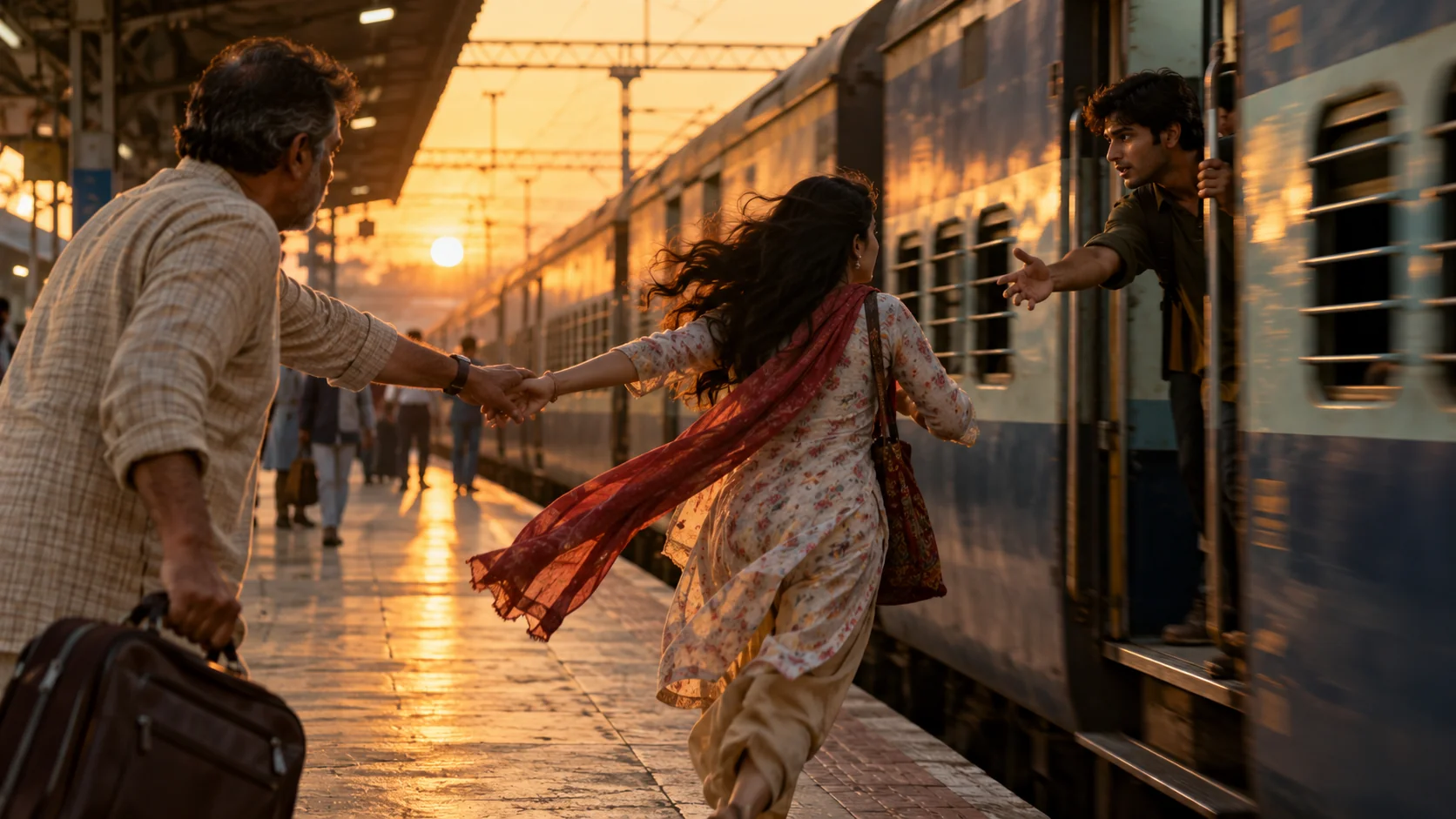
Then came 1995, and the most important Indian film about marriage ever made. In Dilwale Dulhania Le Jayenge, a young non-resident Indian, Raj, falls in love with Simran, whose strict father has already promised her to the son of an old friend in Punjab. Raj follows her to India. Everyone, including Simran’s mother, tells him to run away with her. He refuses. He will not steal her, he says; he will win her father’s blessing. In the final scene the father, watching his daughter strain towards the train where Raj is waiting, lets go of her arm and tells her to go and live her life.
The film has been showing at the Maratha Mandir cinema in Mumbai almost without a break since it opened in October 1995, well over a thousand weeks, the longest run in the history of Indian cinema. And its message has become the dominant Indian ideal of modern marriage: love, yes, but love that is approved. The romance of DDLJ is not that the couple defy the family. It is that the family, in the end, consents.
That compromise is what the young professional on the train meant by “love-cum-arranged”. It is also why many critics have argued that DDLJ, for all its charm, is a conservative film. It tells a generation that the highest form of love is the kind your father signs off on.
Cinema has also told the other story, more recently and more bluntly. In 2016 Nagraj Manjule’s Marathi film Sairat followed a girl from a dominant-caste family and a boy from a lower caste who fall in love, elope and build a life together, until her family finds them. Its last minutes are among the most devastating in Indian cinema. It became one of the most successful Marathi films ever made, and in the years since, it has been cited in reporting on real honour killings, sometimes by the victims’ families themselves.
The app and the aunty
The last great force in this story is globalisation, and it arrived through an economy, a diaspora and a website.
After India opened its economy in 1991, millions of young people moved to cities for jobs in software, services and finance, often far from their families and their communities. Women entered colleges and workplaces in far greater numbers. People met, in offices and hostels, people they would never have met at home. Love marriage stopped being something that happened mostly in films.
At the same time, the internet did something unexpected: it modernised arranged marriage instead of replacing it. In 1996 Anupam Mittal launched an experimental matrimonial site called Sagaai.com, which became Shaadi.com; BharatMatrimony and others followed. They moved the matrimonial advertisement from the Sunday newspaper to the screen, and they kept its categories. A user can filter a potential spouse by religion, caste, sub-caste, mother tongue, diet, horoscope and height, a set of options that would be unthinkable on a Western dating app and that makes the old machinery more efficient than it has ever been.
The horoscope made the move too. In many Hindu families a match is not final until the couple’s birth charts have been compared by an astrologer, most commonly by the aṣṭakūṭa system, which scores a pair out of thirty-six points, or guṇa, across eight categories; eighteen is traditionally the minimum for a match. The matrimonial sites now do this in seconds. And a chart can veto what caste, family and income have already approved, above all through mangal doṣa: a person born with Mars in certain positions is called manglik and is said to bring misfortune, even death, to a non-manglik spouse. By some counts close to half of all charts qualify. The remedies include marrying another manglik, or first performing a ritual “marriage” to a tree, a pot or an idol, and the burden falls hardest on women, for whom the label can shrink the pool of willing families at a stroke.
Alongside them came the dating apps, and a generation that now meets on them, dates, and then, often, introduces the partner to their parents and asks for the approval DDLJ taught them to want. In 2020 a Netflix series, Indian Matchmaking, followed a Mumbai matchmaker, Sima Taparia, as she arranged meetings for young Indians in India and the United States, and the world watched, fascinated and often appalled, as she matched clients by family, height and complexion. Many Indians watched it with a different feeling: recognition.
Complexion has always been on the list. For decades, matrimonial advertisements asked for brides who were “fair, slim, homely”, and the sites inherited the vocabulary: until 2020, Shaadi.com asked users to describe their skin tone as fair, wheatish or dark, and let others search by it. That June, as protests against racism spread from the United States, two users started an online petition, and within a day the company removed the filter, calling it a “blindspot”. Within days, the maker of the country’s best-known skin-lightening cream, Fair & Lovely, announced it would drop the word “Fair”; it became Glow & Lovely. The filter went. The preference, as any aunty with a shortlist will confirm, did not go with it.
The attitudes have moved, but less than the technology. In the same 2016 Lokniti–CSDS survey, half of unmarried young Indians said they would still prefer an arranged marriage. The most common modern Indian marriage is neither purely love nor purely arranged. It is a negotiation, conducted partly in the family’s language and partly in the couple’s, over who will have the final say.
What arranged marriage gets right
It would be easy, writing from Geneva, to treat arranged marriage as simply a relic. That would be dishonest, and it would not match the experience of millions of Indians who chose it willingly and are glad they did.
At its best, arranged marriage treats marriage as what it largely is in India: the joining of two families, not only two people. The couple begin married life inside a network of relatives who have a stake in its success, who will help with money, with children, with illness and with crisis. For a young woman moving into her husband’s household, as most Indian brides still do, a marriage arranged by families who know each other can mean a known and accountable home rather than a stranger’s.
It matches people on the things that, in India, often matter most in daily life: language, food, festivals, religion, the rhythm of the household, the expectations about care for elderly parents. Many couples say that a marriage built on that shared foundation leaves them free to grow into love slowly, rather than expecting it to be there, fully formed, at the start.
And it offers a kind of social insurance. In a country with thin public safety nets, the family is the safety net, and a marriage the family has blessed keeps you inside it.
It is often said that arranged marriages last longer, and it is true that divorce in India is rare by international standards; the figure usually quoted is around one in a hundred marriages, although there is no reliable national statistic. But a low divorce rate is not the same as a happy marriage. It also reflects the stigma of divorce, the economic dependence of many wives, and the difficulty of leaving. The 2011 census adds a telling detail: the number of Indians who were separated was almost three times the number who were divorced. Many Indian marriages that fail do not end in court. They end in a quiet separation, or an abandonment, that no divorce statistic records. The number tells you that Indian marriages endure. It does not tell you what people endure inside them.
Is anyone happier? The research is thinner than the confidence on either side of the train. A small 2005 study found no significant difference in marital satisfaction between couples in arranged marriages in India and couples in marriages of choice in the United States. A 2012 study of 58 Indian-Americans found, to the researchers’ surprise, no differences at all: both groups reported high levels of love, satisfaction and commitment. Samples this small prove very little, and happy people are likelier to fill in questionnaires. But they unsettle both camps. The evidence does not show that either kind of marriage is happier. It suggests that what happens after the wedding matters more than how the wedding was decided.
What arranged marriage gets wrong
The same features, seen from the other side, are its costs.
It is, as Ambedkar saw, the main instrument by which caste survives. Every arranged marriage within the right community is also a small act of reproducing the boundary. A society that wants to end caste discrimination while almost all its marriages stay inside caste is, in Ambedkar’s own phrase from 1949, living a life of contradictions.
It entangles marriage with dowry, which the law has banned for more than sixty years and which remains widespread, and with the violence that follows when a groom’s family decides the dowry was not enough. Dowry is also, in an important sense, not as ancient as it looks. Many communities, especially among the non-dominant castes, traditionally practised bride-price, a payment to the bride’s family. The sociologist M. N. Srinivas described how groups rising in status adopted the customs of the castes above them, a process he called Sanskritisation, and dowry spread with it. He noted that among the Okkaligas of Mysore, educated families had come to see bride-price as demeaning by the 1930s and were paying dowries by the 1950s. The practice the law tries to abolish grew, in part, with the very mobility and modernity that were supposed to end it.
Nor has it faded so much as changed shape. A study of rural marriages between 1960 and 2008 found dowry paid in about 95 per cent of them; it has slowly fallen as a share of household income, but it has not gone away. Today it rarely calls itself dowry. It is “gifts”: a car, a flat, a contribution to the groom’s degree abroad, “whatever you wish to give your daughter”. The 1961 law itself exempts presents given without a demand, and in practice it is the groom’s family that decides where a gift ends and a demand begins.
It turns the wedding itself into a public performance of status. The Indian wedding is an industry: a widely reported 2024 estimate by the brokerage Jefferies put it at around $130 billion a year. The guest list, the venue, the gold and the gifts are read by both families and their communities as a statement of standing, and the cost falls, far more often than not, on the bride’s side. Families borrow, sell land and spend years of savings on a few days, and a wedding that is too modest can itself be read as a failure. The couple are the reason for the event; they are often not its audience.
It often works against consent. The line between an arranged marriage and a forced one is supposed to be the couple’s freedom to say no, and for many Indians, especially young women, especially in villages, that freedom is more theoretical than real. The one in four women married before the legal age of eighteen did not arrange anything.
And it places the heaviest burden of adjustment on the bride, who usually leaves her home, her town and often her name, to fit into a household she did not choose. It places a different burden on the groom, who is expected to arrive already able to support a wife and often his parents too, and whose worth on the marriage market is measured, first and last, by what he earns.
And a market that ranks people by height, complexion and salary ranks some people out altogether. Disabled Indians, and disabled women above all, are routinely treated by families and matchmakers as unmarriageable, or offered only to other disabled people, whatever their education, work or wishes. A handful of specialist matrimonial services now exist for them. That they are needed says something about the rest.
What love marriage gets right
Love marriage, at its best, is built on the principle that Rukhmabai stood up for in 1885: that an adult’s body and life belong to that adult, and that no marriage should begin without both people’s free and informed consent.
It is also the only real engine of social change in Indian marriage. Almost every inter-caste and interfaith marriage in India is a love marriage. If the boundaries Ambedkar described are ever going to be crossed at scale, it will be because individuals chose each other across them.
And it rests on a companionate idea of marriage, two people who know each other, choose each other and build a life as partners, that many young Indians, especially young women with education and careers, now want for themselves.
What love marriage gets wrong, or rather, what India does to it
Love marriage in India fails less often because of love than because of everything around it.
Couples who marry against their families’ wishes often lose the family safety net at exactly the moment they need it most. They may be cut off financially and socially, and in the worst cases they face violence, which in inter-caste marriages very often falls on the husband. India has no reliable national count of honour killings, but the Supreme Court has repeatedly had to intervene to protect couples, and cases continue to be reported every year.
They face the legal friction described earlier, and police who, in some places, see eloping adults as a problem to be returned to their families rather than citizens exercising a right.
And a woman who marries for love and whose marriage then fails often faces a harsher judgement than one whose arranged marriage fails: she chose, so it is her fault.
None of these are defects in the idea of choosing a partner. They are the price that Indian society, at present, charges for choosing.
What the institution does to both
The usual Indian argument about marriage has two camps that rarely listen to each other. One counts what marriage does to women; the other counts what it does to men. Both are counting real things. The institution, as India has built it, distributes harm to both, in different forms, and the law has so far chosen to see only one of them.
What it does to women. The costs to women are older, larger and better documented, and many run through everything above: child marriage, dowry and dowry deaths, brides of non-resident grooms deserted after the wedding. The most basic is the move itself. Marriage is the largest single reason Indians change where they live: in the government’s labour force survey of 2020–21, 86.8 per cent of women who had migrated gave marriage as the reason. Most Indian women, in other words, are expected to leave their home, their town and their support at the moment they marry, and to build a life among people who hold every advantage of familiarity.
The violence is the part that is easiest to count and hardest to see. In the most recent National Family Health Survey, 29 per cent of ever-married women aged 18 to 49 said they had experienced physical or sexual violence from a husband, and more than three in four women who had faced violence had never sought help or told anyone. “Cruelty by husband or his relatives” is, year after year, the largest single category of crime against women recorded by the National Crime Records Bureau, and those are only the cases that reach a police station. The same survey found that about 45 per cent of women, and a similar share of men, agreed that a husband is justified in beating his wife for at least one reason: burning the food, leaving the house without telling him, neglecting the children. The institution does not only permit the harm; it teaches both sides to expect it.
The rest of the cost is quieter. India’s first national time-use survey, in 2019, found women who did any unpaid domestic work spending about five hours a day on it, against about an hour and a half for the men who did any, and for many women marriage is the point at which paid work stops, because the new household expects it, the husband’s job decides where the couple lives, or the children arrive. Since 2005 daughters have had an equal legal share in ancestral Hindu property, but few claim it, because claiming it from a brother can cost a woman the natal family she may one day need to return to. That is the trap at the centre of it: a woman who leaves a bad marriage often has no income of her own, no share of her parents’ house, and a stigma as a divorcee that her husband will not carry in the same way. The law has moved, from Shah Bano in 1985 to the ruling against instant triple talaq in 2017 and the 2024 judgment confirming that a Muslim wife, like any other, can claim maintenance from her husband, but maintenance orders are slow and often unpaid. And, as the next section describes, the criminal law still does not recognise rape within marriage.
What it does to men. The costs to men are less often counted, and the law is largely silent on them. Under India’s new criminal code of 2023, as under the old one, rape and sexual harassment are defined as offences a man commits against a woman. A woman cannot, in law, sexually harass a man, and when the new code replaced the old Penal Code it dropped the provision that had been the only route for adult men to report sexual assault at all. The domestic violence law of 2005 recognises only a woman as an “aggrieved person”; a husband abused by his wife has no equivalent protection. The law against cruelty in marriage, the old Section 498A, now carried into the new code, protects only wives. In 2014 the Supreme Court, in Arnesh Kumar v. State of Bihar, acknowledged that this law was sometimes used as a weapon rather than a shield, with husbands and elderly relatives arrested on complaints that did not hold up, and directed police not to arrest automatically; the conviction rate in these cases has been among the lowest of any crime. Researchers commissioned by the National Commission for Women have argued that the misuse is overstated, and in 2025 the Supreme Court declined a petition to make these laws gender-neutral, holding that they exist because of the deep and specific exploitation of women through dowry. Both points can be true at once: the protection is needed, and a protection available to only one side will sometimes be turned against the other.
The institution also places its own weight on men. An arranged marriage in much of India expects the groom to be the provider, for his wife and often for his parents, and measures him by his income before anything else. In love marriages across caste, it is very often the man, as in Sairat, who is killed by the bride’s family. And in 2021 the National Crime Records Bureau recorded more than 81,000 suicides by married men, against more than 28,000 by married women; family problems were the single largest recorded cause. Married women in India also die by suicide at rates that are high by world standards, and more than twenty thousand of the suicides that year were housewives. The numbers do not make a competition. They describe an institution under strain on both sides.
What it does to those left behind. Marriage in India does not end when one spouse dies, at least not equally. A century and a half after the widows’ remarriage law, remarriage remains far easier and far more common for widowers than for widows. The 2011 census counted about 43 million widowed women and 12 million widowed men, in part because wives are usually younger than their husbands and outlive them, and in part because men remarry and women, much more often, do not. Many widows, especially older ones in poorer families, are still expected to give up colour, jewellery and festivals, and some are pushed out of the family home altogether; the widows of Vrindavan and Varanasi are the most visible, not the only ones. A widower, meanwhile, is often urged to remarry quickly, for the sake of the children or the household, and the institution that pressed him into being the provider offers him little else in grief.
What it does to the promise itself. At the edges, marriage in India is increasingly used for something other than marriage: as a route to a visa, in which either a groom settled abroad leaves a bride behind or a bride who has reached Canada leaves a groom’s family with the bill; or as a claim on property, a settlement, a passport. In these cases the institution is not failing to protect one party from the other. It has stopped being a promise between two people at all.
Consent after the wedding
There is one more place where the essay’s question, can you say no, has to be asked, and it is the most uncomfortable.
Rukhmabai’s argument in 1885 was that a marriage arranged for her as a child did not give her husband a right to her adult body. Indian law has since accepted a great deal of that argument. It sets a minimum age of marriage, it punishes cruelty and dowry, and its courts have said that the right to choose a partner is a fundamental right. But it has kept one exception. Under the rape provision of the old Penal Code, and now of the new criminal code of 2023, sexual intercourse by a man with his own wife, if she is not under eighteen, is not rape. A wife can refuse to marry. The law has not yet said that, within marriage, she can refuse sex.
In May 2022 two judges of the Delhi High Court split on whether that exception is constitutional: one would have struck it down as a violation of a married woman’s right to equality and bodily autonomy, and the other upheld it as a legitimate distinction for a marriage. The question went to the Supreme Court, where the government has argued that criminalising marital rape could destabilise the institution of marriage. As I write, in September 2026, the Court has listed the challenge for final hearing.
Whatever it decides, the case is the end of the line that began with Rukhmabai. India has spent a hundred and forty years deciding whether a woman can say no to a marriage. It has not yet finished deciding whether she can say no inside one.
India has spent a hundred and forty years deciding whether a woman can say no to a marriage. It has not yet finished deciding whether she can say no inside one.
The false binary
Here is what I have come to think, after following this question from the Manusmriti to Shaadi.com.
“Love or arranged?” is the wrong question. It suggests two clean categories, and for most Indians today there are no clean categories. There are couples who meet on an app and then ask their parents. There are parents who shortlist candidates and then let their children spend six months deciding. There are “arranged” marriages in which the bride meets the groom once, and “love” marriages that required the approval of three generations. The India Human Development Survey’s largest group, the 37 per cent who said the choice was made jointly with their parents, is the real middle of the country.
The question that actually matters is the one the Manusmriti was already asking two thousand years ago, when it ranked a daughter given away above a daughter who chose. Who has the final say? Can the two people getting married say no, and be safe after they say it? If they can, the difference between love and arranged matters much less than we think. If they cannot, then no amount of romance on the surface changes what the marriage is.
“Love or arranged?” is the wrong question. The one that matters is: can the two people getting married say no, and be safe after they say it?
The next compartment
So where is this going? Predictions about Indian marriage have a long record of being wrong, usually by announcing the death of arranged marriage a generation too early. With that pinch of salt, here is what is actually moving, and in which direction.
Later, and less often as children. Child marriage keeps falling: the 23.3 per cent figure quoted earlier was 26.8 per cent five years before, and far higher a generation before that. The age at which Indians marry keeps rising, fastest in cities and among women with more education. The pace differs enormously from state to state, but the direction does not.
Or not at all. For the first time, a visible number of Indians are choosing not to marry. The 2011 census counted about 71 million single women, including the widowed, divorced, separated and never-married, a rise of about 39 per cent in a decade, and the fastest rise was among women aged 20 to 29. Most still expect to marry eventually. But for a growing minority, especially urban women with education and income of their own, staying single is no longer only something that happens to them; it is an option they choose, and one their parents are slowly, reluctantly, learning to say out loud on a train.
Smaller families, a different bargain. The most recent National Family Health Survey found India’s fertility rate had fallen to 2.0 children per woman, below the replacement level of 2.1. A couple with one or two children has fewer heirs to spread its hopes across, and each child carries more of them, but also has more to bargain with. At the same time, decades of sex-selective abortion have left some states, Haryana most visibly, with far fewer women than men of marriageable age, and a trade has grown to fill the gap: women from poorer states, known locally as paro or molki, bought as brides and brought into households where they often have no family, language or standing to protect them. The arranged market, squeezed by its own preference for sons, has found a way to buy what it destroyed.
Easier endings. For most of the republic’s history, a divorce required proof of fault or the agreement of both spouses. In May 2023, in Shilpa Sailesh v. Varun Sreenivasan, a Constitution Bench of the Supreme Court held that it could dissolve a marriage that had irretrievably broken down, even though the Hindu Marriage Act does not list that as a ground. It is a quiet but significant shift: the law beginning to treat a dead marriage as a fact to be recognised rather than a wrong to be proved.
Living together, and registering it. The Supreme Court has long held that a long-term live-in relationship can be “a relationship in the nature of marriage” under the domestic violence law. Then, in January 2025, Uttarakhand became the first state to bring a Uniform Civil Code into force, and it went further than anyone expected. Couples living together must register the relationship with the state within a month, and those who do not can face up to three months in prison. The same law that recognises cohabitation also makes it something the government must be told about.
Chosen by individuals, policed by the state. Put these pieces together, with the thirty-day notice under the Special Marriage Act and the anti-conversion laws described earlier, and a pattern appears that I think is the most important thing about where Indian marriage is heading. Young Indians have more freedom than any previous generation to choose whom they marry. And the state is taking a larger role in supervising those choices than it ever has: registering, notifying, investigating and, in some places, criminalising them. For two thousand years the question was how much say the family had. The question for the next generation may be how much say the government has.
The state does not only police; it also pays. Since 2013 the central government’s Dr. Ambedkar Scheme for Social Integration through Inter-Caste Marriages has offered a one-time grant of ₹2.5 lakh to a couple in which one partner is Dalit, to help them “settle down” after what the scheme calls a socially bold step, and many states run incentive schemes of their own. The same state, in other words, rewards some couples for crossing a line, and makes others give thirty days’ public notice before they may cross it. It has not yet decided whether it is the matchmaker, the chaperone or the witness.
For two thousand years the question was how much say the family had. The question for the next generation may be how much say the government has.
The algorithm as the new aunty. Matchmaking is being automated too. In March 2026 researchers published an audit of five families of large language models, including GPT, Gemini and an Indian model, BharatGPT, asked to assess real matrimonial profiles in which only the caste was changed. Every one rated same-caste matches most favourably, by up to 25 per cent, and ranked inter-caste matches along the traditional caste hierarchy. The aunty with the shortlist may be replaced. Her preferences, it turns out, are already in the training data.
Who gets to marry at all. In October 2023, in Supriyo v. Union of India, the Supreme Court declined to recognise same-sex marriage and left the question to Parliament. Afterwards the government, as it had told the court it would, set up a committee under the Cabinet Secretary in April 2024 to examine the practical rights of queer couples: joint bank accounts, medical decisions, the everyday entitlements that marriage confers. Whether India will one day extend marriage itself is now a question for Parliament, and perhaps for a generation not yet old enough to vote.
Love inside the lines. Here is the salt, and it is a lot of salt. Even as love marriages become more common, people fall in love with the people they meet, and most Indians still meet people of their own class, language, region and often caste: at the same colleges, in the same offices, through the same friends. A love marriage between two people of the same caste who met at an engineering college is a real change in who decides. It is not much of a change in who marries whom. The boundaries Ambedkar described may survive the move from arranged to love marriage far more easily than either its champions or its critics expect.
Back on the train
In my essay on elections I quoted Ambedkar’s warning to the Constituent Assembly in November 1949: that on 26 January 1950, India would enter a life of contradictions, with equality in politics and inequality in social and economic life. One person, one vote, one value in the polling booth; and outside it, a society that would continue to deny one person, one value.
I did not realise, when I wrote that, how precisely the contradiction runs through an Indian marriage. The same young people who stand in the queue to vote as equals go home and are asked to marry inside their caste. The same Constitution that guarantees their liberty cannot, on its own, persuade their families to let them use it.
That is what the conversation on the train is really about, underneath the teasing and the anecdotes. When the aunty in the lower berth asks “love or arranged?”, she is asking, without quite meaning to, which India you live in: the one written down in 1950, or the one that has been arranging its marriages for two thousand years. Most of us, if we are honest, live in both.
The train will be late, the onions will be expensive, and India will lose or win at cricket. And somewhere in the dark, in some compartment, someone will be explaining to a stranger why they married the person they married. It is still the most interesting argument on the train.
Perhaps, a generation from now, the aunty in the lower berth will ask a different question: not love or arranged, but whether it was registered, whether the app suggested it, whether the family was even told. I suspect the young person in the middle berth will still be embarrassed, and still be asked. Some things on Indian trains do not change.
Sources
- Wisdom Library: Manusmriti 3.20, the eight forms of marriage
- Marriage in Hinduism (Wikipedia)
- Gandharva marriage (Wikipedia)
- Shakuntala (Wikipedia)
- Britannica: Draupadi’s swayamvara
- Rukhmabai (Wikipedia)
- Law and History Review: Dadaji Bhikaji v Rukhmabai and consent in colonial India
- Age of Consent Act, 1891 (Wikipedia)
- Child Marriage Restraint Act, 1929 (Wikipedia)
- Special Marriage Act, 1872 (Wikipedia)
- Special Marriage Act, 1954 (Wikipedia)
- India Human Development Survey: partner choice
- IndiaSpend: 5% of Indian women have sole control over choosing their husband
- Business Standard: 5 per cent of Indian marriages inter-caste
- Lokniti–CSDS: key findings from the 2016 youth study
- Factly: NFHS-5, women married before 18
- The News Minute: NCRB dowry deaths, 2022
- Indian Kanoon: Lata Singh v. State of U.P. (2006)
- SCC Online: Shakti Vahini v. Union of India (2018)
- Bar and Bench: the Special Marriage Act notice and privacy
- Uttar Pradesh Prohibition of Unlawful Conversion of Religion Act (Wikipedia)
- Supriyo v. Union of India (Wikipedia)
- Dilwale Dulhania Le Jayenge (Wikipedia)
- CNN: why DDLJ still captivates, 30 years on
- Sairat (Wikipedia)
- Scroll: a family cited Sairat as a warning
- Shaadi.com (Wikipedia)
- Indian Matchmaking (Wikipedia)
- Anand Marriage Act, 1909 (Wikipedia)
- Nyaaya: proposal and acceptance in Muslim marriage
- Matrilineal society of Meghalaya (Wikipedia)
- Irawati Karve, Kinship Organization in India (Internet Archive)
- LSE Asia Research Centre: producing a rationale for dowry (on Srinivas and Sanskritisation)
- IHDS: Human Development in India, chapter on gender and marriage
- Economic and Political Weekly: marriage dissolution in India (Census 2011)
- Arnesh Kumar Guidelines (Wikipedia)
- Factly: conviction rate in Section 498A cases
- Section 498A: report for the National Commission for Women
- LiveLaw: Law Commission recommends compulsory registration of NRI marriages
- Tribune: rising “cheating bride” cases in Punjab; Canada warns against marriage fraud
- Section 63 of the Bharatiya Nyaya Sanhita (Wikipedia)
- SCC Online: the Delhi High Court’s split verdict on marital rape
- The News Mill: Supreme Court to consider the marital rape exception (September 2026)
- Wisdom Library: Manusmriti 3.21 (Sanskrit, with translation)
- Wisdom Library: Manusmriti 3.32
- Wisdom Library: Manusmriti 9.3
- Mahad Satyagraha (Wikipedia)
- Devgan: Bharatiya Nyaya Sanhita, Section 75 (sexual harassment)
- The Quint: the new criminal code omits Section 377, and male victims
- Protection of Women from Domestic Violence Act, 2005 (Wikipedia)
- SCC Online: Section 498A, protection or misuse? (including Janshruti v. Union of India, 2025)
- NCRB: Accidental Deaths and Suicides in India
- PMC: changing pattern of suicide deaths in India
- PRS India: National Family Health Survey 5, vital stats
- NFHS-5 India report (DHS Program)
- ThePrint: mol ki bahuein, the women Haryana’s men buy as brides
- Indian Kanoon: Shilpa Sailesh v. Varun Sreenivasan (2023)
- Tribune: live-in couples in Uttarakhand must register or face imprisonment
- News on AIR: the Uniform Civil Code comes into force in Uttarakhand
- Naik et al., “Sima AIunty: Caste Audit in LLM-Driven Matchmaking” (arXiv, 2026)
- LiveLaw: Centre forms committee to examine issues of the queer community (2024)
- Recognition of same-sex unions in India (Wikipedia)
- NCRB: Crime in India 2022
- PIB: Time Use in India 2019
- Shayara Bano v. Union of India (Wikipedia)
- Shah Bano and maintenance for Muslim women, including the 2024 ruling (Wikipedia)
- Moorjani et al., “Genetic Evidence for Recent Population Mixture in India”, American Journal of Human Genetics (2013)
- Basu et al., “Genomic reconstruction of the history of extant populations of India”, PNAS (2016)
- Business Standard: Jefferies puts the Indian wedding industry at ₹10 lakh crore (2024)
- IIPS: Polygyny in India, levels and differentials (2023)
- Uniform civil code and the Goa Civil Code (Wikipedia)
- PIB: Census 2011 data on marital status
- The India Forum: widowhood and its vulnerabilities in India
- IndiaSpend: 71 million single women, 39% rise over a decade
- “Prevalence and determinants of consanguineous marriage and its types in India”, NFHS-4 (PubMed)
- Supreme Court: Ilavarasan v. Superintendent of Police (2023), self-respect marriages
- ThePrint: self-respect marriages don’t need public solemnisation, says SC
- CNN: Shaadi.com removes skin tone filter (2020)
- Myers, Madathil and Tingle, “Marriage Satisfaction and Wellness in India and the United States” (2005)
- Regan, Lakhanpal and Anguiano, “Relationship Outcomes in Indian-American Love-Based and Arranged Marriages” (2012)
- Outlook: ₹2.5 lakh incentive for inter-caste marriages involving a Dalit
- World Bank blog: the evolution of dowry in rural India, 1960–2008
- Factly: PLFS migration report, marriage as the main reason for migration
- The Federal: 45% of women and men justify wife-beating, NFHS-5