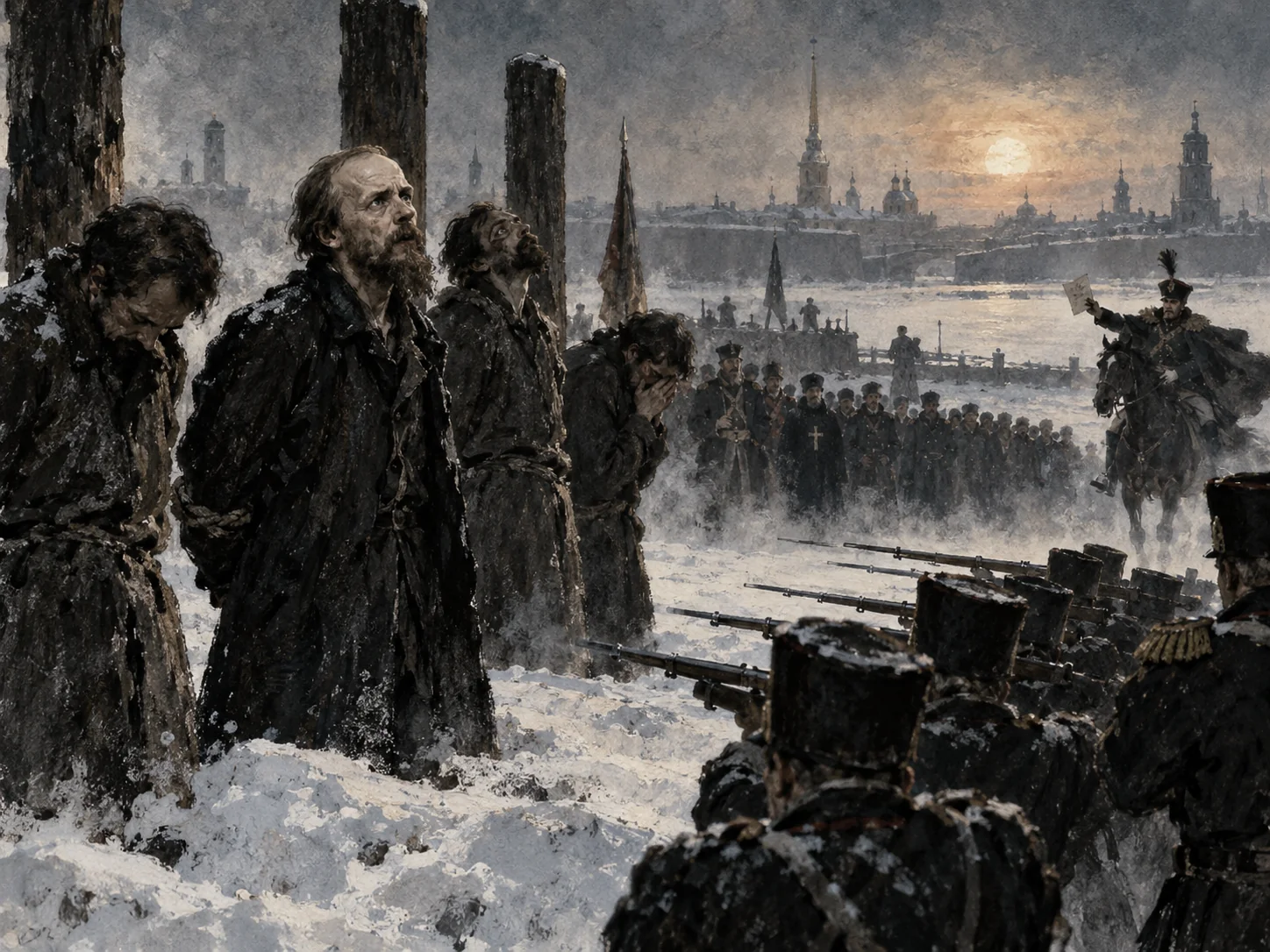
On the morning of 22 December 1849, a line of carriages left the Peter and Paul Fortress in St Petersburg and crossed the frozen city. Inside were members of a discussion group that had been arrested eight months earlier. They had been condemned to death by firing squad on 16 November, and on 22 December they were driven to the Semyonovsky drill ground.
What happened next was a piece of theatre. The men were made to kneel and kiss the cross, they were stripped of their ranks, and swords were broken over their heads. They were put into the white shirts worn by the condemned and bound to stakes in threes. Before the first group was led out, one of the prisoners whispered to his neighbour, in French, “We shall be with Christ.” The neighbour, a hardened atheist named Nikolai Speshnev, answered: “A handful of ashes.”
The man who spoke of Christ was twenty-eight. His name was Fyodor Dostoevsky. He was in the second group of three, standing beside the poets Pleshcheyev and Durov. He wrote to his brother that day that he had realised “I had only a few minutes of life before me.” He used them to embrace the two men beside him and say goodbye.
Then a drum beat the retreat. The prisoners were untied, brought back to the scaffold, and told that the Tsar had spared their lives.
That is the famous version. The twist is what the prisoners did not know. Nicholas I had already pardoned them the day before. The shrouds, the priest, the rifles and the ceremony of the broken swords were all part of the punishment, staged deliberately as macabre theatre. Not everyone survived the performance intact. One of the men tied to the first posts, Nikolai Grigoryev, went mad as soon as he was untied and never recovered his reason.
So the author of the darkest novels of the nineteenth century had his life handed back to him as a piece of stagecraft by his own government. I have come to think that everything he wrote afterwards is about one question that morning left him with: what do you owe for a life you did not expect to keep?
The title of this essay is what nearly every reader says at some point in the middle of one of his books. It is a fair question, and it deserves a long answer.
One rule before I start. Everything factual here comes from his letters, his wife’s records, and the scholars who have spent careers on him, above all Joseph Frank, whose five-volume biography is the standard work. The quotations from the novels come from the public-domain translations, so where I quote him the wording may not match your copy, but the meaning will. Where the record is disputed, I say so.Old Style and New Style dates: Russia used the Julian calendar, which in the nineteenth century ran twelve days behind the Western one. Most dates here are in the Russian calendar, as they are in his letters. Where it helps, I give both.
A boy on the hospital grounds
He was born in Moscow on 11 November 1821 (30 October in the old Russian calendar). His father, Mikhail, was a doctor at the Mariinsky Hospital for the Poor, and the family lived on its grounds. The boy grew up among patients, poverty and a very Orthodox household. His mother died of tuberculosis in 1837. The two eldest boys were sent to the military engineering school in St Petersburg.
Two years later his father was dead, and the story of how he died is the first of many twists.
On 6 June 1839, Dr Dostoevsky died suddenly on the road between his two small villages. The official cause was apoplexy, a stroke. But a darker story grew up around it: that his own serfs, pushed past endurance by a harsh master, had murdered him, and that the family and the authorities had covered it up. Freud built his 1928 essay “Dostoevsky and Parricide” on that murder. He treated it as the hidden source of the writer’s epilepsy and of his lifelong fascination with killing fathers.
It is a wonderful theory, and it is probably wrong. Frank showed that more recent research indicates the father was not murdered, and that there is no evidence of Dostoevsky’s epilepsy until almost ten years later. The scholar Thomas Marullo has since argued, with evidence that is strong though not conclusive, that the father was actually a good parent who treated his peasants decently.
The first lesson of Dostoevsky, then, is not about Dostoevsky at all. It is about us. We want great books to come from a dramatic wound, so we invent one. The truth is plainer and stranger. A doctor’s son from a pious, cash-strapped family went on to write the greatest novel about parricide ever written, and nobody knows exactly why.
The letter that nearly got him shot
In 1846 his first novel, Poor Folk, made him famous almost overnight. His career began with that triumph. The most powerful critic in Russia, Vissarion Belinsky, hailed him as a major new talent. The literary salons took him in. Within a year, after his next books flopped and his touchy vanity began to show, they were laughing at him.
He found a different crowd. From 1847 he took part in the Petrashevsky Circle, a group of intellectuals who discussed utopian socialism, and he eventually joined a smaller, secret group within it devoted to revolution and illegal propaganda. His motive appears to have been a strong hatred of serfdom rather than any sympathy with communism or terrorism.
On 23 April 1849 the members of the circle were arrested. The charges against Dostoevsky are worth reading slowly, because one of them is almost comic. Among them was reading aloud a banned letter that attacked the Orthodox Church and the Tsarist government. The letter was Belinsky’s famous attack on Gogol. Dostoevsky did not write it. He read it to a room of friends. For that, among other things, the state went through the whole performance of shooting him.
A handful of ashes
He had written to his brother on the evening of the mock execution. The most striking thing in the letter is not fear but an almost dizzy gratitude. Life, he wrote, is a gift, and “each minute could be an eternity of bliss.” Remember that sentence. It comes back at the end of this essay, and not in the way you might expect.
What came next was four years of hard labour at Omsk in Siberia, in shackles, among murderers, followed by years as a private soldier in the garrison town of Semipalatinsk. On the way into Siberia, at the transit prison in Tobolsk, he met the wives of the Decembrists, aristocratic rebels exiled a generation earlier. One of them, Natalya Fonvizina, visited him in the Tobolsk transit prison in 1850 and gave him the only book he was allowed to have: a New Testament. He kept it all his life.
In 1854, just out of prison, he wrote her a letter that has become the key to everything he believed. He described himself as a child of his century, full of unbelief and doubt, and admitted how much “terrible torments this thirst to believe has cost me”. Then he set out his creed. There was nothing more beautiful, deep or perfect than Christ. And if someone proved to him that the truth lay outside Christ, he would prefer to remain with Christ rather than with the truth.
Read that twice. It is not the confession of a man who is sure. It is the confession of a man who knows his reason might side with the atheists, and who chooses anyway. He repeated the idea in a notebook in the last month of his life: he would rather stay with a mistake, with Christ, than with his rationalist opponents.
The man who came back to St Petersburg in 1859 was no longer a socialist. He had lived shoulder to shoulder with peasants and convicts, and he came out believing in two things the educated reformers had not given him: the Russian people and Christ. But he had not stopped doubting. He had simply decided which side of the doubt he would stand on.
The worst year
In 1862 he travelled to Western Europe for the first time. He spent eight days in London during the International Exhibition of 1862 and saw the Crystal Palace, the enormous glass-and-iron building that had housed the Great Exhibition of 1851. It frightened him. The next year, in Winter Notes on Summer Impressions, he presented it as a symbol of utilitarian reason in control, a creation of the pagan god Baal, offering material plenty in exchange for spirit and freedom. Hold on to that building. It is about to become the most famous metaphor he ever wrote.
A year later, in 1863, at Wiesbaden, he played roulette for the first time, and so began an obsession that lasted until 1871. A letter to his brother Mikhail that September has an entire short story compressed into it. He believed in his system, won 600 francs in a quarter of an hour, then lost everything, staked his last coins, and lost those too. “In Geneva I pawned my watch.” He was not travelling alone. His companion that summer was Apollinaria Suslova, a young writer with feminist convictions and a temper to match his own, with whom he had begun an affair earlier that year. The relationship was stormy and ended badly, and she walked into his fiction almost unchanged: she is widely seen as the model for Polina in The Gambler and for the proud, self-destructive Nastasya Filippovna in The Idiot. Years later she married the philosopher Vasily Rozanov, seventeen years her junior.
For anyone writing in Geneva, that is a sentence that stops you. Somewhere in this city there was a pawnbroker’s counter where the future author of Crime and Punishment handed over his watch.
Then came 1863 and 1864, which took almost everything. In May 1863 the authorities banned Time, the magazine he ran with his brother Mikhail. They started a new one, Epoch. On 15 April 1864 his wife, Maria, died of tuberculosis after a long and painful illness. Three months later Mikhail collapsed, worn down by the magazine’s debts and ill, after hearing that the censors had rejected an important article. He died three days later at forty-three.
Dostoevsky took on the debts and the care of his brother’s family, and kept the magazine going until it failed. Meanwhile, in the first issues of that same failing magazine, he published a short, strange book that would outlive everything else from that year.
Two times two makes five
Notes from Underground appeared in Epoch in 1864. Dostoevsky had originally announced it under the title “A Confession.” It begins with one of the most famous openings in literature: “I am a sick man…. I am a spiteful man.”
To understand why it mattered, you need to know who it was answering. The book’s first part attacks new Western ideas, and in particular Nikolai Chernyshevsky’s novel What Is to Be Done?, published the year before and adopted as a handbook by young Russian radicals. Its philosophy was “rational egoism”. People do wrong only because they misunderstand their own interests. Show them their true interests, organise society on reason, and cruelty and misery will fade away. Its symbol of the coming world was a palace of glass and iron.
Dostoevsky had seen that palace in London. His narrator, the Underground Man, is a retired civil servant of forty who lives alone in a corner, nursing grudges, and he takes the palace apart.
Suppose, he says, science really does work out the laws of human desire and draws up tables of them, like tables of logarithms. At that point a human being will be no more than a piano key. And he predicts that people will then do something mad, simply to prove they are not piano keys. Twice two makes four is an excellent thing, he concedes, but twice two makes five is sometimes a very charming thing too.
His argument is that the reformers draw up a list of human interests and always leave one off: the freedom to choose, including the freedom to choose against your own advantage. Take that away, even in exchange for happiness, and you have taken away the person.
This is where the essay turns personal, and I should declare an interest. I design chips that read signals off the brain. In the Underground Man’s terms, I spend my working days helping to build the table of logarithms. I have read his rant about the piano key more times than I can count, and I still cannot tell whether he is warning me or mocking me.
Where I have landed is this. His case is not against science. It is against a quieter assumption: that knowing what someone wants means knowing what they will choose. The Underground Man is the part of you that sees an advert perfectly suited to your interests and refuses to click on it, out of pure spite. You have felt it. He named it in 1864.
Then the book turns. Part two, “Apropos of the Wet Snow”, is not philosophy. It is a story. A young prostitute named Liza comes to the Underground Man for help, because a few nights earlier he moved her with a speech about a better life. He humiliates her, and as she leaves he pushes money into her hand. The freedom to be spiteful turns out to include the freedom to be cruel.
And here is the biggest twist, the one that changes how the whole book should be read. On 26 March 1864 Dostoevsky wrote to his brother in fury about what the censor had done to Chapter 10 of Part One. The “censor pigs”, he complained, had let through every passage where he mocked everything and sounded close to blasphemous, but had cut the parts where he showed that all this led to the need for faith in Christ. The book has stayed secular ever since, because Dostoevsky never restored the missing passage.
So the book that twentieth-century existentialists adopted as a founding text was, in its author’s mind, an argument for Christ with the ending cut off.
The arithmetic of an axe
Crime and Punishment began to appear in The Russian Messenger in January 1866 and ran until December. It opens with a former student lying in a room shaped like a coffin, doing sums.
In a tavern, Raskolnikov overhears a conversation that puts his own thought into words. There is an old pawnbroker who is mean, useless and harmful. Kill her, take her money, and use it for a hundred good deeds. As the student in the tavern puts it: one death, and a hundred lives in exchange; it is simple arithmetic. Raskolnikov has also written an article arguing that extraordinary people, the Napoleons of history, have the right to step over a corpse if their idea requires it.
So he takes an axe and kills the pawnbroker. Then her gentle half-sister Lizaveta walks in unexpectedly, and he kills her too.
Watch how early the sum fails. The second body was never in the calculation. Cost-benefit ethics meets the real world and immediately runs into a person nobody counted. Dostoevsky did not need a lecture to refute his hero’s theory. He needed one unexpected visitor.
The next twist is structural. This is not a mystery. You watch the murder happen early on, and the remaining several hundred pages are about what happens afterwards. The investigator, Porfiry Petrovich, barely bothers with evidence. He talks, and waits, because he understands that the idea will rot from the inside. It does. Raskolnikov discovers that he is not a Napoleon. It was not the old woman he destroyed, he realises, but himself.
The person who saves him is Sonya, a young girl who has been driven into prostitution to feed her family. She reads him the story of Lazarus rising from the dead. He confesses, and he is sent to Siberia, where Dostoevsky himself had been.
Why did the theory make sense to anyone? Because in the 1860s it was not a novelist’s invention. The young Russian radicals really did argue that morality was superstition and that the only real question was what was useful. Dostoevsky’s contribution was to show where that logic leads when a lonely, proud, hungry young man takes it seriously.
He wrote the trolley problem as a thriller, a century before philosophers gave it that name, and showed you what it does to the person who pulls the lever.
Twenty-six days
Now the story takes a turn that no editor would accept in a novel.
While Crime and Punishment was appearing month by month, Dostoevsky was also caught in a trap he had set for himself. Desperate for money, he had signed a contract with a publisher named Fyodor Stellovsky. If he did not deliver a new novel of a set length by 1 November 1866, Stellovsky would gain the right to publish all of Dostoevsky’s work, without paying him anything, for nine years, until 1 November 1875.
Absorbed in Crime and Punishment, he did not turn to the contract until early October 1866, leaving himself four weeks. Friends offered to write the novel for him in pieces, and he refused. Instead he hired a stenographer. She was Anna Snitkina, one of the first stenographers in Russia. He dictated, and she took it down in shorthand and made a clean copy. Working together from 4 to 29 October 1866, they produced The Gambler. Its heroine, Polina, whom the narrator loves and resents in equal measure, is Suslova, three years on.
Stellovsky had one more move. He shut his office and left town, so the manuscript could not be delivered on time. On advice Anna obtained from a lawyer, Dostoevsky registered the manuscript with the police officer of Stellovsky’s district instead, and got a receipt, two hours before the deadline.
A novel about a gambling addict, written in twenty-six days to escape a contract signed by a gambling addict, delivered by a man who had learnt something from the stenographer’s common sense. He married her a few months later, on 15 February 1867. He was twenty-five years older than she was. On their honeymoon they spent five weeks in Baden-Baden, where he lost all their money at roulette again. He lost her clothes and belongings too.
She stayed. After years of borrowing and pawning, he finally gave up gambling in 1871. Anna ran the finances, published his books herself, and after his death became the guardian of his work. The quieter truth behind the great novels is that they were made possible by a woman who could read shorthand and a balance sheet.
Geneva, 1868
To escape their creditors, the couple lived abroad for over four years, until July 1871. For almost a year they lived in Geneva, where Dostoevsky worked extremely hard to recover his fortunes.
It is here that the story comes closest to where I am writing it. On 5 March 1868 their first daughter, Sofia, was born. She died of pneumonia on 24 May, three months old, and was buried in the Cimetière des Rois in Plainpalais. Her grave was later cleared, as old graves there are; in 1986 the International Dostoevsky Society placed a plaque in her memory.
He was writing The Idiot in those years. It is his attempt to put a truly good man, a Christ-like figure, into the modern world and see what happens. Prince Myshkin is gentle, honest, and epileptic, like his author. He describes the moment just before a seizure as a flash of complete harmony, so intense that a whole life might be worth that one second. Dostoevsky was describing his own seizures.
What happens to the good man is the twist. He does not save anyone. The women who love him are destroyed, the man who loves the same woman commits murder, and Myshkin ends the novel sunk back into idiocy. Dostoevsky set out to show that goodness could survive among us, and wrote a book suggesting that it cannot. The idea that beauty will save the world comes from this book. So does one of the most searching demonstrations that it might not.
The Idiot also contains the mock execution. What Dostoevsky may have felt that morning is reflected in one of Myshkin’s monologues. I am saving that scene for the end.
The second of harmony
There is one passage in The Idiot that I read differently from most people, because of what I do for a living.
Before his seizures, Myshkin says, there comes a moment of extraordinary light: a feeling of complete harmony, clarity and reconciliation, so intense that for that one second he would give his whole life. Afterwards, in the dark of the fit and the dullness that follows it, he wonders whether the feeling was simply part of the illness. And he decides that it does not matter. If in that second he felt the highest synthesis of life, what difference does it make that it was a disease?
Dostoevsky was describing his own seizures, and neurologists have taken him at his word. The condition is now called ecstatic epilepsy, and it is rare: a form of focal epilepsy in which the seizure begins not with fear or confusion but with bliss. Patients describe physical well-being, a sudden mental clarity, a sense of oneness with the world, and time seeming to stretch. Some of the most important work on it has been done here in Geneva, by the neurologist Fabienne Picard at the Geneva University Hospitals, who has linked these auras to a region deep in the brain called the anterior insula. In 2019 a team led by Fabrice Bartolomei in Marseille reported reproducing ecstatic feelings in patients by stimulating that region directly with electrodes.
The insula is involved in how we sense the state of our own body and in how the brain monitors uncertainty, the gap between what it expects and what happens. Picard has proposed that the ecstatic aura may be what it feels like when that monitoring of uncertainty is switched off: a moment in which, for once, nothing is in doubt.
I find this the most moving hypothesis in the whole story, and I hold it lightly, because it is a hypothesis. But consider it for a moment. Here is a man who described himself as a child of unbelief and doubt, who spent his life writing arguments he could not win, who chose Christ over the truth because he was not sure the truth was on Christ’s side. And the one time in his life he felt total certainty, he felt it in the second before his brain misfired.
I design chips that read signals off the brain. Somewhere in the recordings from a patient with this condition, there is a trace of Myshkin’s second: a pattern of electrical activity that, for its owner, was worth a whole life. I do not think that makes the experience less real. Dostoevsky, through Myshkin, had already answered that question a hundred and fifty years before anyone could measure it. What difference does it make that it was a disease?
The one time in his life he felt total certainty, he felt it in the second before his brain misfired.
A murder in a Moscow park
On 21 November 1869, Sergei Nechayev and four others lured a student named Ivan Ivanov, who had tried to leave their group, to a grotto on the grounds of the Petrovsky Agricultural Academy in Moscow, and killed him there. Nechayev tried to strangle him, was badly bitten on the hand, drew a pistol and shot him in the head. The body was weighed down with stones and pushed through a hole in the ice of a nearby pond.
Why kill one of your own? It removed a possible rival and at the same time implicated Nechayev’s comrades in a crime, which guaranteed their obedience. A group that has committed a murder together is a group bound to its leader.
Nechayev had co-written a pamphlet, the Catechism of a Revolutionary. Its first line reads: “The revolutionary is a doomed man.” Most Russian revolutionaries were repelled by the idea that the end justified any means, but some admired his total commitment, and historians have long argued over how much Lenin’s methods owed to him.
Here is a twist I did not expect to find. After the murder, Nechayev escaped arrest and on 15 December 1869 fled Russia, heading back to Geneva. In August 1872 he was arrested in Zurich and handed over to the Russian police. So the real-life model for Dostoevsky’s most frightening revolutionary spent his exile in the same city where Dostoevsky had just buried his daughter.
Dostoevsky, living in Dresden by then, followed the case closely. He had heard about Ivanov through his brother-in-law, a student at the same academy, and he was horrified by the murder. He vowed to write a political novel about what he called “the most important problem of our time”.
The result was Demons, serialised in 1871–72. The novel is full of people for whom an idea has become more real than any person. Pyotr Verkhovensky, modelled on Nechayev, runs a small cell held together by complicity. Kirillov has reasoned his way to the belief that killing himself will prove that man is free and has become God. Shigalyov presents a plan for the perfect society and admits, a little embarrassed, that having started from unlimited freedom he has ended with unlimited despotism.
At the centre is Stavrogin: handsome, magnetic, admired by everyone, and completely empty. The others build their ideas around him, and he believes in nothing. In one chapter, “At Tikhon’s,” he confesses to a monk that he abused a young girl, who then killed herself. The editor, Mikhail Katkov, insisted the chapter be removed from the magazine. Dostoevsky valued it highly and tried several revisions, none of which satisfied Katkov. He never restored it to later editions. Most editions now print it as an appendix. It is the key to Stavrogin: everything that follows is a man trying to feel something and failing.The chapter “At Tikhon’s” was cut when Demons was first published and did not appear in print until 1922. Editions differ on where they place it.
Read Demons after 1917 and it is hard to believe it was written in 1871. The cell bound by complicity, the purges, the intellectual who becomes an executioner, the theory that ends in a camp: it is all there. Albert Camus, who adapted it for the stage, called it one of the four or five works he ranked above all others. He directed the production at the Théâtre Antoine in 1959, the year before he died, and paid for it partly with his Nobel Prize money.
The twist is that a conservative wrote it to mock the left, and the most useful way to read it today is as a warning about any movement, of any colour, that asks its members to prove their loyalty by giving up their consciences.
A boy named Alyosha
On 16 May 1878, Dostoevsky’s three-year-old son Alyosha had an epileptic seizure that lasted twelve hours and forty minutes, and died. The child had most likely inherited the disease from his father, and that fact haunted Dostoevsky for the rest of his life.
Anna saw that he was burying his grief, and she asked for help from a young friend, the philosopher Vladimir Solovyov. Solovyov agreed to take Dostoevsky to the Optina monastery in late June. They arrived on 25 June, and Dostoevsky asked for a memorial service for his son the next day. There he met the elder Ambrose. Anna believed that the words of the elder Zosima in the novel, consoling a mother who has lost her child, echo what Ambrose said.
Then he went home and wrote The Brothers Karamazov. The magazine The Russian Messenger serialised it from January 1879 to November 1880. He did two things with names that tell you everything. He gave the gentle youngest brother his dead son’s name. And he gave the lecherous, buffoonish father his own first name, Fyodor.
The best argument against God ever written
Ivan Karamazov, the middle brother and an intellectual, sits in a tavern with Alyosha and makes his case. He does not argue that God does not exist. He grants that God exists. What he refuses is God’s world.
He has been collecting newspaper stories about cruelty to children, and he tells them to his brother one after another. Dostoevsky took all of these cases from real newspaper reports. At the end Ivan says this. Suppose that at the end of time everything is reconciled, and the tears of tortured children turn out to have been part of the price of a final harmony. Then he wants nothing to do with that harmony. The price is too high. And so, he says, he hastens to return his ticket.
Then he tells the story of the Grand Inquisitor. Christ returns to earth in sixteenth-century Seville, at the height of the Inquisition. He heals the sick and raises a dead child. In the whole legend Jesus speaks only two words, in Aramaic, “talitha cumi” (“little girl, arise”), as he raises the child. The old Cardinal Inquisitor has him arrested, and at night he visits the cell to explain himself.
The Inquisitor’s charge is devastating. Christ, he says, burdened humanity with freedom, and people cannot bear it. When Satan tempted Christ in the wilderness, Christ refused the three things people actually want: bread, miracle, and authority. The Church has since corrected his mistake. It gives people bread, mystery and someone to obey, and it takes their freedom off their hands out of love for the weak. Now it will have to burn Christ, because he threatens that bargain.
Christ says nothing. At the end he walks over and kisses the old man on his bloodless lips. The Inquisitor shudders, opens the door, and tells him to go and never come back.
Then Ivan stops, a little embarrassed. He asks his brother whether he will reject him because Ivan will not give up the formula “everything is permitted”. Alyosha says nothing and kisses Ivan on the lips. Ivan calls it plagiarism, and he is delighted.
The twist is this. A devout Christian wrote the strongest argument against his own faith, and it is the part of the book everyone remembers. He knew the risk. In May 1879 he told his editor, Lyubimov, that he was writing the chapter on the monk Zosima “with fear, trepidation and awe”. In August he wrote to Pobedonostsev that he would answer Ivan not point by point but indirectly, through an artistic picture. He added that this was what worried him: “will I be understood and will I achieve anything of my aim?”
Zosima’s answer is not an argument. It is a life. His teaching is that each of us is responsible to everyone, for everyone and for everything. Ivan asks why God permits suffering. Zosima replies, in effect: you, at least, can stop adding to it. It does not refute Ivan. It changes the subject from explaining evil to answering for it, and I have never decided whether that is the most profound move in the book or its most elegant evasion.
The Grand Inquisitor and the algorithm
What follows is my own reading, not a claim about what Dostoevsky intended. But once you have seen it, it is hard to stop seeing.
The Inquisitor’s offer has three parts. Give people bread, meaning material satisfaction. Give them miracle and mystery, meaning something wonderful they do not need to understand. And give them authority, meaning someone who decides for them. In exchange, take away the burden of choosing. He is not a villain in his own eyes. He is the most compassionate man in the story. He has looked at human freedom, seen that it produces misery, and decided to relieve people of it for their own good.
Now describe a well-designed recommendation system. It gives you exactly what you want before you know you want it. It works by processes you cannot see and would not understand if you did. And it decides, gently and constantly, what you will see next. Its designers mostly believe they are serving you, and in a sense they are. Very few people using it feel unfree. That is the point. The Inquisitor’s great insight was that people do not want freedom taken from them by force. They want to hand it over, and to be thanked for doing so.
I do not think this makes engineers Inquisitors. I am one of the engineers. But the legend asks a question that product meetings rarely do: what if the thing people most want from you is the thing you should not give them? Dostoevsky’s Christ does not argue with the Inquisitor. He does not overthrow the system. He kisses the old man and walks out. The only alternative the legend offers is a kind of respect for the other person’s freedom, even when that freedom will hurt them. I don’t know how to build that into a product. I suspect that is exactly the problem.
The line he never wrote
One more twist before we leave the book, because it concerns the most quoted sentence Dostoevsky is supposed to have written.
“If God does not exist, everything is permitted.” It is everywhere, attributed to The Brothers Karamazov. But the tidy sentence is not in the novel. Its most influential attribution is Sartre’s, in Existentialism Is a Humanism in 1946: “Dostoevsky once wrote: If God did not exist, everything would be permitted.” The nearest the book comes is a few approximations, such as Dmitri reporting a debate in which he asked what would become of people without God and immortality, and whether everything would then be permitted. The idea is Ivan’s, passed from character to character as a slogan. Some readers who know Russian argue that the original wording is closer to the famous version than English translations suggest. But the neat, quotable sentence belongs to Dostoevsky’s readers more than to him.
So what was his philosophy?
He never wrote a system, and he would have distrusted anyone who did. But five convictions run through everything.
- Freedom is our deepest need and our heaviest burden: the Underground Man and the Grand Inquisitor are the two halves of that sentence.
- Reason alone cannot hold up morality: Raskolnikov, Kirillov and Shigalyov.
- Suffering can purify: his most dangerous idea, and I come back to it below.
- Everyone is responsible for everyone: his answer to evil, a duty rather than an explanation.
- The educated must return to the soil: pochvennichestvo, his and his brother’s name for reconnecting Russia’s Westernised intellectuals with the faith of the common people.
The Russian critic Mikhail Bakhtin, in his 1929 study Problems of Dostoevsky’s Art, named what matters more than any single conviction: the novels are polyphonic. Every character argues in a full voice of their own, and the author does not shout them down. He let his opponents win their arguments inside his own books, which is why atheists, existentialists, Christians and psychoanalysts have all claimed him. Walter Kaufmann began his 1956 anthology Existentialism from Dostoevsky to Sartre with Notes from Underground.
What he does to you
Reading Dostoevsky is a physical experience. He writes the emotions other novelists politely leave out: shame, and the strange pleasure of being humiliated, as when Marmeladov describes drinking away his daughter’s earnings to a tavern full of strangers with something close to relish; spite, like the Underground Man’s pleasure in a toothache; and above all what Russians call nadryv, tearing yourself open in public and loving in a way that wants to be wounded.
His scenes are built like fevers: eight people in a room, all shouting, a confession, money thrown into the fire, a scandal. And part of that pace, the unromantic twist, came from money. He was paid by the instalment and always in debt, and every magazine part had to end on something that would sell the next issue. The intensity philosophers treasure was partly the cliffhanger of a man who needed to be paid.
The last thing he does to you is the one that stays. He makes you feel compassion for people you would cross the street to avoid: a murderer, a drunk, a prostitute, a buffoon of a father. That is what his idea of universal responsibility feels like from the reader’s side. You close the book, and it turns out he was talking about everyone.
The man he never met
Russian literature in those years had two giants, and they spent their lives some five hundred miles apart. Tolstoy was a count, living on his estate at Yasnaya Polyana, writing about battles, ballrooms and harvests with a calm, all-seeing eye. Dostoevsky was a former convict in rented rooms in St Petersburg, writing about fevered students and drunks at two in the morning. The critic George Steiner later wrote a whole book, Tolstoy or Dostoevsky, arguing that readers tend to belong to one or the other.
They never met. Once, they came very close. In 1878 both attended one of Solovyov’s lectures on “Godmanhood”, but they were not introduced. It was the only time they were ever in the same room. The man who brought Tolstoy was their mutual friend, the critic Nikolai Strakhov, who had reportedly promised not to introduce Tolstoy to anyone.
In 1880, ill, Tolstoy reread Notes from the House of the Dead, Dostoevsky’s account of prison. He wrote to Strakhov that he knew no better book in modern literature, and ended by asking Strakhov: if you see Dostoevsky, “tell him I love him”.
A few months later Dostoevsky was dead. Tolstoy’s letter to Strakhov is one of the saddest documents in Russian literature. He wrote that he had never seen the man and never had any direct relations with him, but that when he died he suddenly realised Dostoevsky had been to him “the most precious, the dearest, and the most necessary of beings.”
The admiration was never uncritical. In later years Tolstoy praised The Brothers Karamazov, especially the Grand Inquisitor and the Zosima chapters, but criticised Dostoevsky’s “slipshod manner of writing” and unnatural dialogue.
And there is a strange final chapter. In October 1910, at eighty-two, Tolstoy fled his home in the middle of the night. He went first to the Optina monastery, where Dostoevsky had found comfort in 1878 while writing The Brothers Karamazov. Twice on 28 October he walked towards the hermitage of the elders, and twice he turned back, full of doubt. He died days later at the railway station of Astapovo. Several accounts say The Brothers Karamazov was the last book he was reading.Tolstoy’s final reading comes from later accounts, not from a document I could trace directly. His opinions of Dostoevsky are documented in his letters and diaries.
The two men never exchanged a word. At the end, one was walking to the monastery the other had written about, carrying the other’s last novel.
The hostile guide
If Tolstoy is the rival who loved him from a distance, Nabokov is the enemy who read him closely.
Nabokov taught Russian literature to American undergraduates for two decades, first at Wellesley and then at Cornell. His lecture notes were published after his death as Lectures on Russian Literature. In them he admits that his position on Dostoevsky is a difficult one, and then declares him “not a great writer, but a rather mediocre one”, with flashes of humour and wastelands of platitude between them. He says openly that he is eager to debunk him.
He was not being casual about it. Across interviews, letters and lectures for decades, Nabokov kept repeating that Dostoevsky was a third-rate writer whose fame rested on misreading, a mediocre author of sentimental gothic novels. His one-liners are as cruel as they are funny. He called The Brothers Karamazov “a riotous whodunit — in slow motion”. Elsewhere he called Dostoevsky a “cheap journalist” and a “crude comedian”.
Nabokov is worth taking seriously because some of his charges are true. The sentences are often clumsy and repetitive. The plots lean on coincidence and conversations conveniently overheard. The characters are often voices for ideas more than people you could meet. The weather barely exists.
But his hostility also reveals something. Nabokov judged novels as works of verbal art, and by that standard Dostoevsky often fails. Dostoevsky was not really trying to make beautiful objects. He was trying to stage arguments that could not be resolved, and to make you feel their weight. Nabokov is right about the prose and wrong about the point. Reading the two of them together is the best way I know to see both what Dostoevsky could not do and what nobody else has done.
Where he breaks down
Now the part his admirers skip.
His antisemitism. Dostoevsky spent his last decade publishing a monthly one-man magazine called A Writer’s Diary, which contains some of his finest short fiction and some of his ugliest writing. His essay “The Jewish Question,” published in the March 1877 issue, portrays Jews as the implacable enemies of the Russian people, while still calling for them to have full rights. The poison reaches the novels too. The Brothers Karamazov refers directly to a ritual-murder trial of 1878–79, in which the Jewish defendants were acquitted. When a character asks Alyosha whether it is true that Jews torture Christian children, he replies that he does not know. Critics are still divided over how harshly to judge that silence.
The picture is not simple, and the scholars who know him best say so. Frank noted that Dostoevsky’s references to Jews in his fiction and his Diary are invariably uncomplimentary. Yet he corresponded frankly and courteously with at least two Jewish correspondents, tried to help them, and insisted that “there has never been such a hatred in my heart.” Even so, Frank said David Goldstein’s book on the subject left him with an unrelieved sense of dismay. That is the right feeling to have.
His politics. He cheered Russia’s war against Turkey in 1877, believed Russia was destined to save the world, and had little patience for Catholics or Poles. He was also a friend of Konstantin Pobedonostsev. Through the 1870s Pobedonostsev corresponded with Dostoevsky, valued his religious and nationalist ideas as useful to a government fighting revolution, and discussed parts of The Brothers Karamazov with him while it was being written. From 1880 to 1905 Pobedonostsev was the lay official in charge of the Russian Orthodox Church, and under Alexander III he was the chief voice of reaction and the power behind the throne. He was nicknamed the “Grand Inquisitor”, and his influence lay behind the repression of religious and ethnic minorities and liberal intellectuals.
That is the ugliest twist in the whole story. Some believe Pobedonostsev was himself one of the models for the Grand Inquisitor. The man who wrote the greatest attack on religious authority ever put into a novel was the friend and ally of the man who became its real-life embodiment.
His theology of suffering. The idea that suffering purifies is beautiful as a description of someone who has suffered and grown. It is monstrous as a prescription for other people. Sonya sells herself to keep her family alive, and the novel makes her a saint without ever asking who put her on the street. His women are mostly saints or hysterics.
His answer to Ivan. Zosima’s teaching is moving, and I think it is true as a way to live. But it is a sermon offered in reply to a court case. Ivan’s children are still on the table at the end of the book. Dostoevsky gave the unbeliever the argument and the believer the aura. That is honest, and it is not a victory.
In fairness, he usually put the case against himself into his own books. Ivan is the best critic of Zosima, and the Underground Man is the best critic of the Crystal Palace. His journalism is where he had no characters to argue back, and that is where he is at his worst.
Why he is still here
The roll call of people he influenced is almost comic. Nietzsche wrote that Dostoevsky was “the only psychologist … from whom I had anything to learn”, and counted him among the luckiest finds of his life, even more so than Stendhal. That was in Twilight of the Idols, one of the last books he wrote before his mental collapse.
Freud, in the parricide essay, went further. He placed Dostoevsky not far behind Shakespeare and wrote that “The Brothers Karamazov is the most magnificent novel ever written.” In the same essay, the founder of psychoanalysis admitted that, faced with the problem of the creative artist, analysis had to lay down its arms.
Einstein is reported to have said that Dostoevsky gave him more than any scientist, more even than the mathematician Gauss. C. P. Snow recalled that Einstein regarded The Brothers Karamazov as the supreme summit of literature, and that he still thought so when they spoke in 1937.The Einstein remark about Gauss is widely quoted, usually traced to his early biographer Alexander Moszkowski. I have treated it as reported rather than documented.
But the real reason he is still read is that his cast of characters has walked out of the nineteenth century and is living among us.
The Underground Man now has a broadband connection. His spite, his wounded pride and his rage at a world that ignores him are the ordinary weather of the internet’s worst corners. The Crystal Palace is being built from data, and the question of whether a predicted person is still a free one has moved from philosophy seminars to product meetings. The cell bound by shared guilt, the clever young man who reasons his way to violence, the brilliant idea that ends with someone’s blood on the floor: none of these disappeared with the Tsars.
Every age finds its own Dostoevsky. The twentieth century found the prophet of totalitarianism. Ours may find the prophet of the feed.
Should you read him deeply?
Yes, with three warnings.
Read him because nobody describes better the moment when a clever idea becomes permission to hurt someone. That moment happens in dormitories, boardrooms, parliaments and online forums, and it is worth learning to recognise it from the inside.
Read him because he takes both belief and unbelief more seriously than almost anyone. He will not let the believer skip Ivan’s children, and he will not let the atheist skip the question of what holds morality up once God is gone.
But read him warily in three places. Where he writes about Jews, Poles and Catholics, he is a hostile witness, not a prophet. Where he praises suffering, take it as a description of how some people survive, not as advice. And where his characters argue brilliantly for terrible things, remember that he gave them the best lines on purpose, so that you would feel how persuasive the terrible can be.
People say he is too dark to read when you are low. I think it is the other way round. Nobody writes despair more precisely, and nobody refuses more stubbornly to let it have the last word.
If you want an order, start with Notes from Underground, because it is short, and read the censorship letter alongside it. Then Crime and Punishment, then The Brothers Karamazov. Keep Nabokov’s lecture nearby as a hostile second opinion. Save Demons for when you are ready for it, and The Idiot for when you want your heart broken slowly. For translations, Constance Garnett’s older versions read smoothly. Richard Pevear and Larissa Volokhonsky’s are rougher and closer to the Russian, and Dostoevsky’s Russian was rough.
The last minute
In June 1880 Dostoevsky had the greatest public triumph of his life. On 8 June (20 June in the modern calendar) he gave a speech at the unveiling of the Pushkin monument in Moscow. It crowned his final years, raised him to the status of a prophet, and confirmed him as the greatest living Russian writer. Almost immediately, the audience’s enthusiasm turned into a fierce public argument about what he had meant. Of course it did.
He died on 28 January 1881, a little over six months later. The cause was a haemorrhage in the lungs, associated with emphysema and an epileptic seizure. Tens of thousands of people followed the coffin through St Petersburg to the Alexander Nevsky Lavra. Among those carrying it were Pleshcheyev and Palm, his comrades from the Petrashevsky Circle. Two of the men who had stood with him on the parade ground in 1849 carried him to his grave.
His tombstone bears a verse from the Gospel of John, which is also the epigraph of The Brothers Karamazov: “Except a corn of wheat fall into the ground and die, it abideth alone: but if it die, it bringeth forth much fruit.”
And now the scene I promised.
Early in The Idiot, Prince Myshkin tells a group of women about a man he once knew. The man was led out to be shot for a political crime and stood with only minutes left to live. The worst thing, the man told him, was a single thought that kept coming back: what if he were not to die? What if he could go back to life? He would turn every minute into an age. He would count every minute and waste none. He was spared at the last moment.
One of the women asks the obvious question. What did he do with that life? Did he live as he had sworn, counting every minute?
No, says the prince. He told me himself: he didn’t live like that at all; “he wasted many, many minutes.”
“He wasted many, many minutes.”
Now put that beside the letter written on the evening of the mock execution, the one that said each minute could be an eternity of bliss. Twenty years later, through the mouth of a holy fool, Dostoevsky tells you he did not keep the vow. He gambled, he quarrelled, he pawned his watch in Geneva and his wife’s dresses in Baden-Baden, and he wrote cruel articles about entire peoples. He was given a life for nothing, and he spent a lot of it badly.
He also spent it asking the only question that morning had left him with. If your life is not your own achievement, what is it for? He refused to let reason answer too easily, and he refused to let God answer too easily. When neither answer held, he wrote the argument down anyway, with both sides at full volume.
So, what the fuck, bro? This, as far as I can tell. He was a man who had stood in front of a firing squad and learnt the difference between an idea and a life. He spent the rest of his life trying to make sure his readers would not have to learn it the way he did.
In Plainpalais, not far from where I am writing this, there is a plaque for a girl who lived three months in 1868. Her father was the man who had stood at the post in the snow. By the time she was born he had lost his brother and his first wife, pawned his watch in this city, and signed away his future to a publisher and won it back in twenty-six days. He buried her here and went on writing. Every minute he did not waste after that is in the books.
Sources
- Britannica: Fyodor Dostoyevsky and Political activity and arrest
- UBC Wiki: The Mock-execution of Fyodor Dostoevsky
- Public Domain Review: Reborn Into a New Form (Alex Christofi)
- Crime and Punishment, Translator’s Preface (Dostoevsky’s letter to Mikhail)
- Literary Hub: The hoax execution
- The Daily Economy: Two Centuries of Dostoevsky
- Commentary: review of Joseph Frank, The Seeds of Revolt
- Gary Saul Morson, New York Review of Books: Dostoevsky and His Demons
- Was Dostoevsky’s Father Murdered?
- Springer, Sophia: Anti-theodicy Radicalised (Fonvizina letter and last notebook)
- Taylor & Francis: Imago Dei anthropology in The Brothers Karamazov
- Cambridge University Press: Christian Themes in Crime and Punishment (the censorship letter)
- Springer: Dostoyevsky, Eastern Orthodoxy, and the Crystal Palace
- Alma Classics: The Gambler introduction (Hugh Aplin)
- FemBio: Anna Dostoevskaya
- Anna Dostoevskaya (Wikipedia)
- Mikhail Dostoevsky (Wikipedia)
- Find a Grave: Sofia Dostoevskaya, Plainpalais, Geneva
- Encyclopedia.com: Sergei Nechayev
- Spartacus Educational: Sergei Nechayev
- Demons (Wikipedia)
- Pravoslavie.ru: the suppressed chapter
- Open Culture: Camus on The Possessed
- Camus, The Possessed, foreword
- OrthoChristian: Optina Pustyn
- Ecstasy, Epiphany and Epilepsy
- The Brothers Karamazov, Everyman introduction (Dostoevsky’s letters to Lyubimov and Pobedonostsev)
- The Mallard: Dostoevsky’s Answer to the Problem of Evil
- ABC Religion & Ethics: Slavoj Žižek on “everything is permitted”
- Cambridge University Press, Dostoevsky in Context: Jews, race, and biology
- Joseph Frank, New York Review of Books: His Jewish Problem
- Britannica: Konstantin Pobedonostsev
- Tchaikovsky Research: Konstantin Pobedonostsev
- Cambridge University Press, Slavic Review: Toward Understanding Stavrogin (Nietzsche quotation)
- Partisan Review 1946 (Freud quotation)
- University of Toronto Press journal: Dostoevsky and Solovyov (Tolstoy at the lecture)
- Dostoevsky in the Judgment of his Contemporaries (Tolstoy’s letters to Strakhov)
- Tolstoy’s Diaries, edited by R. F. Christian
- Astapovo: Retracing Tolstoy’s final journey
- ResearchGate: Orhan Pamuk and Vladimir Nabokov on Dostoevsky
- Taylor & Francis: Nabokov, Dostoevsky, and “Dostoevskyness”
- Jonathan Rosenbaum: review of Nabokov’s Lectures on Russian Literature
- Dostoevsky’s Pushkin Speech (Wikipedia)
- OrthodoxWiki: Fyodor Dostoevsky
- Springer: Freeborn, Russian Literary Attitudes
- The Gambler (Wikipedia): Wiesbaden, the 1863 letter, and the manuscript lodged with the police)
- Vremya (magazine) (Wikipedia))
- Existentialism Is a Humanism (Wikipedia)
- Internet Infidels: Dostoevsky didn’t say it
- Cimetière des Rois (Wikipedia)
- Scielo: Alyosha Dostoevsky’s death during an epileptic seizure
- Russia Beyond: did Dostoevsky and Tolstoy meet?
- Konstantin Pobedonostsev (Wikipedia)
- Lapham’s Quarterly: Einstein on Dostoevsky
- Polina Suslova (Wikipedia)
- Picard and colleagues, “Epilepsy and Ecstatic Experiences: The Role of the Insula”, Brain Sciences (2021)
- Picard, “Insights from Ecstatic Epilepsy: From Uncertainty to Metacognitive Feelings” (2024)
- Journal of Cognitive Neuroscience: ecstatic or mystical experience through epilepsy
- The Idiot (Wikipedia)