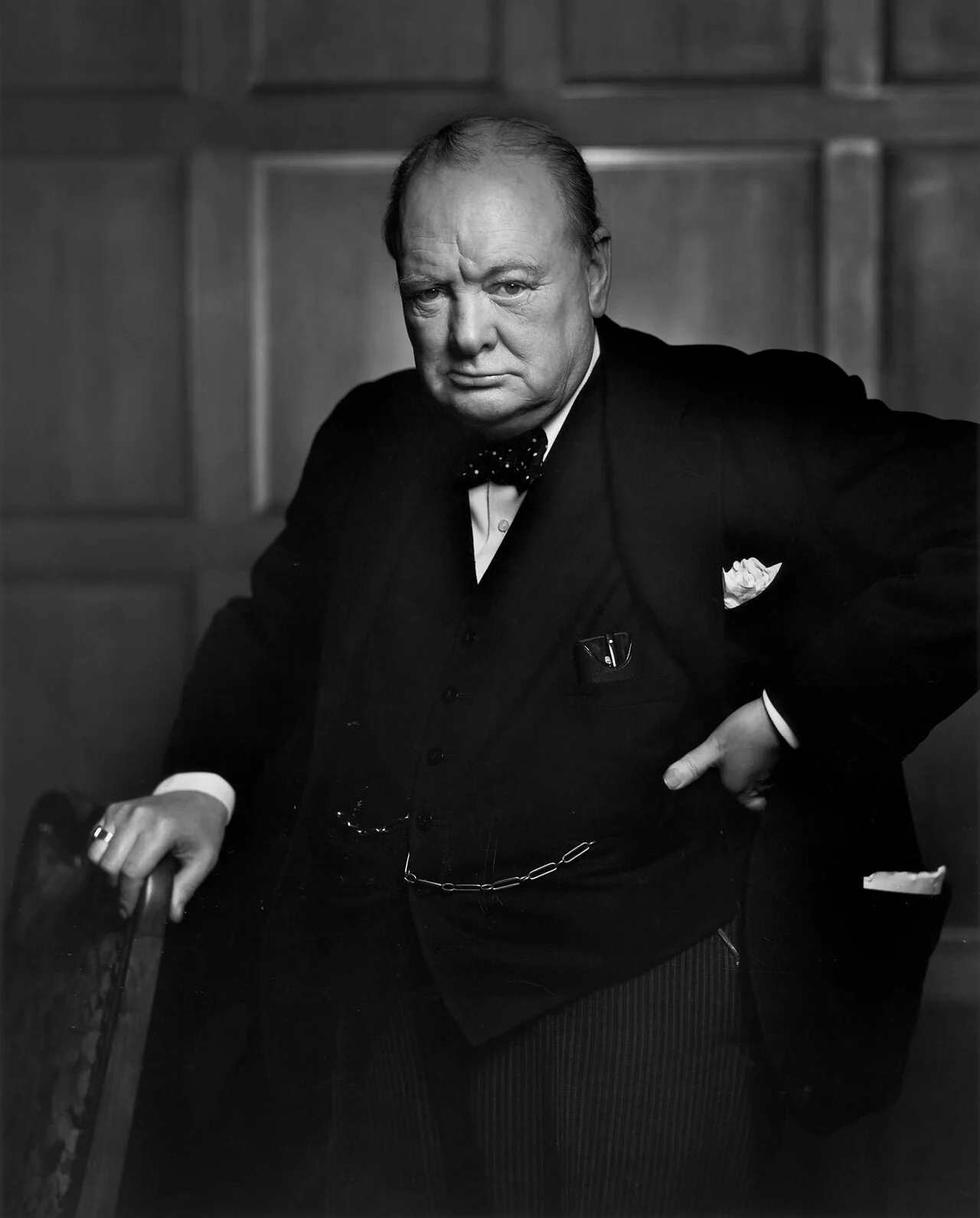
Eighty years ago, in September 1946, Churchill gave a speech in Zurich calling for “a kind of United States of Europe.” In this part of the world it is still treated as one of the founding texts of the Europe we now live in. The speech was given in a country he never had to conquer, to a continent he had just helped save.
I grew up in India, where Churchill’s name tends to come with a famine attached. I now live in Europe, where it comes with a victory attached. For a long time I assumed one of these must be propaganda. This essay is my attempt to explain why neither is.
One rule before I start. There are three kinds of evidence against Churchill, and they are not equally strong. The first is what he said. The second is what he decided. The third is what was done by people he was responsible for. His critics often run the three together, and his admirers use the blur to wave away all three. I will try to keep them apart. Where historians are still fighting, I say so in the notes.Most of the private remarks about India come from two diaries, Leo Amery’s and Lord Wavell’s. Both men were Churchill’s colleagues, not his enemies, which gives their evidence weight. But several of the famous lines rest on one witness, and I have tried to say “is recorded as” rather than “said” where that is the case.
A life in five acts
He was born in 1874 at Blenheim Palace, the grandson of a duke. His father, Lord Randolph Churchill, was a brilliant politician and a distant parent. His mother, Jennie Jerome, was American. He did badly at school, got into Sandhurst at the third attempt, and joined the cavalry.
Between 1895 and 1900 he went looking for wars. He found them in Cuba, on India’s North-West Frontier, in the Sudan and in South Africa. He wrote about every one of them for the newspapers. In the Boer War he was captured, escaped, and came home famous. He entered Parliament in 1900 as a Conservative. In 1904 he crossed to the Liberals over free trade, and twenty years later he crossed back. He is supposed to have remarked that anyone can rat, but it takes ingenuity to re-rat.
As a young Liberal minister he was a real reformer. He helped create labour exchanges and minimum wages in the sweated trades, and at the Home Office he pushed through prison reform. As First Lord of the Admiralty from 1911 he switched the fleet from coal to oil. In 1915 he championed the Dardanelles campaign, which became the disaster at Gallipoli. He resigned and went to command a battalion in the trenches. He came back as Minister of Munitions, then served as Secretary for War and Air, then for the Colonies. As Chancellor in 1925 he put Britain back on the gold standard at the pre-war rate, a decision Keynes demolished and he later regretted.
In the 1930s, out of office, he ran two campaigns at once. One was against Hitler. The other was against self-government for India. He became Prime Minister in May 1940. He lost the election of 1945, gave the “Iron Curtain” speech in 1946, and was Prime Minister again from 1951 to 1955. He won the Nobel Prize in Literature in 1953 and received a state funeral in 1965.
If you remember one thing from that list, make it the two campaigns of the 1930s. He fought them in the same decade, with the same energy, and in his own mind for the same cause.
What he believed
It is worth stating his beliefs the way he would have stated them, because the contradictions only make sense from the inside.
He believed in liberty, meaning the freedoms of the English: Parliament, the rule of law, the right of a free people to govern themselves. He was sentimental about the House of Commons. He hated tyranny whether it came from the left or the right. He wanted Bolshevism strangled in its cradle in 1919, and he saw what Hitler was long before most of his party did.
He also believed in the Empire. To him it was a trust, a civilising mission that did the ruled as much good as the rulers. Looking back on his years as a young officer in India, he wrote of his pride in Britain’s “high mission to rule these primitive but agreeable races for their welfare and our own.” He never really stopped believing it.
And he believed in a hierarchy of peoples. This was ordinary Victorian racial thinking, and he said it out loud long after many of his contemporaries had learnt not to. Churchill College, Cambridge, which carries his name, said it plainly in 2020: “on race he was backward even in his day.”
The key to both reputations is how these three beliefs fitted together. For Churchill, liberty was not a universal right. It was a possession, earned by a people and extended to others in proportion to their “fitness” for it. As a junior minister in 1906 he spoke of advancing equal rights of civilised men irrespective of colour. The word “civilised” does all the work in that sentence, and he decided who counted.
So he saw no contradiction between fighting for the freedom of Poles and Belgians and refusing it to Indians and Kenyans. His admirers read that as the flaw of a great man. His victims read it as the whole man. Most of the argument about him happens in the gap between those two readings.
How he led
Churchill’s reputation as a strategist is stranger than his admirers admit. He was not usually more often right than the people around him. He was a fountain of ideas, some brilliant and many terrible. The diaries of his army chief, Alan Brooke, are one long record of a professional soldier trying to keep the good ideas and quietly bury the rest.
The Dardanelles plan was a good instinct: find a way round the slaughter on the Western Front instead of feeding more men into it. It was executed catastrophically. Norway in 1940, Greece and Crete in 1941, and Singapore in 1942 all carry his fingerprints. So does his long preference for the Mediterranean over a cross-Channel invasion. Historians still argue whether that was wisdom or two years lost.
What he got right, he got right at the one moment that mattered. In late May 1940 France was collapsing and the British army was trapped at Dunkirk. His Foreign Secretary, Lord Halifax, wanted to explore whether Mussolini might broker terms with Hitler. Churchill outmanoeuvred him, partly by taking the argument out of the small War Cabinet to the full cabinet, where he knew the mood was with him. Britain did not negotiate.
After that he did three things that are still taught as leadership, and deserve to be.
- He used language as a weapon. “Blood, toil, tears and sweat.” “We shall never surrender.” Edward R. Murrow is credited with saying Churchill mobilised the English language and sent it into battle. The speeches were not decoration. For about a year they were most of what Britain had.
- He saw the war as a coalition problem. From 1940 his whole strategy was to survive long enough to bring the United States in. He courted Roosevelt relentlessly. When Hitler invaded the Soviet Union in 1941, Churchill, who had spent twenty years as Bolshevism’s loudest enemy, embraced Stalin within hours. He joked that if Hitler invaded Hell he would say something kind about the Devil in the Commons.
- He ran government at his own tempo. His minutes came down stamped “Action This Day.” He badgered and interfered. He was exhausting to work for, and things moved.
The lesson I draw is not that he was a genius. It is that conviction multiplies whatever it is attached to, but does not choose the direction. In 1940 his absolute certainty was pointed at Hitler, and it saved a great deal. The same absolute certainty was pointed at India for his whole career, and there it did enormous harm. The quality Britain loves in him and the quality India remembers are the same quality.
The quality Britain loves in him and the quality India remembers are the same quality.
The man Britain remembers
It is hard to overstate his place in British memory. In 2002 he was voted the Greatest Briton. His face went onto the five-pound note in 2016. The story of 1940, a small island standing alone, is close to the founding myth of modern Britain, and he is its hero.
That is why the summer of 2020 was such a shock there. Protesters sprayed “was a racist” on the plinth of his statue in Parliament Square, and the statue was then boxed in to protect it. The Prime Minister, Boris Johnson, wrote that the statue reminded Britain of how Churchill had saved the country and Europe from fascist and racist tyranny.
That sentence is true, and it is also the whole problem. Seen from Bengal, the man who saved Europe from a racist tyranny was also running a racial empire of his own.
It is worth adding that Britain has never been quite as simple about him as the statue suggests. In July 1945, two months after victory in Europe, British voters threw him out in a landslide. They were grateful for the war and did not want him for the peace. The first people to see two Churchills were British.
What Britain has been simple about is the Empire. When YouGov asked in 2016, 44 per cent of Britons said they were proud of the country’s history of colonialism and 21 per cent said they regretted it. Much of the rest of this essay is about the 21 per cent’s reasons, and why they are hard to see from inside the 44.
The view from the other end
For much of the world, 1940 is not the main part of the story. Here is what the other parts look like, place by place.
A young soldier, 1897–1899
His first books are about colonial wars, and they are candid. On the North-West Frontier in 1897 he described punitive expeditions that went from village to village destroying houses, wells, crops and reservoirs, and he described them as routine. As a Sandhurst cadet he had consoled himself that, although wars between civilised nations seemed to be over, there were still “savages” left to fight.
In fairness, he could see brutality when it was in front of him. He criticised Kitchener for desecrating the Mahdi’s tomb after Omdurman. What he could not see was that the enterprise itself was the brutality.
Ireland, 1920
As Secretary of State for War during the Irish War of Independence, he was not a bystander. He was central to creating the Auxiliaries, the ex-officer force that served alongside the Black and Tans. Both forces became notorious for reprisals against civilians. In September 1920 Henry Wilson, the Chief of the Imperial General Staff, wrote in his diary about the reprisals: “Winston saw very little harm in this but it horrifies me.”
In November 1920 Churchill proposed a policy of official reprisals instead, and the cabinet accepted it in December: houses and creameries were now to be destroyed under military supervision. In December 1920 much of Cork city was burned.
The same man later helped negotiate the treaty that created the Irish Free State. Michael Collins sent word before his death that nothing could have been done without him. Ireland remembers both. It mostly remembers the Black and Tans.
The frontier and Iraq, 1919–1921
In a War Office minute of May 1919, written while Britain was fighting on India’s North-West Frontier and the India Office was reluctant to use gas, he wrote: “I am strongly in favour of using poisoned gas against uncivilised tribes.”
His defenders have a real point here. The gas under discussion was tear gas, not chlorine or phosgene, and Churchill confused matters by writing “poison gas.” Whether any gas was actually used against Iraqi rebels the following year is still disputed; the most careful study concludes that it was not.The tear gas versus lethal gas distinction is real and often ignored by critics. It narrows the charge. It does not remove the phrase “uncivilised tribes.”
Read the sentence again, though. The argument was not that gas is acceptable. It was that gas is acceptable against a particular kind of people. The same minute talks of gases that would “spread a lively terror”.
The thinking carried over into the Middle East. At the Cairo Conference of March 1921, as Colonial Secretary, Churchill put Iraq under “air control”: the Royal Air Force would keep order instead of garrisons, which in practice meant leaflets first and then bombing villages and livestock when a tribe rebelled or refused to pay taxes, because it was cheaper. The policy of the Colonial Office under Churchill was, in plain terms, terror as a cost saving.
Palestine, 1937
Giving evidence to the Peel Commission on 12 March 1937, he said: “I do not agree that the dog in a manger has the final right to the manger even though he may have lain there for a very long time.” He went on to deny that any wrong had been done to Native Americans or Aboriginal Australians when “a stronger race, a higher-grade race” took their place.
His defenders argue that the full testimony is more moderate than this passage suggests. Perhaps. But no amount of context changes what the phrase “higher-grade race” is doing in that sentence. It is a theory of history in which conquest needs no apology, as long as the right people do the conquering.
India, 1929–1945
India is where the record is longest.
He fought the Government of India Act of 1935, which gave Indians only a modest share of self-government, as if Britain’s survival depended on stopping it. In 1931 he sneered at Gandhi, “a half-naked fakir,” striding up the Viceroy’s steps to negotiate as an equal.
As Prime Minister he turned down a 1940 Congress offer of military support in exchange for independence. In 1941 he and Roosevelt signed the Atlantic Charter, promising the right of all peoples to choose their government. On 9 September 1941 Churchill told the Commons that it did not apply to India. In November 1942 he announced that he had not become Prime Minister to “preside over the liquidation of the British Empire”.
When Congress launched Quit India in August 1942, the Government of India crushed it with the full backing of his cabinet. More than 100,000 people were arrested, and official figures counted over 1,000 dead in the first seven months. There were reports of aircraft machine-gunning protesters.
Meanwhile, about 2.5 million Indian men volunteered for the British forces, fighting for a freedom they were being refused at home.
Bengal, 1943
This is the charge that matters most, so I will be slow about it.
The famine commission’s official estimate of deaths was 1.5 million. Estimates since have run from under a million to nearly four; the most careful modern figure, the economic historian Cormac Ó Gráda’s, is about 2.1 million, and many put it nearer three. People died on the pavements of Calcutta, a city that was a hub of the war effort.
The causes were tangled. Rice imports from Burma were lost when the Japanese took it, and more than half a million refugees from Burma poured into Bengal. A cyclone struck in October 1942, and a fungal disease ruined much of the winter rice crop that followed. Local politicians made things worse. A “denial policy,” meant to deny supplies to a Japanese invasion, confiscated boats and rice along the coast, and critics say this broke the local food trade.
Amartya Sen, who saw the famine as a child, later showed that it was not mainly a shortage of food. It was a collapse in what people could afford: rice prices roughly tripled while wages rose by about a third. The government’s own Famine Inquiry Commission had reached a similar conclusion in 1945: the crisis was one of distribution, not of supply. In 2019, researchers at IIT Gandhinagar reconstructed a century and a half of soil-moisture data. Of six major Indian famines between 1870 and 2016, five were linked to drought; 1943 was the exception. The weather did not kill those people. Decisions did.
Which decisions were London’s? The prosecution’s case goes like this. The Government of India received only a small fraction of the wheat imports it asked for, while grain exports continued through the 1942–43 fiscal year; about 71,000 tons of rice left India between January and July 1943 alone. Madhusree Mukerjee argues that Churchill used the available ships and wheat to build stockpiles for postwar Britain and Europe instead.
Then there is what he said in private. Leo Amery, his own Secretary of State for India, recorded him saying on 9 September 1942 that Indians were “a beastly people with a beastly religion”. A year later, while the cabinet was discussing grain for Bengal, Amery recorded Churchill complaining that Indians bred like rabbits. Amery also wrote that he could see little difference between Churchill’s outlook and Hitler’s. Amery also recorded him saying, half in jest, that the starvation of “anyhow underfed Bengalis” was less serious than that of “sturdy Greeks”. The Viceroy, Lord Wavell, noted after one cabinet debate that Churchill wanted to feed “only those actually fighting or making munitions or working some particular railways.” And in July 1944, after Gandhi had been released from prison on medical grounds and promptly returned to politics, Wavell wrote in his journal that Churchill had sent him “a peevish telegram to ask why Gandhi hadn’t died yet”. The telegram itself is more careful: it asks how Gandhi’s “remarkable recovery” squares with the medical reports that justified his release. The meaning is not much kinder.
The defence’s case also deserves a fair hearing. Tirthankar Roy, a leading economic historian who grew up in post-famine Calcutta, notes that the cabinet believed officials in Calcutta and Delhi who told it there was no real shortage. Shipping was desperately short: between January 1942 and May 1943 the Axis sank some 230 Allied merchant ships in the Indian Ocean alone. In August 1943 the War Cabinet agreed to send 150,000 tons of Iraqi barley and Australian wheat. Churchill appointed Wavell, and in April 1944 he asked Roosevelt for American ships to carry grain to India; Roosevelt refused on military grounds. By the end of 1944 about a million additional tons had reached Bengal. Defenders also point out that the worst remarks rest on a single source, Amery’s diary.
Here is where I come down.
The strongest accusation, that Churchill deliberately set out to starve Bengal, goes further than the evidence. Genocide requires an intent to destroy a people, and the papers do not show that.
The strongest defence, that this was a natural disaster which Churchill heroically relieved, is also false. The relief came late and in amounts fixed by a scale of whose lives counted. The weather was not the cause.
What the record does show is a government that treated Indian lives as a lower claim on ships and grain than almost anything else, led by a man whose contempt for Indians is recorded by his own colleagues. Try one thought experiment. If three million people had been starving in Kent in 1943, would the shipping arithmetic have looked the same? Nobody, on either side of the debate, seriously thinks so. That is the whole case in one question.
Kenya, 1952–1955
His second government was in office when the Governor of Kenya declared a state of emergency in October 1952. Roughly 150,000 Kenyans were held in detention camps without trial, and many were tortured; around a million more were herded into fortified “villages” behind barbed wire. The worst of it, including Operation Anvil, which emptied Nairobi of Kikuyu, Embu and Meru for screening and detention, happened on his watch. The historian Caroline Elkins pieced the system together in Imperial Reckoning, which won the Pulitzer Prize in 2006. The Hola massacre came in 1959, after he had retired.
In 2013 Britain settled with 5,228 survivors, paying each £2,600 and expressing “sincere regret”. Churchill’s personal role in Kenya was less direct than in Bengal. He was old and often ill by then. But the camp system was built under his government, and a man who wanted to be judged as the leader of his era cannot pick which parts of it he led.
How the other side remembers
There is a reason the two memories so rarely meet, and it is not only that people prefer flattering stories. It is that they were kept in different places.
Britain’s memory of Churchill is kept in archives, memoirs, statues and his own six volumes. The colonised remembered him mostly in places archives do not reach. Some of that was because the evidence was hidden. When Kenyan survivors took Britain to court in 2011, the Foreign Office turned up thousands of colonial files, including papers on the Kenya emergency, that had been shipped back from the colonies at independence and kept out of the public archive for half a century. The survivors had been telling the truth all along. The paperwork had been at a government site in Buckinghamshire.
So memory went elsewhere, and it is worth knowing where.
In Bengal, it went into pictures. Wartime censorship kept the famine out of the papers until late August 1943, when Ian Stephens, the British editor of The Statesman in Calcutta, published photographs of the dead and dying on the city’s streets on 22 and 29 August. The pictures did more to force relief than any memo. The artist Chittaprosad walked through Midnapore district and published his drawings as a booklet called Hungry Bengal; the authorities seized and destroyed the 5,000 copies, and one survived because he had sent it to his mother. Zainul Abedin’s ink sketches of the famine made him the founding figure of modern art in what is now Bangladesh. Thirty years later Satyajit Ray made Ashani Sanket, Distant Thunder, about a village as the famine arrives. If you want to know how Bengal remembers 1943, these are the documents.
In Kenya, it went underground and then into bronze. The Mau Mau movement stayed banned in independent Kenya until 2003. In 2007, on the fiftieth anniversary of his execution, a statue of the rebel leader Dedan Kimathi went up on Kimathi Street in Nairobi. The 2013 settlement came six years later. Kenya’s memory took half a century to become official, and it did so against the grain of the British record.
In Ireland, it went into song and street names, and into the plain phrase “the Tans”, which still needs no explanation there.
In Australia and New Zealand, it went into a single word: Gallipoli. Anzac Day, 25 April, commemorates the landings that Churchill championed. Those countries do not remember him as a colonial oppressor. They remember him as the man whose plan killed their grandfathers on a beach in Turkey. It is a reminder that even inside the Empire, the “we” was smaller than it looked.
The survivors had been telling the truth all along. The paperwork had been at a government site in Buckinghamshire.
What historians still argue about
It would be misleading to present any of this as settled, so here, briefly, is the shape of the argument among people who have spent years in the archives.
Andrew Roberts, in Churchill: Walking with Destiny (2018), the most admired recent biography, does not hide the racial views but defends the wartime record, including on Bengal, as that of a leader making terrible choices with too few ships.
Richard Toye, in Churchill’s Empire (2010), argues that the Empire was not a side interest of Churchill’s but central to his whole politics, and that his imperialism was often inconsistent and opportunistic rather than a single fixed doctrine.
Arthur Herman, in Gandhi and Churchill (2008), tells the two lives as one long duel and is unsparing about both men’s blind spots.
Madhusree Mukerjee, in Churchill’s Secret War (2010), makes the prosecution’s case on Bengal from the War Cabinet’s own shipping papers.
Amartya Sen, in Poverty and Famines (1981), is not writing about Churchill at all. That is exactly why his account of 1943 matters: it establishes what kind of disaster the famine was before anyone starts assigning blame.
Caroline Elkins, in Imperial Reckoning (2005) and Legacy of Violence (2022), places Kenya inside a longer pattern of British colonial violence, and her work was part of the evidence in the case that led to the 2013 settlement.
Shashi Tharoor, in Inglorious Empire (2017), is a polemicist rather than an archival historian, but he has done more than anyone to put the Indian view of Churchill in front of a British audience.
My own reading is that the facts are much less disputed than the verdicts. Almost nobody now denies the remarks, the denial policy, the delays, the camps or the reprisals. What they disagree about is weight: how much of it to lay at one man’s door, and how much to set against 1940.
So, was he a war criminal?
Since this piece is filed under Explained, the terms are worth explaining.
A war crime is a violation of the laws of war: the Hague and Geneva conventions, and later the Nuremberg principles. Crimes against humanity, meaning widespread attacks on civilians, were only defined in the Nuremberg Charter of August 1945. Starving civilians as a method of warfare was not explicitly outlawed until 1977.Additional Protocol I to the Geneva Conventions (1977), Article 54. The Rome Statute of 1998 lists starvation of civilians as a war crime.
In the strict legal sense, then, no court could convict Churchill. Much of what he did was not clearly illegal at the time, and no tribunal ever sat in judgement on the winners.
The West has its own version of this argument, and it is about Germany rather than the colonies. Critics of the bombing of German cities have long called it a war crime. Churchill himself seemed to half-agree: on 28 March 1945, after Dresden, he wrote that “the moment has come when the question of bombing of German cities simply for the sake of increasing the terror, though under other pretexts, should be reviewed.” Under pressure from the Chiefs of Staff he withdrew the minute and replaced it with a milder one. Even the case Western historians argue about most turns on the same question: what may be done to civilians who are on the other side.
That last point about tribunals is the heart of the Asian and African case, and I think it is a fair one. Britain helped write the Nuremberg principles and helped apply them to the defeated. Apply them evenly, and several counts against Churchill’s governments look serious: reprisals against civilians in Ireland, the collective punishment of villages from the air, and detention without trial and systematic torture in Kenya. Add one charge that sits outside the legal categories but inside any moral one. Shashi Tharoor says Churchill “has as much blood on his hands as Hitler does.”
I would not sign that sentence. There is a real difference between a regime built to exterminate people and an empire willing to let people die. But I understand why it is said, and I no longer think it is said in bad faith.
Where I end up is this. As a legal verdict, “war criminal” cannot stand. As a moral judgement on specific acts, it is not only understandable. On several counts it is correct. The honest British answer is not that he was a great man with some flaws. It is that he was a great war leader who, over a long life, did things to colonised people that Britain would call crimes if anyone else had done them.
What I have kept
The contradiction that puzzled me for years turns out not to be a contradiction. Churchill in 1940 and Churchill in 1943 are the same man applying the same rule. His idea of freedom had a membership list. Inside the list, he would defend your liberty to the last beach and the last street. Outside it, your life was a line in the shipping budget. Britain remembers him from inside the list, and Bengal remembers him from outside it. Both are describing him accurately.
From the Churchill of 1940 I keep something I believe: at the right moment, one person’s refusal to give in can decide the fate of a civilisation. That is not a myth, and it would be dishonest of me to pretend otherwise just because I grew up on the other side of his empire.
From the Churchill of 1943 I keep a test, and it has become the question I now ask of every hero, including my own. Who was outside his “we”? You cannot judge a leader only by how he behaves when his own people are in danger. Nearly everyone is brave for their own. You judge him by how he behaves when the people in danger are ones he has decided do not count.
Churchill’s “we” was large enough to save Europe. It was not an inch larger. Both statements belong in the same biography.
Sources
- International Churchill Society: Amery diaries
- History Reclaimed: Churchill and the Bengal Famine
- Hillsdale Churchill Project: Masani on Bengal
- Hillsdale Churchill Project: the Wavell telegram
- Bengal famine of 1943 (Wikipedia)
- Churchill’s Secret War (Wikipedia)
- Missed History: Bengal famine
- Mishra et al., “Drought and Famine in India, 1870–2016”, Geophysical Research Letters (2019)
- Business Standard: IIT Gandhinagar study
- The Business Standard (Bangladesh): Churchill and the Bengal famine
- Simla Conference (Wikipedia)
- Hansard, 9 September 1941: the Atlantic Charter and India
- Hansard: Mau Mau Claims settlement, 2013
- Society for Cultural Anthropology: Mau Mau justice
- Harvard Magazine: Caroline Elkins and Imperial Reckoning
- The Conversation: Mau Mau camps
- Imperial War Museums: Kenya Emergency
- Wikisource: Churchill’s 1919 War Office Memorandum
- Hillsdale: Churchill and chemical warfare
- Hillsdale: Churchill and the race question
- Racial views of Winston Churchill (Wikipedia)
- RAF Iraq Command (Wikipedia)
- International Churchill Society: Churchill and the Anglo-Irish War
- Irish Times: The Auxiliaries
- Irish News: Churchill and Ireland
- Richard Langworth: Churchill, Harris and the bombing of Germany
- Defense Media Network: Churchill and the Raj
- The Conversation: Churchill and India
- Global Nonviolent Action Database: Quit India
- History Matters (Sheffield): Churchill’s statue
- Varsity: Churchill College panel
- NPR: Churchill statue covered
- Newsweek: Tharoor on Churchill
- Mani Bhavan: Gandhi’s letter to Churchill, 17 July 1944
- International Churchill Society: Churchill and Gandhi
- The Roaring Lion (Wikipedia)
- Media coverage of the 1943 Bengal famine (Wikipedia)
- Chittaprosad Bhattacharya (Wikipedia)
- Zainul Abedin (Wikipedia)
- YouGov: British attitudes to the British Empire
- Dedan Kimathi (Wikipedia)
- Andrew Roberts, Churchill: Walking with Destiny (2018)
- Richard Toye, Churchill’s Empire (2010)
- Arthur Herman, Gandhi and Churchill (2008)
- Madhusree Mukerjee, Churchill’s Secret War (2010)
- Amartya Sen, Poverty and Famines (1981)
- Caroline Elkins, Imperial Reckoning (2005) and Legacy of Violence (2022)
- Shashi Tharoor, Inglorious Empire (2017)